

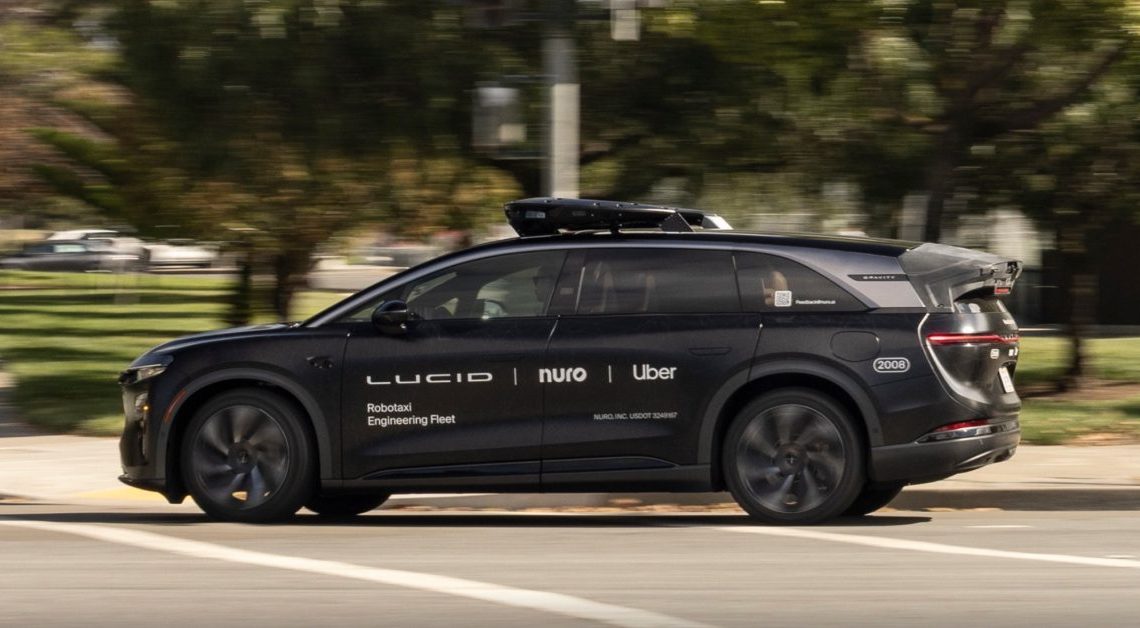
Uber is publicly trashing its robotaxi partner Waymo while simultaneously investing more than $10 billion to build its own autonomous vehicle fleet with Rivian, Lucid, and Nuro.
The ride-hailing giant’s executives have spent the last few months taking direct shots at Waymo’s technology and deployment strategy — even as Waymo vehicles still operate on Uber’s platform in Austin and Atlanta.
Uber execs go after Waymo
According to a new Business Insider report, Uber executives have been painting AV-only operators like Alphabet’s Waymo as “less scalable” and “less reliable” than Uber’s hybrid approach, which mixes human drivers with robotaxis on a single ride-hailing platform.
The attacks haven’t been subtle. Uber CTO Praveen Neppalli shared a video on X in April showing what he described as a “scary” encounter with a Waymo vehicle in San Francisco. The Waymo appeared to overtake a Muni bus in the wrong lane, squeezing between the bus and Neppalli’s car. He wrote: “Big fan of AVs, but perception ≠ judgment. Edge cases matter!”
CEO Dara Khosrowshahi has also been distancing Uber from the AV-only model. In February, he acknowledged that autonomous vehicles hold “enormous potential” but added that they are “far from capable of meeting the level of reliability” customers expect.
Uber also released a white paper last week through Axios, arguing that robotaxis are currently deploying in wealthy neighborhoods while failing to serve cities like Oakland, where Waymo already has regulatory permission. Uber is calling for “equitable distribution” across markets — a barely veiled critique of Waymo’s expansion strategy.
As far as we know, Waymo is actively trying to expand throughout the entire Bay Area, including Oakland, and it is trying to secure all regulatory approval.
$10 billion to own the fleet
While Uber publicly undermines Waymo, which is still a partner, the company is spending aggressively to build its own robotaxi infrastructure with alternative partners.
The numbers are staggering. Uber has committed more than $10 billion total to autonomous vehicles, including roughly $2.5 billion in direct equity investments and $7.5 billion in vehicle purchase commitments. The key deals include:
Uber now owns 11.5% of Lucid after investing $500 million, with a commitment to purchase at least 35,000 Lucid Gravity SUVs — up 75% from the original 20,000-vehicle deal. These vehicles will be equipped with Nuro’s Level 4 autonomous driving system.
Uber invested up to $1.25 billion in Rivian to deploy up to 50,000 autonomous R2 robotaxis, with the first 10,000 expected in San Francisco and Miami starting in 2028.
Nuro just secured a California driverless permit to test Lucid Gravity SUVs without a safety driver — a critical milestone before Uber’s planned commercial robotaxi launch in San Francisco later this year.
Uber is also investing $100 million in fast-charging hubs specifically for autonomous vehicles and has struck partnerships with Baidu’s Apollo Go for Dubai, Wayve for London, and Avride for Dallas.
Competing with Waymo in its own backyard
The strategic shift is unmistakable. Uber plans to deploy Lucid-Nuro robotaxis in San Francisco — Waymo’s home market — by late 2026. In Dallas, Uber will run Avride robotaxis. In London, Uber goes with Wayve while Waymo has its own fleet deal with Moove.
The big question is what happens to the Austin and Atlanta deployments, where Waymo vehicles currently operate exclusively through Uber’s app. As former Uber CEO Travis Kalanick recently noted, Waymo is “obviously” ahead in the robotaxi race — but Uber’s current leadership clearly doesn’t want to depend on that lead.
Meanwhile, Waymo is scaling fast on its own. The company now delivers around 400,000 paid rides per week across 10 US cities and is targeting 1 million weekly rides by the end of 2026.
Author: Fred Lambert
Source: Electrek
Reviewed By: Editorial Team