

Rare noctilucent clouds shine above the city of Kennewick in Washington State June 2. (Image credit: John Clement.)
Noctilucent cloud season has officially begun!
One of the earliest sightings was captured by photographer John Clement, glowing in the skies over the city of Kennewick, Washington, on June 2, who had set out to capture a striking conjunction of Venus and Jupiter, which had occurred earlier that evening.
“As Twilight deepened I began to notice the possible noctilucents starting to become visible over Badger Mtn. as we call it, A popular hiking hill about a mile from my house,” Clement told Space.com in an email. “So at 9:58 I turned my camera towards Badger and took the first set of images and it confirmed they were noctilucent.”
The three-shot panorama was captured using an Olympus OM-D E-M1 Mark III camera coupled with a 150 mm lens set to capture a series of bracketed 1-second exposures as the clouds shone in the skies above Clement’s patio in southwest Kennewick.
Astronomy enthusiast Daniel Fischer also posted a view of noctilucent clouds to the social media site X, showing the rare cloud formation shining above the town of Flensburg in a livestream on May 31.
The #NoctilucentCloud season 2026 which began a few nights ago at high Northern latitude has reached Germany: a #webcam view – https://t.co/E4YbOrJ8Hl – from #Flensburg at 54.8°N from 15 minutes ago! pic.twitter.com/Ycy4EB55EeMay 31, 2026
What are noctilucent clouds?
Noctilucent clouds coalesce from tiny ice water crystals that accumulate in the mesosphere 50 miles (80 kilometres) above Earth’s surface — roughly 10 times the height of ordinary cirrus and cloud formations.
Their extreme altitude near the edge of space allows them to catch and reflect sunlight long after sunset and before dawn, when the sun lurks just below the horizon from the viewer’s perspective. As a result, they shine brightly against the twilight sky, where other clouds in the lower atmosphere appear dark, according to NASA.
When and where to look for noctilucent clouds
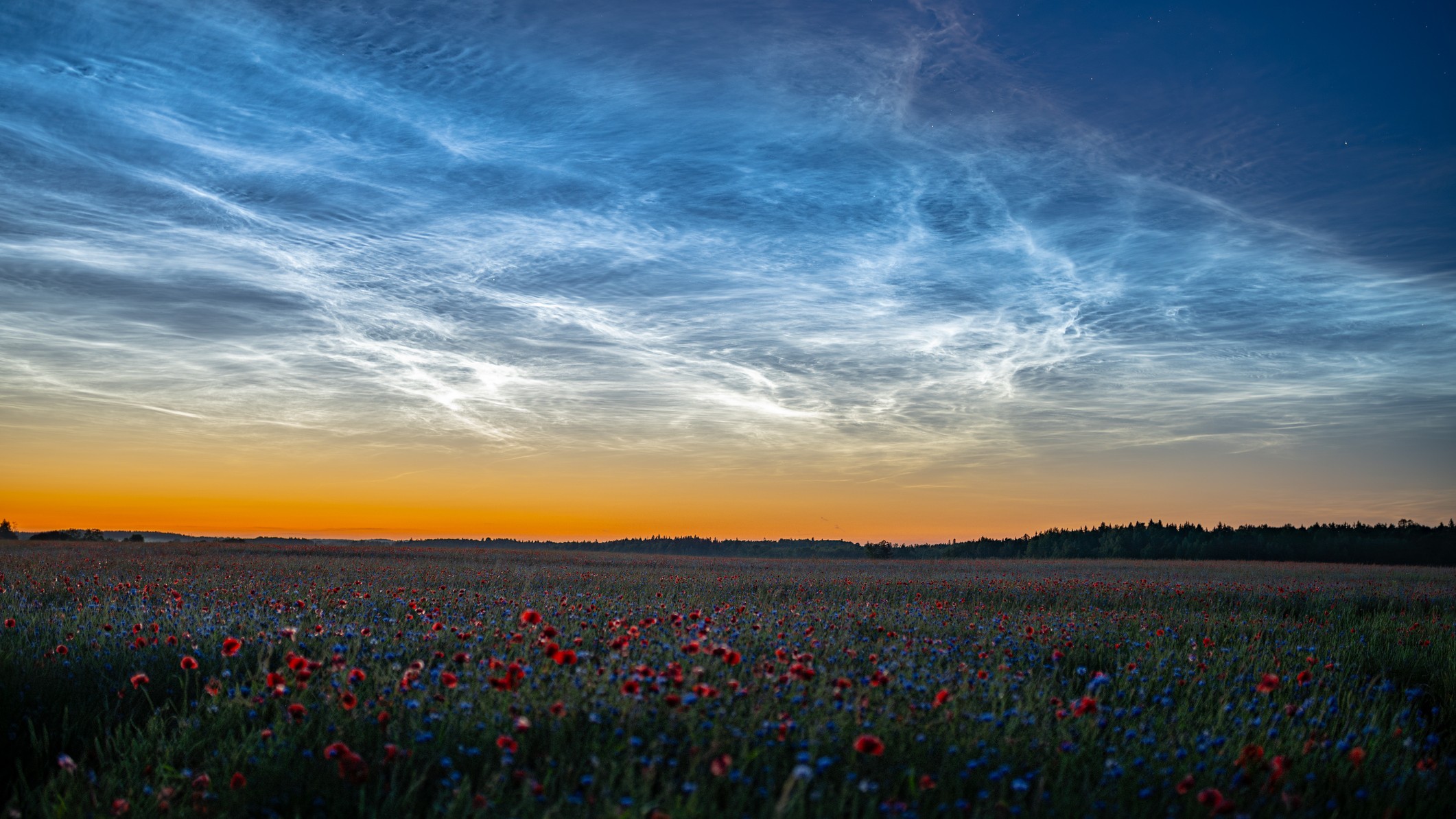
Noctilucent clouds are most commonly spotted between mid-May and mid-August, with a peak in sightings often occurring in the summer month of July in the northern hemisphere, according to the British Astronomical Association.
The clouds tend to form near polar regions, where the mesosphere is at its coldest, according to the Royal Meteorological Society. As such, Noctilucent displays are most commonly seen at latitudes ranging from 45 to 80 degrees north of the equator, based on data from the UK Met Office.
For your best chance of spotting noctilucent clouds, look toward the western sky as the brightest stars begin to emerge after sunset. Look out for delicate, wispy cloud formations that shine silver and blue in the twilight, while other clouds near the horizon appear dark and silhouetted in the evening sky.
Author: Anthony Wood
Source: Space.com
Reviewed By: Editorial Team