

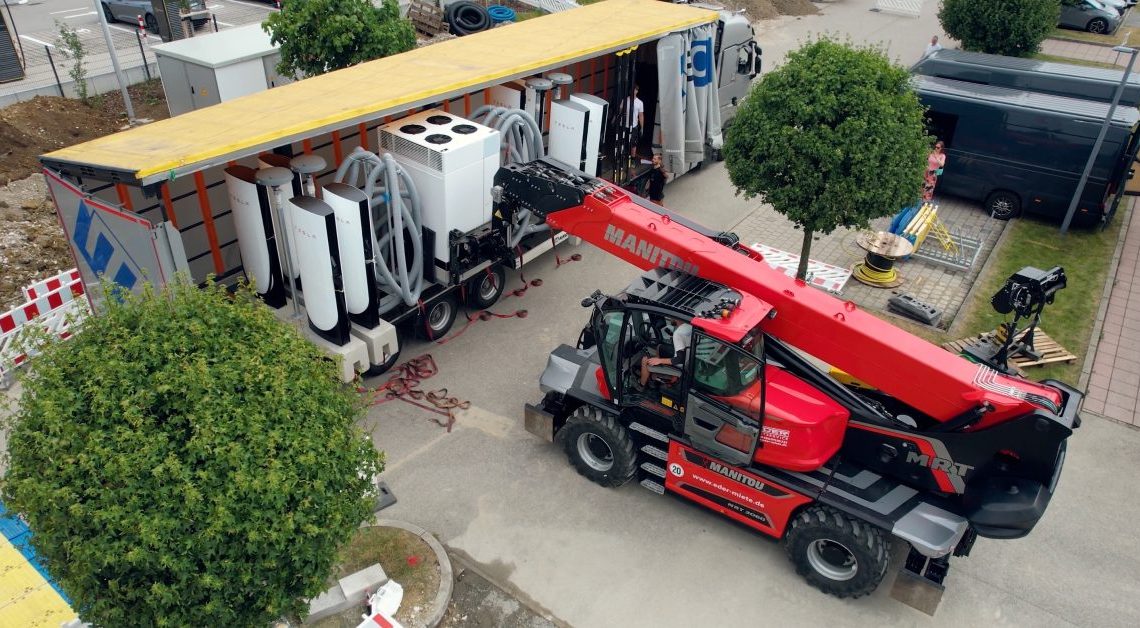
Tesla deployed its first “Accordion” Supercharger, a pre-assembled charging unit that ships 16 stalls on a single truck and installs 20% cheaper than a conventional site.
Tesla’s charging team says the goal is now to pre-assemble every Supercharger in a factory. It’s a smart move, and one the company badly needs after two years of slower deployment.
What the Accordion Supercharger is
The unit folds up like an accordion (hence the name), so one truck carries 16 V4 stalls at once. Tesla says it installs 20% cheaper than a conventional station, commissions instantly with no technician needed to energize it, and is built for sites where you can’t trench a cabinet behind a curb. It drops in between parking spaces instead.
“Our goal is to pre-assemble all Superchargers in a factory,” Tesla’s charging account wrote. “If we can’t install Superchargers behind a curb, we now have a pre-assembled solution for Superchargers between parking spaces.”
Behind-the-curb installs need civil work: trenching, conduit, permitting. A pre-wired island that sits between parking spaces skips most of it, which opens up tight urban and retail lots Tesla couldn’t easily build before.
Tesla has been chasing this for years
This isn’t Tesla’s first prefab rodeo. Back in March 2022, Tesla built a full Supercharger station in just 8 days using an early pre-fabricated system. By April 2024, it had that down to 4 days from delivery to online, with then-charging chief Rebecca Tinucci citing 15% deployment savings.
Then Elon Musk fired the entire Supercharger team.
In late April 2024, Musk laid off all ~500 people on the charging team, Tinucci included, in one of the most baffling calls of his tenure. Tesla rehired some of them within weeks and Musk pledged $500 million for Superchargers that year. But the damage showed up in the numbers.
The deployment still hasn’t recovered
In Q2 2024, the quarter right after the firing, Tesla added just 2,017 new Supercharger connectors worldwide. That was its slowest pace in three years, down from 2,687 the quarter before.
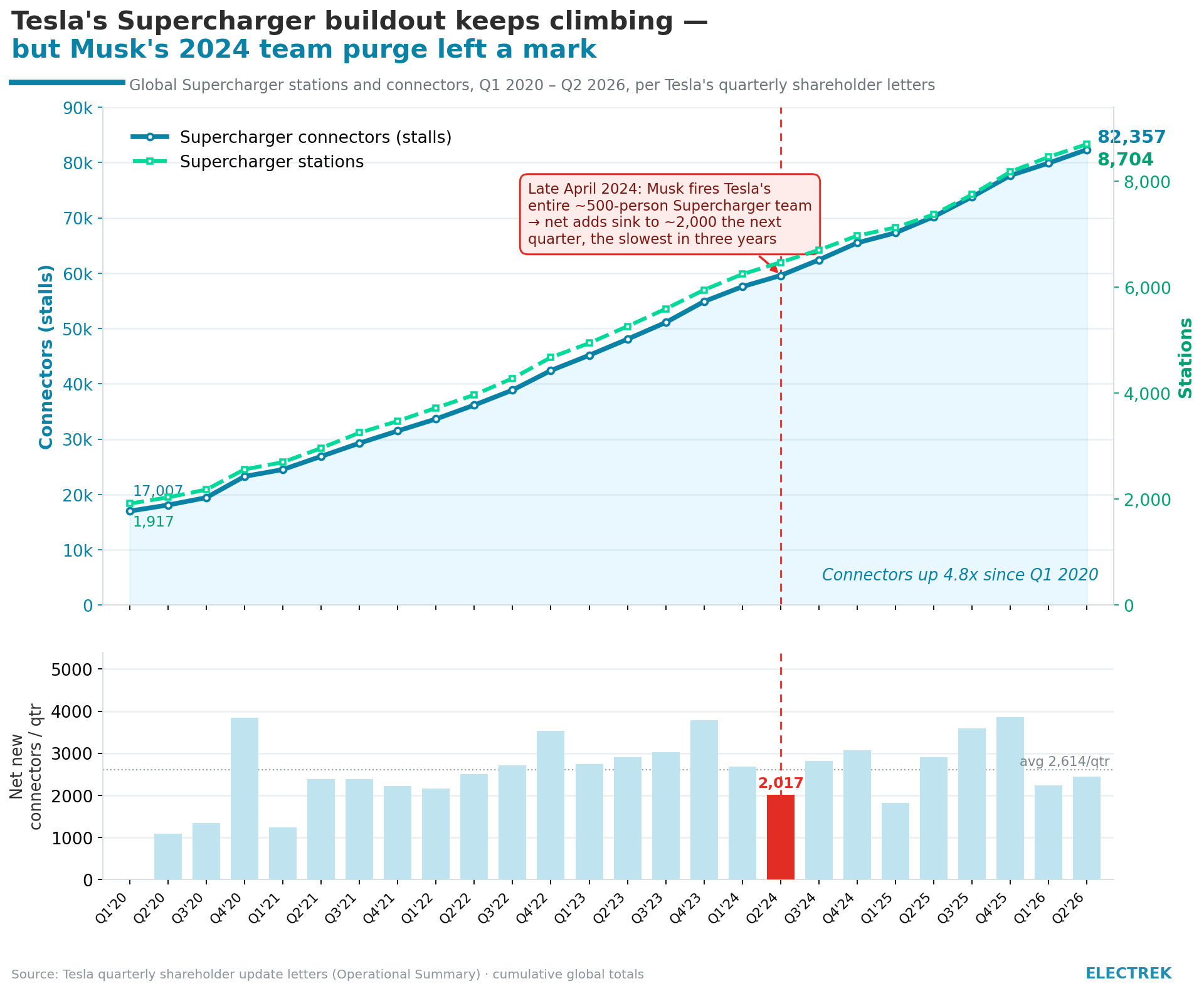
The buildout has been choppy ever since. Tesla added only 1,821 stalls in Q1 2025, bounced back to 3,865 in Q4 2025, then slowed again to 2,236 and 2,439 in the first two quarters of 2026.
Zoom out and the deceleration is clear. Tesla’s connector count grew 35-45% year-over-year in 2020 and 2021. As of Q2 2026, with 82,357 connectors across 8,704 stations, annual growth is down to about 17%. The network is still expanding, just nowhere near as fast as it used to, or as fast as it needs to.
Tesla’s EV deliveries stopped growing in 2024, which mitigated the slower charging infrastructure buildout, but Tesla also opened up the network to non-Tesla EVs, which are growing.
Meanwhile, BYD is lapping Tesla
Here’s the part that should worry Tesla: BYD is now putting fast chargers in the ground faster than anyone.
BYD installed 10,000 of its 1,500 kW “flash charging” stations in five months, from a March 2026 launch to 10,000 by late August, across 325 Chinese cities. It’s targeting 20,000 by year-end. At two guns per station, that’s roughly 40,000 charging points, approaching half of Tesla’s global stall count, built in under a year.
BYD’s chargers are also more powerful. At 1.5 MW, they take the company’s Blade 2.0 battery from 10 to 70% in about five minutes. Tesla’s V4 cabinets top out at 500 kW.
The comparison isn’t perfectly apples-to-apples. BYD’s numbers are China-mainly, with some deployment now happening in Europe and other Asian countries; Tesla’s are global, and BYD’s peak-power claims depend on its own cars. But on raw pace, BYD is now deploying more than twice the charging power per month that Tesla is. That gap didn’t exist two years ago.
Author: Fred Lambert
Source: Electrek
Reviewed By: Editorial Team