

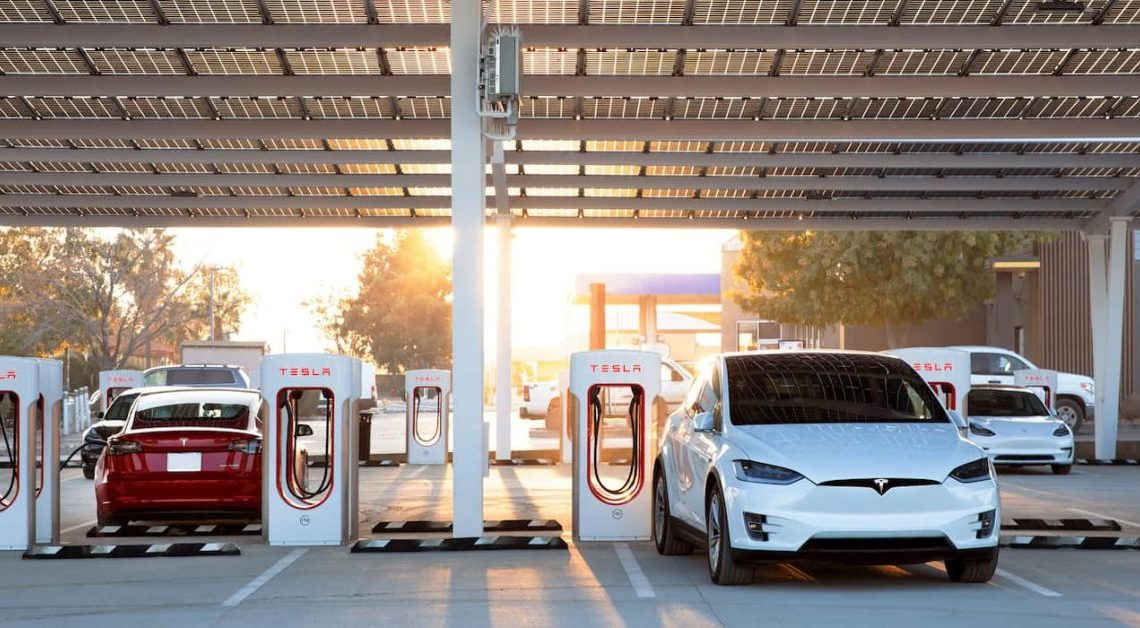
Tesla has submitted permit applications for two private Supercharger stations in Arizona that would be dedicated exclusively to its Robotaxi fleet — marking the first time the automaker has planned charging infrastructure specifically for autonomous vehicles.
The filings, discovered in municipal records in Chandler and Mesa, call for V4 Supercharger stalls that will not be open to the public.
The first application, submitted to the city of Chandler, outlines the construction of 56 V4 Supercharger stalls on an industrial plot along South Roosevelt Avenue. A second application was filed for a site in Mesa at 5349 E Main St. Both were submitted simultaneously last week.
Tesla Supercharger permit sleuth Marco RP found the filings:
Unlike Tesla’s roughly 7,000 public Supercharger locations worldwide, the applications explicitly state that these new chargers will not be publicly available. The designation makes them the first dedicated fleet charging hubs for Tesla’s Robotaxi operations.
Right in Waymo’s backyard
The location choice is notable. The Phoenix East Valley — encompassing Chandler, Mesa, and Tempe — is the exact region where Waymo first launched and scaled its autonomous ride-hailing service back in 2018. Waymo now operates roughly 3,000 robotaxis across 10 US cities, completing about 500,000 paid rides per week. Its manufacturing hub is also in Mesa, where Magna retrofits Jaguar I-PACE vehicles for the fleet.
Tesla choosing to build its first dedicated Robotaxi charging infrastructure directly in Waymo’s home territory sends a clear competitive signal — even though Tesla’s own autonomous operations remain far smaller in scale.
The filings come just days after Tesla launched its Robotaxi service in Dallas and Houston on April 18, expanding beyond Austin for the first time with unsupervised rides. However, the service areas remain small — roughly 25 square miles in Houston — and the total fleet across all three Texas cities consists of only a few vehicles operating simultaneously, most of which still carry safety monitors.
In Austin, where the service launched in June 2025, Tesla operates fewer than 10 truly unsupervised vehicles, as we covered when Tesla expanded its unsupervised Robotaxi area in Austin last month.
A second attempt at Robotaxi charging infrastructure
These Arizona filings also represent Tesla’s second attempt at building dedicated Robotaxi charging facilities. In February, Tesla dropped plans for a robo-charging site in San Francisco that would have accommodated 150+ vehicles with 600 amps of power at 825 Sansome Street. The cancellation came on the same day the project was scheduled for a planning commission hearing, after pushback from the Teamsters union.
It’s worth noting that these V4 Supercharger stations would serve Tesla’s current Model Y Robotaxi fleet, which uses conventional plug-in charging. Tesla’s purpose-built Cybercab, which rolled its first unit off the production line in February, uses wireless inductive charging — meaning it would need different infrastructure entirely.
The dedicated stations would allow Tesla to centralize charging, cleaning, and maintenance of its fleet vehicles without impacting public Supercharger availability — a logistical necessity if the company ever scales its Robotaxi operations to thousands of vehicles.
Author: Fred Lambert
Source: Electrek
Reviewed By: Editorial Team