


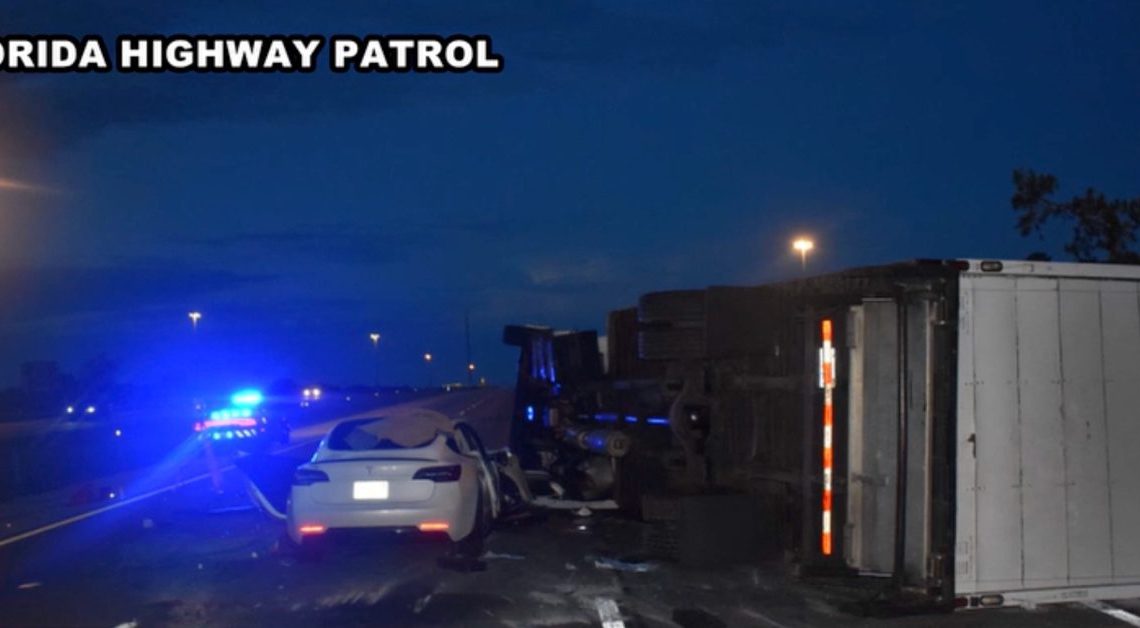
A Tesla Model 3 drove into an overturned box truck on I-75 near Naples, Florida, killing two of its passengers and a man who had stopped to help. Tesla’s own report to federal regulators says Autopilot or “Full Self-Driving” was engaged, at 71 mph.
Police and local media covered the May 31 crash as a truck wreck in the dark, and none of it mentioned a driver-assist system. It’s the latest case in our ongoing investigation into fatal crashes hidden in Tesla’s NHTSA data, and it lands as Tesla’s monthly crash count hits another record.
What happened on I-75
Just before 4 a.m. on Sunday, May 31, 2026, the 31-year-old driver of a 2014 Freightliner lost the road near the Pine Ridge Road exit in Collier County, steered back onto southbound I-75, and flipped it, according to the Florida Highway Patrol. The overturned truck ended up blocking the center and outside lanes.
Jonathan Garcia Arias, a 25-year-old Naples man and former Marine, was driving by in a BMW. He pulled over and got out to help the truck driver.
Then a southbound 2023 Tesla with five young men from Naples inside came up on the scene. FHP’s report says the front of the Tesla hit the underside of the overturned truck and Garcia Arias. Two of the Tesla’s passengers, aged 18 and 19, died at the scene, and Garcia Arias died later in the hospital. The 20-year-old driver and two more passengers were seriously hurt.
A few days later, FHP used the crash as a warning about stopping near wrecks on the interstate. Senior Trooper Kenn Watson said the Tesla driver would have seen only the truck’s underside, with “no lights, no reflectors, nothing warning them.”
So that’s the official story. A dark obstacle, a driver who couldn’t see it in time. Nobody said a word about Autopilot.
What Tesla told the federal government
Under NHTSA’s Standing General Order, automakers have to report crashes where a Level 2 driver-assist system was engaged within 30 seconds of impact and someone was killed or hurt. Tesla filed one for this crash.
It identifies the car as a 2023 Model 3 on a highway, flags a traffic incident on the roadway, and marks the automation “Engagement Status” as “Verified Engaged.” That means Tesla confirmed through its own telematics that Autopilot or FSD was on. It logs a pre-crash speed of 71 mph and a fatality, lists the Florida Highway Patrol as the investigating agency, and says it learned of the crash from police and the media.

Then it blacks out the crash narrative, the software version, and whether the road was within the system’s approved operating domain, all as “confidential business information.” That’s the same redaction Tesla applies to 99.9% of its reports.
The report also surfaced late. Tesla filed it as a 5-Day report, the urgent category for fatal crashes, but it didn’t land until Tesla’s September filings, more than three months after the crash. And Tesla lists law enforcement as one of the ways it found out about it.
How we matched it: Tesla logged the incident time as 07:56 UTC, which converts to 3:56 a.m. in Florida, two minutes off the 3:54 a.m. in FHP’s report. The city, the highway, the 2023 model year, the month and the fatal outcome all line up, and it’s the only fatal Tesla driver-assist report in Naples that month. It’s the same crash.
Tesla has been here before
A Tesla on driver-assist going highway speed into the underside of a big truck, in the dark, in Florida. If that sounds familiar, it should.
In 2016, Joshua Brown was killed near Williston when his Model S on Autopilot drove under a tractor-trailer crossing the highway. In 2019, Jeremy Banner died in Delray Beach when his Model 3 on Autopilot went under a trailer at 68 mph and had its roof sheared off. In both crashes, neither the driver nor the system braked.
Trooper Watson’s point was that a human couldn’t see the truck. But a big, unlit obstacle sitting across two lanes at night is exactly the kind of thing a driver-assist system is supposed to catch, and Tesla now sells FSD as nearly ready to drive with nobody watching. And an attentive driver could clearly see it, as the BMW driver did, and stop before the Tesla arrived.
We want to be fair about what the data doesn’t prove. “Engaged within 30 seconds” is the reporting trigger. Tesla’s 71 mph may be a telematics snapshot rather than the impact speed. And with the software version redacted, we can’t say whether this was Autopilot or FSD.
A new record: 264 crashes in September
The NHTSA release that surfaced this crash, covering filings through October 15, also set a new monthly high. Tesla reported 264 driver-assist crashes in September 2026, beating July’s 236, which was itself a record. That’s up from 135 in March.

September may still grow as late reports come in. This Naples crash shows how late they can be.
Our merged dataset now holds 4,669 Tesla driver-assist crash reports since 2019, 69 of them flagged fatal. The same release added two other fatal reports, both “Verified Engaged” and both covered locally with no mention of driver-assist: a Model Y that hit a tree and burned in El Dorado Hills, California, killing three, and a Model X that hit a signal pole in Naples on September 30, killing a passenger. We’ll lay those out separately.
Author: Fred Lambert
Source: Electrek
Reviewed By: Editorial Team
