

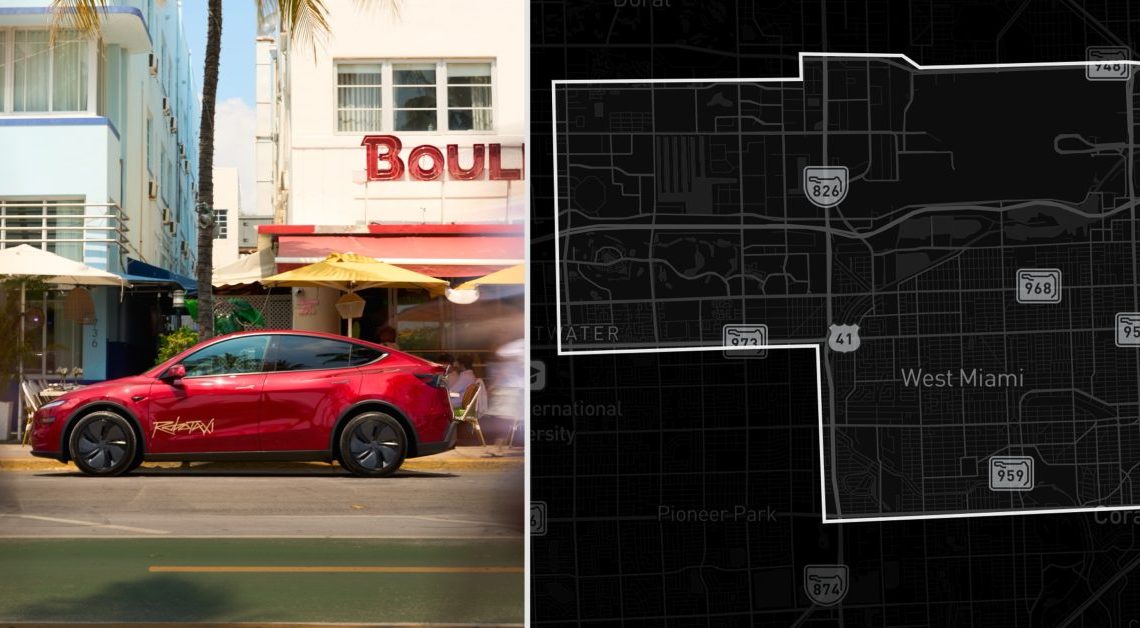
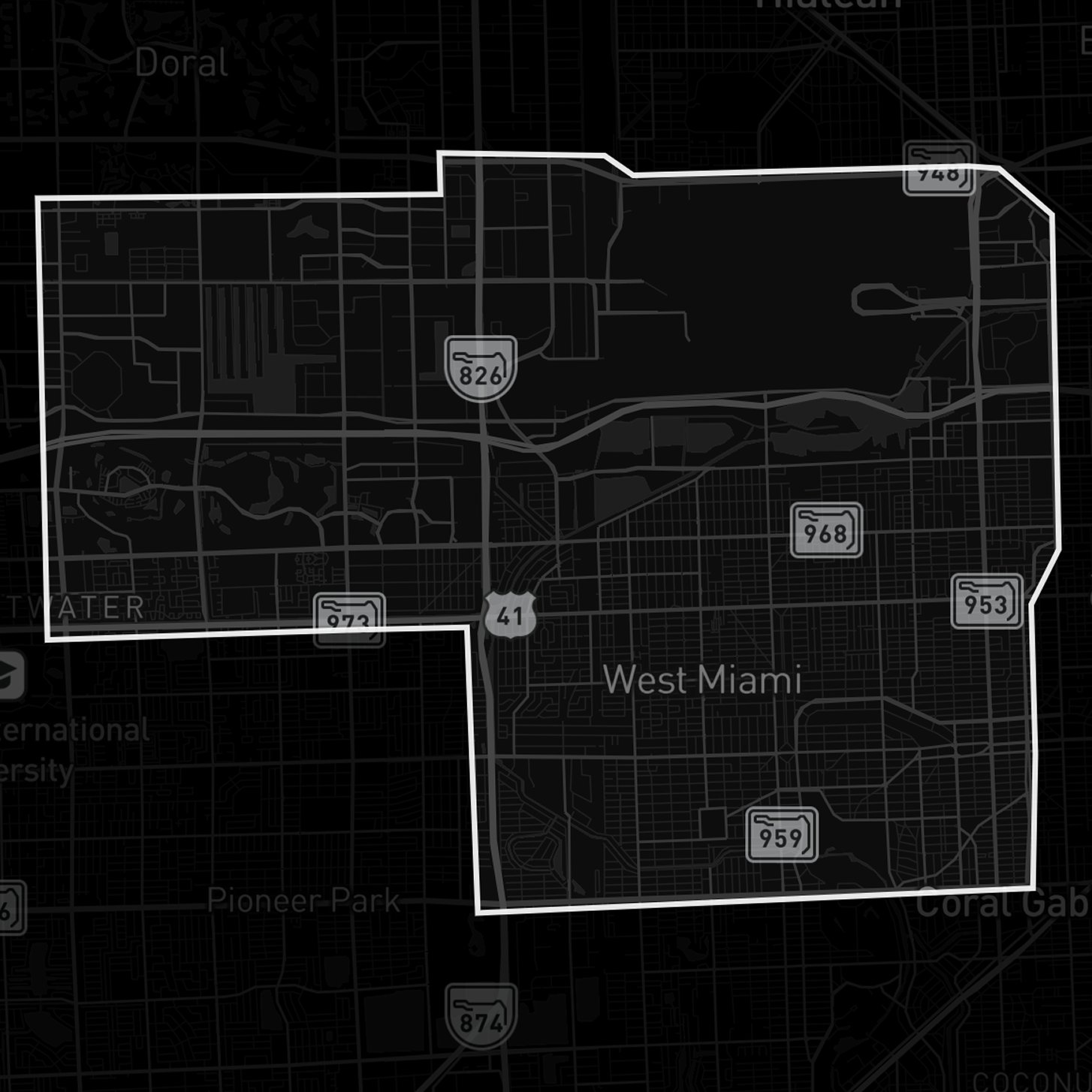
Tesla has mapped out a Robotaxi service area in Miami, publishing a geofence that covers only a small slice of the metro — mostly West Miami and a strip stretching toward Doral and Sweetwater.
It’s the latest city Tesla has drawn a box around, but the announcement lands with a thud when you consider what’s happened in Texas over the past year.
A geofence, not a launch
Tesla’s Robotaxi account shared the Miami map, showing a coverage zone bounded roughly by SR-826 (the Palmetto) to the north, US-41 to the south, and a handful of state roads on the edges. It leaves out the vast majority of Miami-Dade — no downtown Miami, no Miami Beach, no airport, and only a corner of Coral Gables.
Miami has been on Tesla’s list for a while. The company named it among five new US cities targeted for the first half of 2026, alongside Phoenix, Orlando, Tampa, and Las Vegas. That timeline has since quietly softened from a firm “1H 2026” to a vaguer “preparations underway.”
Drawing a service area on a map is the easy part. Tesla has done it repeatedly — in Austin, then Dallas and Houston, each launched with tiny geofences and a supervisor sitting in the car.
The Texas problem Tesla still hasn’t solved
Tesla launched Robotaxi in Austin in June 2025. A year later, the service is still tiny.
City officials peg Tesla’s Austin fleet at roughly 50 vehicles, and the unsupervised portion — the cars actually running without a Tesla employee behind the wheel — is far smaller. Recent data shows Tesla’s unsupervised fleet has been shrinking, not growing, sliding from a peak of about 25 cumulative vehicles down toward roughly 14 active cars.
Tesla eventually expanded its map to cover the entire Austin metro — but with only about 20 vehicles running, the bigger box changed little for riders. Wait times routinely stretched past 15 minutes, and in more than a quarter of checks, no cars were available at all.
The reason Tesla isn’t scaling isn’t a mystery, and it isn’t a mapping problem. It’s safety, and Musk has said so himself.
On Tesla’s Q1 2026 earnings call, Musk told investors that safety validation is the limiting factor for Robotaxi expansion, and that Tesla is holding back until improvements arrive in a rewritten FSD v15. Tesla has reported a string of crashes to NHTSA in Austin, and independent analysis has pointed to a crash rate roughly four times worse than the average human driver.
Author: Fred Lambert
Source: Electrek
Reviewed By: Editorial Team