

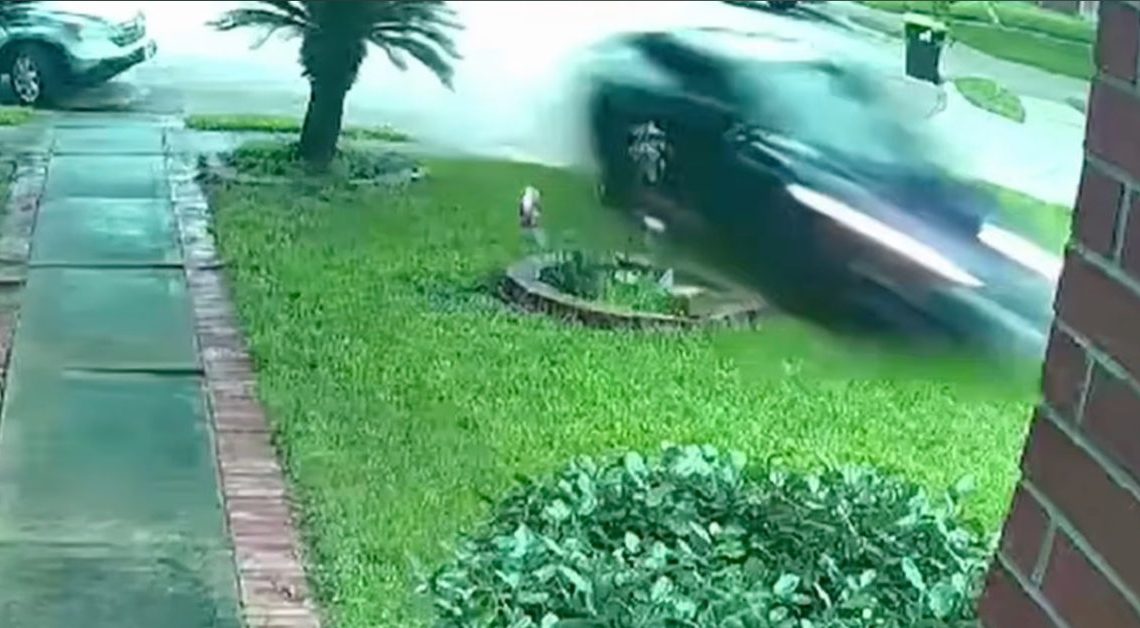
Harris County prosecutors have charged the Tesla driver who crashed into a Katy, Texas, home and killed a 76-year-old woman with manslaughter, alleging he overrode Full Self-Driving to floor the car to 73 mph in a residential cul-de-sac.
The charging document also reveals something new: in the weeks before the crash, the driver had been Googling that FSD wasn’t aggressive enough.
Michael David Butler, 44, of Richmond, was charged July 1 in Harris County’s 208th District Court with one count of manslaughter in the June 19 death of Martha Avila. He remains in jail on a $150,000 bond and is due in court Monday. Manslaughter is a second-degree felony in Texas, carrying two to 20 years.
We laid out the most likely scenario when first reporting on this accident earlier this week and again when Tesla admitted FSD was engaged but blamed the driver for “overriding” it. The criminal complaint is the fullest account yet, reportedly built from the car’s telemetry, dashcam footage, cellphone records, and medical evidence. It fills in a lot.
What the black box shows
Butler was doing DoorDash deliveries and had re-engaged FSD after what investigators believe was his last drop-off.
According to the complaint, the car drove itself through the neighborhood under FSD until Butler pressed the accelerator approaching a stop sign, overriding the system’s speed and carrying it through the intersection. This is not unusuals for people familiar with FSD. NHTSA has forced Tesla to make FSD do full stops. For people used to a ‘California stop’, this is a bit slow and many FSD users will press the accelerator to have the vehicle move forward quicker at a stop.
Seconds later, as the Tesla lined up a left turn toward his next delivery, FSD flipped on the turn signal and began steering left. Butler pressed the accelerator again, sending the car straight into the cul-de-sac instead.
Then he held it down. Investigators describe the pedal going to the floor, “pedal to the metal,” for about six seconds. The Model 3 hit roughly 73 mph, more than double the residential limit, clipped the curb, went airborne, and tore through the front of Avila’s home. The brake was never touched in the final minute.
Investigators found no mechanical failure, no stuck pedal, no floor-mat interference. Medical testing found no seizure, stroke, or heart attack, and no alcohol or drugs. Butler had told paramedics he remembered “changing the music” and looking at the navigation screen, then “passed out.”
Prosecutors also recovered Google searches from his phone: “Tesla fsd not aggressive enough 2026,” “FSD is not aggressive enough for city driving,” and “Tesla fsd too timid.” They’re using those searches as evidence he overrode the speed on purpose.
Why “too timid” is both true and false
Here’s where it gets interesting, because the premise behind those searches is both accurate and completely misleading.
It’s true that FSD drives too timidly. Tesla now ships new cars in a “Sloth” profile that drives below the speed limit, and the system is notorious for phantom braking — stabbing the brakes for shadows and overpasses that aren’t there. Plenty of owners find it too hesitant to trust in the city. Butler’s frustration wasn’t imaginary.
But “not aggressive enough” as a blanket description of FSD is false. The same software, in Tesla’s Mad Max mode, routinely drives 15 to 30 mph over the limit, behavior so brazen it drew its own NHTSA scrutiny within a day of release. FSD isn’t consistently timid. It’s inconsistent. Sometimes it crawls, sometimes it speeds, and the driver never quite knows which one he’s getting.
That inconsistency is the actual product problem, and it’s the thing that conditions a driver to keep his own foot ready on the accelerator to “fix” the car’s speed while letting FSD keep steering. Which is exactly what Tesla’s override is designed to allow: press the pedal and you control the speed while FSD keeps turning, lane-keeping, and navigating. The car is still driving itself. You’re just goosing it.
Manslaughter doesn’t clear Tesla
So yes, the driver overrode the speed. But FSD was steering the entire time, right up to the moment Butler cancelled its turn. “The driver pressed the accelerator” is mostly likely true and it’s not the exoneration Tesla keeps treating it as.
This is the same dynamic that already cost Tesla in court. Avila’s family has sued Tesla, leaning on the landmark $243 million Florida verdict in which a jury put 67% of the blame on a driver who was clearly misusing Autopilot and still found Tesla 33% responsible, because its marketing and weak driver monitoring fostered the false confidence in the first place. Criminal fault for the driver and civil liability for Tesla are not mutually exclusive.
Author: Fred Lambert
Source: Electrek
Reviewed By: Editorial Team