

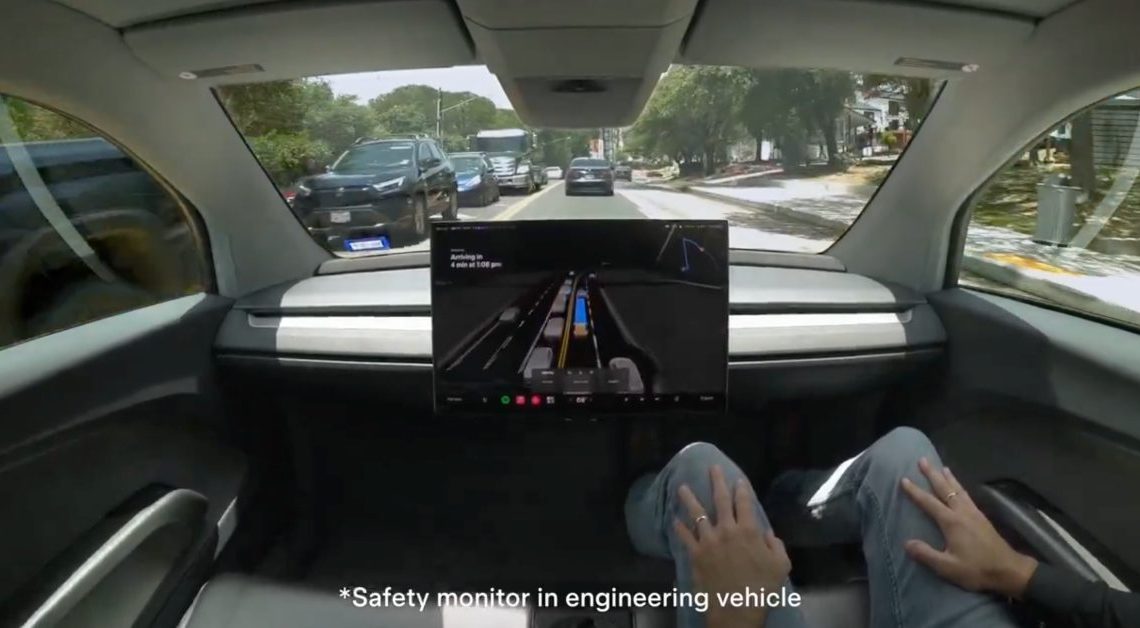
Tesla says it has started engineering tests of its first production Cybercab on public roads in Austin, marking the first time a customer-spec unit of the purpose-built robotaxi has been validated outside the factory.
But a video shared by the company shows the two-seater driving with a supervisor sitting in the front passenger seat — a reminder that the car still isn’t operating on its own in Tesla’s paid service.
What Tesla actually showed
In a post on X early Monday, Tesla announced that “engineering tests of the first production Cybercab have begun in Austin.” The clip shows the vehicle navigating city streets with no one in the driver’s position — which is unavoidable, since the Cybercab is built without a steering wheel or pedals — while a person rides in the passenger seat.
That framing matters. These are “engineering tests,” not driverless customer rides, and a human is still aboard the vehicle during the runs. Tesla describes the person in the front seat as a “safety monitor.”
It’s a meaningful step nonetheless. Tesla rolled its first steering-wheel-less Cybercab off the line at Gigafactory Texas on February 17, then confirmed the start of production during its Q1 earnings call in April. Putting a production-line unit through public-road validation is the next box to check before the car can carry paying passengers.
The robotaxi service still doesn’t run on Cybercabs
Here’s the catch: Tesla’s actual Robotaxi service in Austin has never used the Cybercab. Since launching the public service, Tesla has been running the rides on Model Y SUVs retrofitted with its Full Self-Driving software.
Tesla began the Austin service in June 2025 with an employee in the passenger seat, moved those safety monitors to the driver’s seat in September, and started removing in-car monitors for a portion of rides in January. Even then, reports showed Tesla’s “unsupervised” vehicles being trailed by chase cars with safety monitors inside — the monitor moved to a different vehicle rather than being eliminated.
Today, Tesla only has a handful of vehicles operating without supervisors in Texas.
The Cybercab entering engineering tests is the beginning of a separate, longer process: validating the dedicated hardware platform, not flipping a switch on an existing fleet.
The car itself is no longer a mystery. Tesla’s EPA filing revealed the Cybercab weighs 3,113 lbs with 219 HP and a 48 kWh battery, and at 165 Wh/mi it ranks as the most efficient EV Tesla has ever built. Musk has pitched a sub-$30,000 price, though he has narrowed that to roughly $25,000 on earnings calls.
Waymo is the benchmark
While Tesla tests a production Cybercab with a passenger riding shotgun, Waymo is already operating a fully driverless commercial service at scale.
Waymo is now delivering roughly 500,000 paid driverless rides per week across the US — double its volume from less than a year ago — and is targeting one million weekly rides by the end of 2026. Those vehicles operate with no one in the car at all, backed by remote assistance rather than in-car or trailing human supervisors.
That’s the gap Tesla is trying to close, and the Cybercab is its long-term answer: a vehicle designed from the ground up with no manual controls and a target cost low enough to undercut ride-hailing economics.
Author: Fred Lambert
Source: Electrek
Reviewed By: Editorial Team