


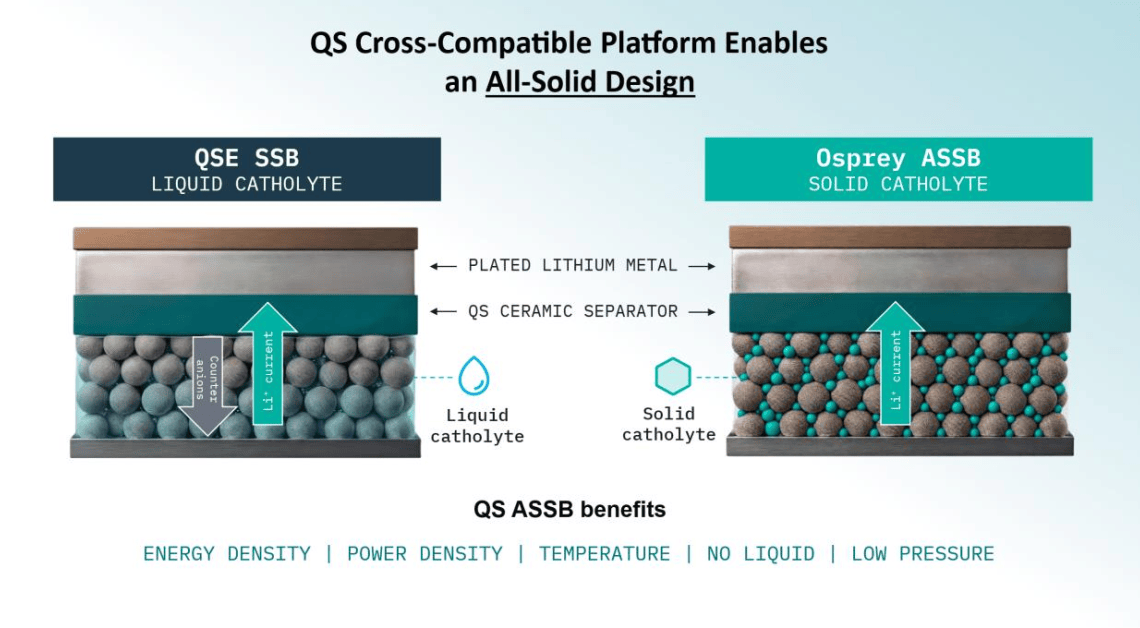
QuantumScape (QS) is finally going all-solid-state. Its new Osprey platform swaps the liquid in its cathode for a sulfide solid electrolyte, and the company says the cells have hit 1,000 full cycles to 80% capacity at just one atmosphere of pressure.
That’s a big deal for the sulfide camp, which includes Toyota, Samsung SDI, BYD, and Factorial. Their cells typically need heavy clamping to work. But the white paper behind the announcement shows these are small, early lab cells, and some headline numbers come with important conditions.

QuantumScape’s current cells aren’t all-solid-state
Here’s something QuantumScape has rarely spelled out this plainly: its current product isn’t all-solid-state.
The new white paper describes the QSE platform, including the QSE-5 cell it’s shipping as samples from its Eagle Line pilot production in San Jose, as a ceramic separator paired with “a relatively conventional high-nickel NMC cathode and a liquid catholyte.”
The solid part is the separator. It sits between the cathode and a lithium-metal anode that QuantumScape doesn’t manufacture at all. The cell is built “anode-free,” and lithium plates against the separator during the first charge.
Osprey keeps that separator and anode-free design and swaps the liquid in the cathode for a solid sulfide electrolyte. That makes the whole cell solid.
Sulfides as separators: QS still says no
The interesting part is that QuantumScape hasn’t changed its mind on sulfides. It has spent years arguing that sulfide electrolytes can’t work as separators, and the white paper doubles down, calling their problems “fundamental properties” of the material rather than engineering challenges.
The company lists four issues: sulfides react with lithium metal, they need high pressure to keep contact with the electrodes, they struggle at room temperature and below, and they can’t handle fast charging with a lithium-metal anode before dendrites form.

The pressure point is the one automakers care about most. QuantumScape illustrates it this way: 20 atm on a single 10 x 24.2 cm cell works out to roughly 5,000 kg of force, about three mid-size cars. Holding that across a pack takes thick steel end plates and tie rods, which add weight, volume, and cost.
And 20 atm is on the generous side. Many sulfide cells in labs run at 30 to 100+ atm (3 to 12 MPa), and some even higher. China’s FAW reported large-format sulfide cells cycling at 5 MPa, or about 50 atm, in September, which was billed as a low-pressure achievement.
So QS’s pitch is simple: keep the sulfide in the cathode, where it’s good at moving lithium ions, and let the QS ceramic separator handle the lithium metal.
What the Osprey data shows
QuantumScape published four main data sets:
Cycle life: the real result
This is the strongest result. A 2-layer cell with a 50 x 65 mm cathode, the same area as QSE-5, ran 1,000 cycles to about 80% capacity. The test used full 1C charge and 1C discharge, 0 to 100% state of charge, 30°C, and 1 atm. The cathode loading was 5.5 mAh/cm², which is in line with commercial EV cells.

QuantumScape says no other sulfide-based cell has shown this, and Electrek couldn’t find published data that contradicts it. Academic groups have shown sulfide cells running with little or no external pressure, but not for 1,000 full cycles with a sulfide cathode and lithium-metal anode.
But this is a small cell. By our math, two layers at that size come out to roughly 0.3 to 0.4 Ah, compared to about 5 Ah for a QSE-5.
Fast charging: at 80°C
The press release says “five-minute fast charging from 10% to 80%.” The white paper shows that was achieved at 10C, in a 2-layer cell, at 80°C (176°F). The chart itself is captioned “High temperature enables 5 min fast charge.”

Batteries charge much faster when hot, and EVs do precondition packs before fast charging. Still, 80°C is well above what EV packs are usually preconditioned to before a fast charge. QS didn’t publish a room-temperature fast-charge result.
Cold weather: a tiny cell
“Operational down to -20°C” came from a single-layer cell with a 21 x 21 mm cathode, discharged slowly at C/3. It kept 68% of its room-temperature capacity at -20°C (about 52% of its energy) and 85% at 0°C.

That’s a real result for a sulfide system, which have historically needed heat. But it’s a tiny cell at a gentle rate.
Energy density: projected
The “up to ~1,100 Wh/L” figure is a projection. QS says high-loading cathodes (10 mAh/cm², about double today’s EV cells) are possible with sulfide catholytes. The test backing that up used an 11 mm coin-size cell at 3 atm, not 1 atm, and ran for 100 cycles.
For reference, QSE-5 is rated at 844 Wh/L and 301 Wh/kg.

An “open platform” for everyone else’s sulfide cathodes
The business model is the bigger story.
QuantumScape is pitching Osprey as an “open platform.” Customers can use QS’s own sulfide cathode, made with a proprietary dry process, or bring their own. QS says it has already tested Osprey with solid cathodes developed by its automotive customers.
In other words, after years of being the sulfide skeptic, QuantumScape now wants to sell its separator and anode-free design to the companies that have spent billions developing sulfide cathodes.
That fits the licensing model it already uses with Volkswagen’s PowerCo and Honda. QS reported $9.8 million in customer billings in Q3 and announced a 100 MWh production line targeting start of production in 2028 for QSE-5.
There’s no timeline for Osprey. The white paper says the process has been demonstrated “at laboratory scale,” that higher-throughput processes are “in the development stage,” and that “significant work remains in process engineering.” Automakers also want larger prismatic cells than QSE-5, which means more layers and more area per layer.
Where this fits in the solid-state race
Everyone else is on the clock. Samsung SDI is targeting mass production of sulfide all-solid-state cells in its Ulsan plant in the second half of 2027. BYD plans small-batch sulfide solid-state production in 2027, with mass production toward the end of the decade. Toyota is aiming for 2027 to 2028, after slipping from 2020, 2023, and 2026. Factorial’s sulfide Solstice platform is targeting up to 450 Wh/kg.
CATL, the world’s largest battery maker, said in June that true mass-market solid-state is still “years away,” around 2030.
None of those companies has published 1,000-cycle data at 1 atm with a sulfide cathode and lithium-metal anode. That’s QuantumScape’s opening shot.
Author: Fred Lambert
Source: Electrek
Reviewed By: Editorial Team
