

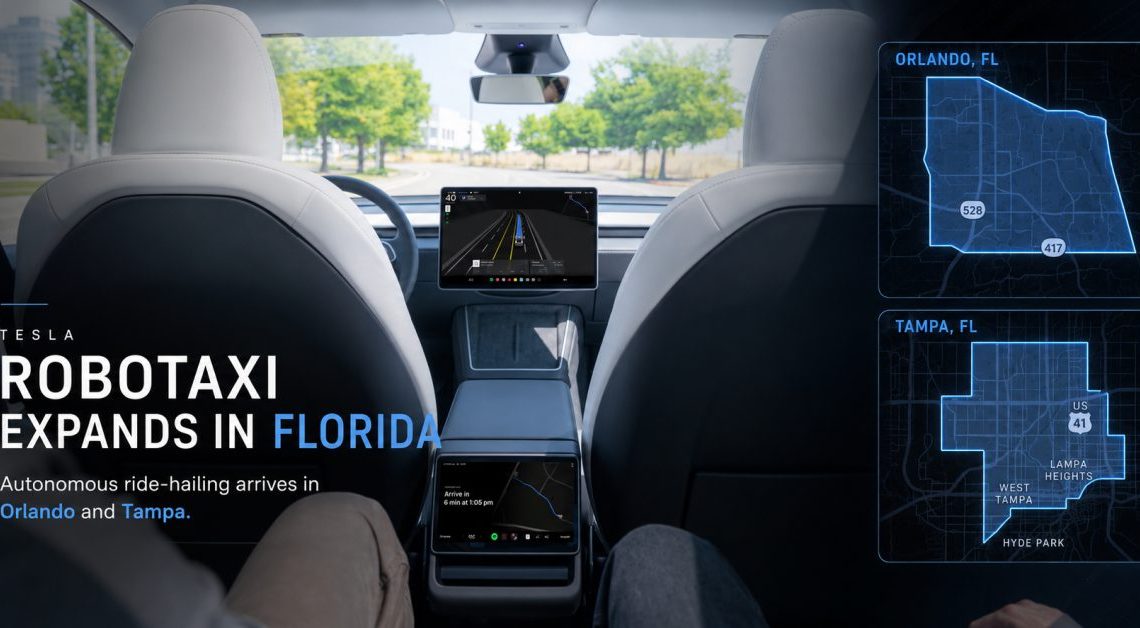
Tesla switched on its “Robotaxi” service in Tampa and Orlando on Monday, adding two Florida cities to a driverless network that still runs on a couple dozen cars. The company’s @robotaxi account announced it in a four-word post: “Robotaxi now in Tampa & Orlando!”
The timing isn’t subtle. Tesla reports second-quarter earnings on Wednesday, and Robotaxi is the story Elon Musk keeps selling to investors. Two new city names the day before make for a nice slide. The fleet behind them tells a different story.
A bigger map, the same tiny fleet
Tesla didn’t say how many cars it’s putting in Tampa or Orlando. It rarely does. Every market it’s opened beyond Austin this year has launched small, typically with a Tesla employee monitoring from inside the car, and there’s no sign Florida is different.
Look at Austin, and you can see the ceiling. That’s Tesla’s flagship robotaxi market, the first city it launched in June 2025, and the one with the most built-out service area — Tesla stretched the geofence to cover the entire metro in June. A full year in, the unsupervised fleet is still stuck at about 17 active cars, down from a peak of roughly 25 in late April.

Add Dallas and its four cars, and Tesla’s entire unsupervised operation runs on around 21 vehicles, according to community tracking of the fleet. It’s not growing. We reported in May that the fleet was actually shrinking, not scaling, and the numbers since then haven’t reversed that.
Austin is the tell
Here’s the simple version. If Tesla were ready to scale unsupervised robotaxis, it would flood Austin first.
It’s the market with the most data, the most validation, the widest approved service area, and a full year of operation behind it. Every incentive points to putting hundreds of cars there and running a real service. Instead the fleet sits under 20 and drifts sideways, while Tesla lights up new metros in Florida.
Adding cities is cheap. Lighting up a new metro or redrawing a geofence costs nothing close to what it takes to actually scale a fleet. It’s a map edit and a tweet. Deploying enough cars to run a dense, reliable service in your best market is the hard part, and that’s the part Tesla hasn’t done anywhere.
Musk already told us why
The reason isn’t a secret. Musk said it himself.
On the Q1 2026 earnings call in April, he named the constraint: “rigorous validation, making sure things are completely safe.” He said Tesla doesn’t want “a single accidental injury” from the rollout (there already were a couple of injuries according to Tesla’s NTHSA reporting). That’s not a manufacturing limit or a software-shipping delay. That’s Tesla keeping the fleet small on purpose because it can’t yet prove the cars are safe enough to scale.
Independent data backs him up. Community tracking of Tesla’s Austin operation has put its incident rate at roughly four times that of human drivers, which is the opposite of what you’d want before adding cars, let alone whole new cities.
The contrast with Waymo is stark. Waymo runs roughly 3,000 driverless vehicles and does more than 500,000 paid trips a week across US cities, and it just expanded its coverage by more than 20%. Tesla, after a year, runs about 21 unsupervised cars and just added two markets it isn’t giving a fleet number for.
Author: Fred Lambert
Source: Electrek
Reviewed By: Editorial Team