

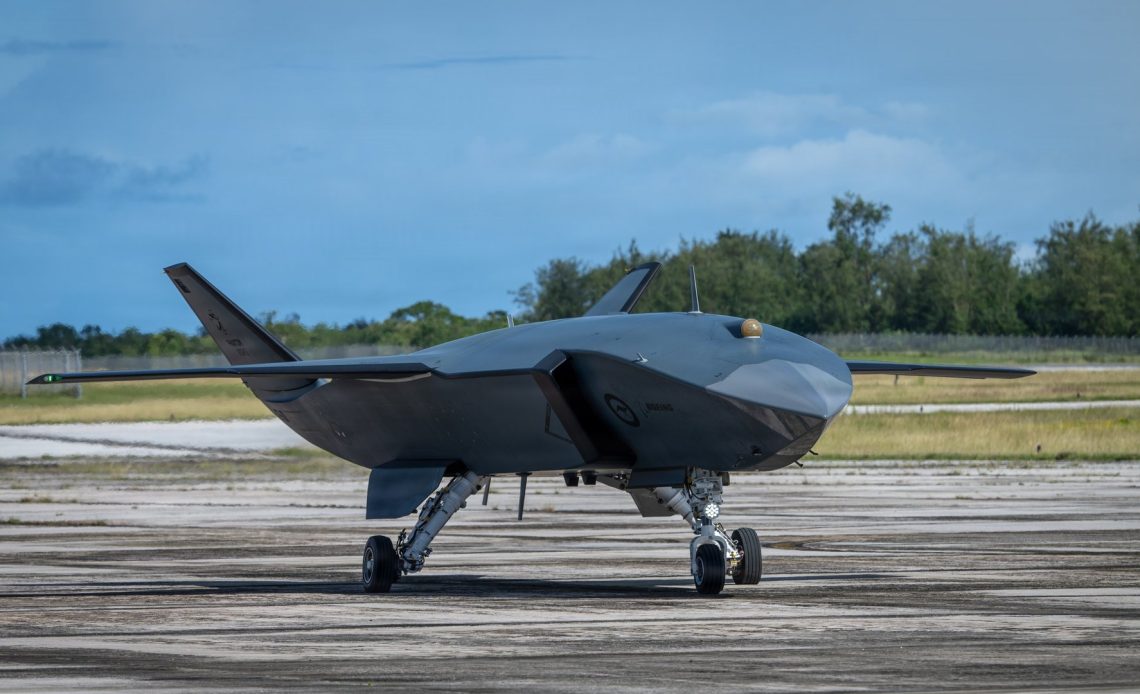
LONDON — An unusually warm London sun beat down on the grey body of an aircraft. Sleek and gently curved, an average onlooker taking a cursory glance at the airframe may have assumed it to be a small fighter jet.
And it may accompany fighter jets, but no pilot will ever buckle themselves into a seat in the cockpit of a Boeing MQ-28 Ghost Bat.
Australia’s flight-ready uncrewed aircraft made its Farnborough International Airshow debut this week, the static display representing what the company this month said was the first collaborative combat aircraft, or CCA, to participate in a multinational, joint operational exercise.
The Ghost Bat in June soared alongside crewed aircraft around the Marinas Island Range Complex in the Western Pacific as part of Exercise Valiant Shield 2026. According to Boeing, the CCA participated as F-35A, F-35B and other crewed coalition jets honed tactics.
The aircraft were included with U.S. Pacific Command forces to support the U.S. Air Force’s Experimental Operation Unit.
“Having MQ-28 participate in such a significant military training exercise is a first, and this is just the start of demonstrating how advanced human-machine teaming extends the reach and awareness of crewed platforms and enhances joint force operations,” Steve Parker, the president and chief executive officer of Boeing Defense, Space and Security, said in a release. “We’ve proven that it’s combat capable.”
The integrated exercise came after the Ghost Bat successfully completed a live fire demonstrating, shooting an AIM-120 AMRAAM missile to destroy a drone.
With a range of more than 2,000 nautical miles, the Ghost Bat was designed to support crewed jets by performing missions like surveillance and electronic warfare.
The aircraft has “length of a trainer and the full wingspan of a modern stealth fighter,” according to Boeing, and it can reach a ceiling of over 40,000 feet.
For years, industry leaders have seen autonomous aircraft as a market primed for potential growth, as experts push for crewed-uncrewed teaming as a key difference maker in beating a near-peer rival like China.
This year, some companies took that a step further, as they prepare for an era of air combat characterized by unmanned aerial systems — like the Ghost Bat.
Betting on the need for future crew to manage drone wingmen — fleets of drones under human command — BAE Systems unveiled a helmet to help pilots manage more data than ever before.
The U.S. Air Force has also introduced incorporating uncrewed aircraft into missions, and in June it awarded CCA contracts to Anduril, for its FQ-44A “Fury,” and General Atomics, for its FQ-42A.
Models of both were on display at the airshow.
Author: Eve Sampson
Source: DefenseNews
Reviewed By: Editorial Team