

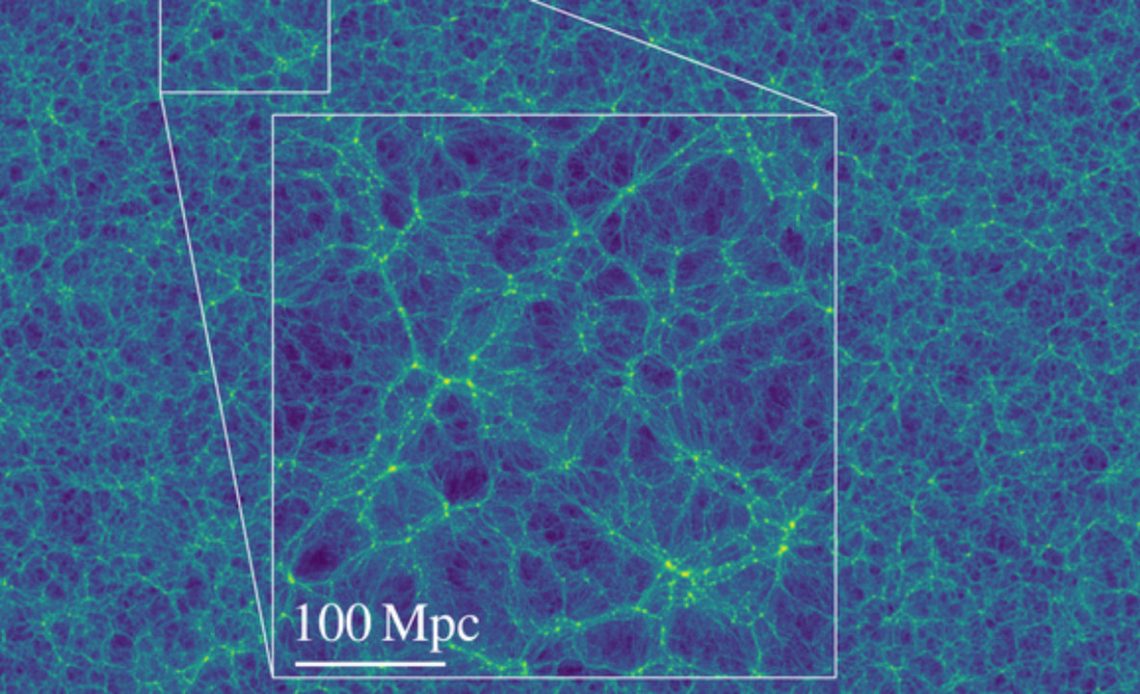
Astronomers have unveiled one of the largest cosmological simulation datasets ever created, offering an expansive new tool to explore how the universe evolved across billions of years.
Produced by the FLAMINGO project — short for Full-hydro Large-scale structure simulations with All-sky Mapping — the dataset contains more than 2.5 petabytes of data, an amount researchers say is roughly equivalent to half a million HD movies. The sheer scale of the release reflects a growing need in astronomy: matching increasingly precise observations with equally sophisticated theoretical models, according to a statement from the Netherlands Research School for Astronomy (NOVA).
Modern telescopes and sky surveys are capturing the universe in extraordinary detail, but interpreting that data requires simulations that can reproduce both the large-scale structure of the cosmos and the complex physics unfolding within galaxies. FLAMINGO was designed to bridge that gap.
“These simulations allow us to follow the growth of cosmic structure across vast regions of space, while still modelling the complex physics of galaxy formation,” Joop Schaye, co-author of the study from Leiden University, Netherlands, said in the statement. “By making the data publicly available, we hope researchers worldwide will use FLAMINGO to test new ideas about how the universe works.”
The simulations function as “virtual universes,” beginning shortly after the Big Bang and evolving forward in time. They track how tiny fluctuations in matter gradually grew into galaxies, clusters and the vast cosmic web that defines the large-scale structure of the universe today. What sets FLAMINGO apart from many earlier efforts is its ability to model not just dark matter — which makes up most of the universe’s mass — but also ordinary matter and the effects of dark energy in a single, self-consistent framework, according to the study.
That combination allows scientists to study how processes on vastly different scales interact. The same simulation can capture the turbulent physics of gas forming stars inside galaxies while also mapping the distribution of galaxy clusters across billions of light-years. In turn, this helps researchers more accurately reproduce the observable universe.
The dataset’s enormous volume also makes it especially powerful for studying rare phenomena. Massive galaxy clusters, luminous quasars and other uncommon cosmic objects are difficult to capture in smaller simulations simply because they occur so infrequently. FLAMINGO’s scale increases the odds of finding these outliers, giving scientists a better understanding of some of the universe’s most extreme environments.
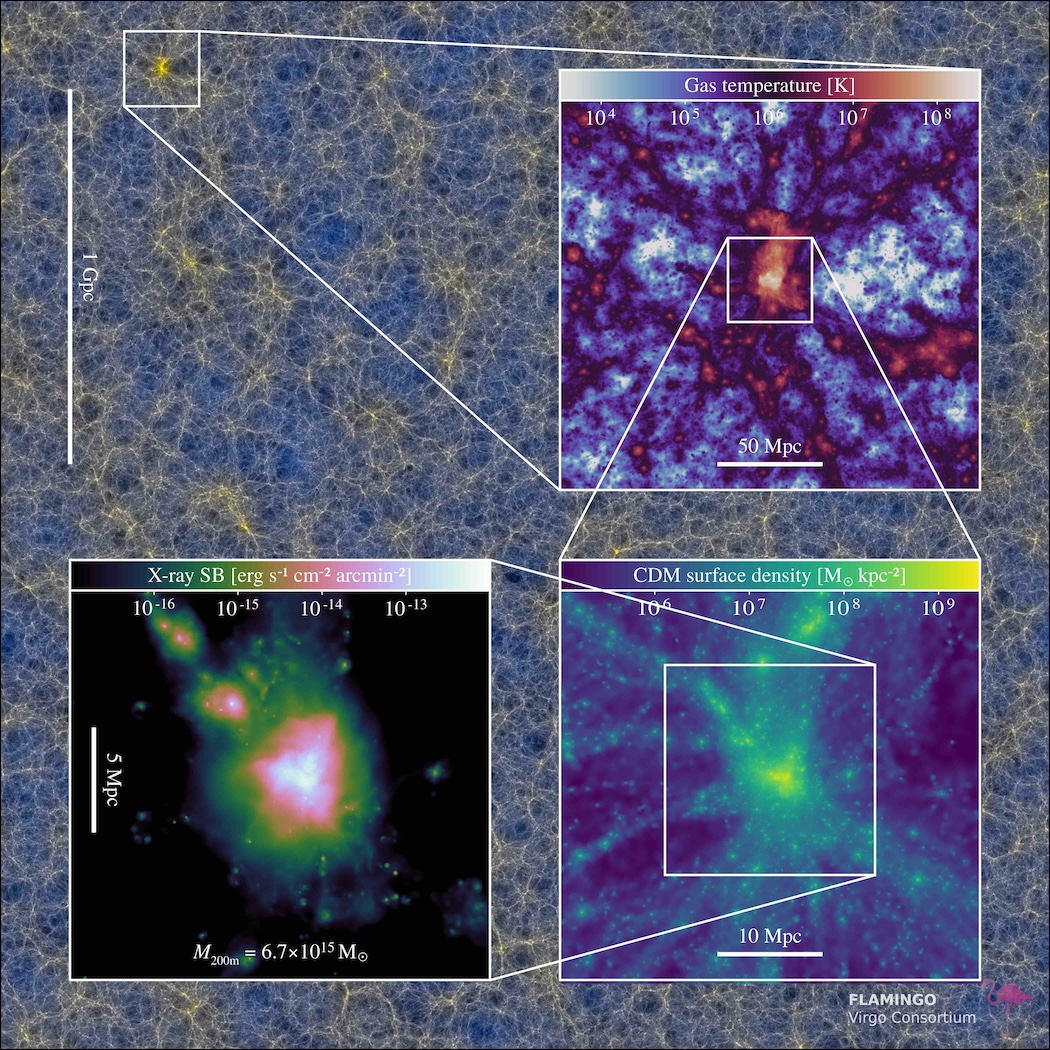
Beyond individual discoveries, one of the project’s most important roles will be helping astronomers interpret incoming data from next-generation observatories. As new surveys map the sky in unprecedented detail, researchers will need robust theoretical frameworks to compare against their observations. Simulations like FLAMINGO provide that context, allowing scientists to test competing models of dark matter, dark energy and galaxy formation.
The team has made the dataset publicly available, opening it to researchers around the world. That accessibility is key as astronomy becomes increasingly data-driven, with collaborations often spanning continents and relying on shared computational resources.
“Open access to datasets of this scale can significantly accelerate scientific progress,” Matthieu Schaller, co-author of the study from Leiden University, said in the statement. “We aim to provide a resource that will support a wide range of astrophysical research.”
Ultimately, FLAMINGO represents a shift in how scientists study the cosmos. Rather than relying solely on observations, researchers can now experiment within detailed virtual universes — adjusting physical assumptions, testing predictions and uncovering patterns that might otherwise remain hidden.
The FLAMINGO simulations data release was submitted to Astronomy & Computing on April 28 and is available on the arXiv preprint server.
Author: Samantha Mathewson
Source: Space.com
Reviewed By: Editorial Team