


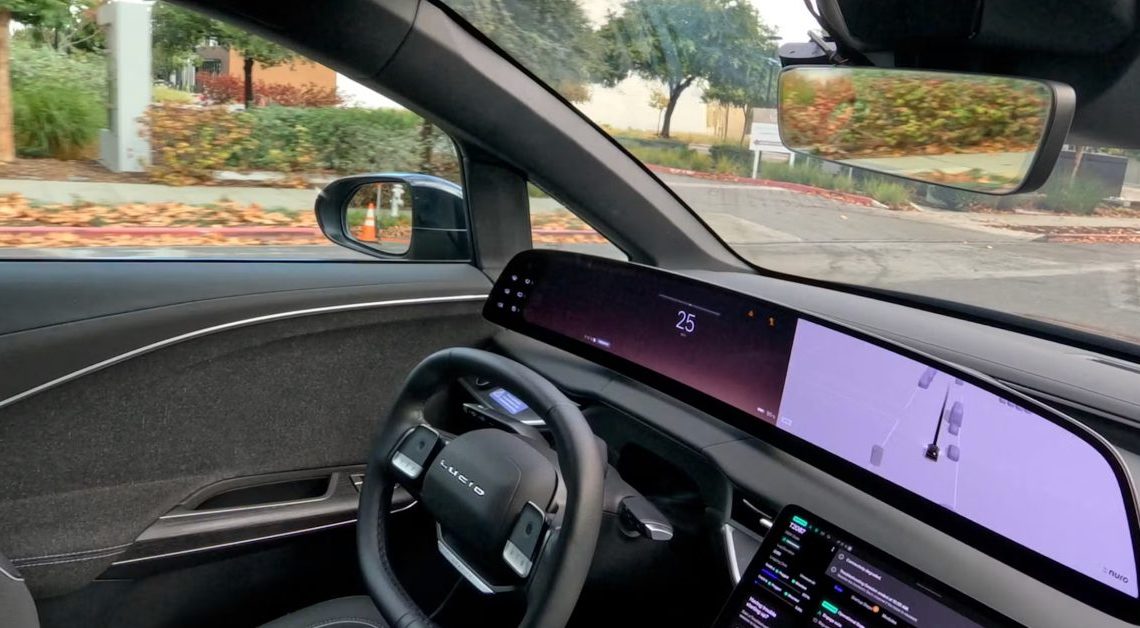
Nuro is now testing Lucid Gravity robotaxis on public roads in the San Francisco Bay Area with nobody in the driver’s seat. The driverless testing starts in four Peninsula and South Bay cities, with a fleet of more than 100 Gravity SUVs delivered by Lucid for the program.
It’s the biggest step yet for the Uber-Nuro-Lucid partnership. But it comes with a quieter update: the public launch, originally promised for 2026, is now expected in Q1 2027.
Driverless in four cities, employee rides next
According to Nuro’s announcement, driverless testing covers Palo Alto, Mountain View, Los Altos, and Sunnyvale, with more Bay Area cities to follow next year. Uber employees will “soon” be able to ride in the driverless vehicles.
Nuro has run the Gravity robotaxis around the clock in the Bay Area and Houston since December 2025, but always with a safety driver. Before pulling the driver, the company says it ran no-vehicle-operator testing at its Las Vegas closed course, covering things like pedestrian encounters and right-of-way violations, plus large-scale simulation.
Tilo Schwarz, Nuro’s head of the Nuro Driver, pointed out that driverless operation “isn’t new” for the company. That’s fair. Nuro has run driverless delivery pods in California since 2020. But this is its first time doing it with a passenger vehicle.
The regulatory pieces were already in place. As we reported in May, the California DMV extended Nuro’s driverless testing permit to the Lucid Gravity, and the CPUC followed with a drivered pilot permit for carrying passengers.
A short list, and Tesla isn’t on it
Nuro says it’s one of just six companies allowed to test without a driver on California roads. The DMV’s list, last updated November 5, confirms it: AutoMo, Nuro, Tensor, Waymo, WeRide, and Zoox.
Tesla isn’t one of them. Its “Tesla Robotaxi LLC” entity only holds a permit to test with a driver in California, and it has no deployment permit either.
Waymo, of course, is the benchmark. It already runs a paid, fully driverless service across much of the Bay Area, including the Peninsula and South Bay where Nuro is just now pulling its safety drivers.
The timeline keeps sliding
When Lucid, Nuro, and Uber announced the program in July 2025, the plan was to launch “later next year” in a major US city. As recently as June, when Uber named Houston as the second market for mid-2027, the Bay Area launch was still slated for this year.
Now it’s Q1 2027. Not a huge slip, but it’s a slip.
The scale ambition has gone the other way. Uber’s purchase commitment grew from 20,000 vehicles to at least 35,000 Lucid vehicles with the Nuro Driver, starting with the Gravity and later Lucid’s upcoming midsize models. Uber will own and operate the cars with fleet partners, and they’ll only be available through the Uber app.
For context, Lucid delivered 3,806 vehicles in Q3 2026. At that pace, 35,000 robotaxis would take more than two years of Lucid’s entire output.
Author: Fred Lambert
Source: Electrek
Reviewed By: Editorial Team
