


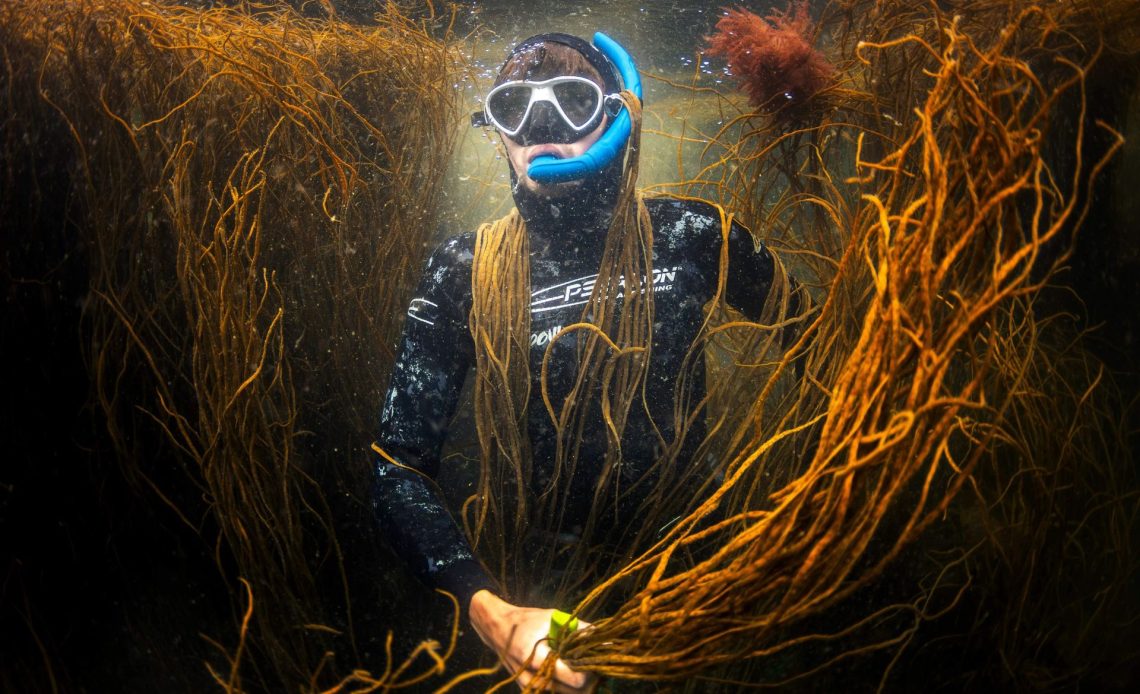
We’ve all eaten spaghetti Bolognese but, unlike the wheat-based pasta at the heart of that dish, did you know that there’s another type of spaghetti? Only this spaghetti is brownish-green, slimy and grows underwater.
I’m talking about buttonweed. Otherwise known as sea spaghetti, buttonweed is an edible brown seaweed native to the North Atlantic – including the Cornish coast of southwest England, where documentary photographer Brad Wakefield captured a diver harvesting it for commercial products.
The frame recently won the “Documentary” category at the British Photography Awards (BPA) 2026, with Wakefield telling the BPA that in his shot, we see Dan Hawkes, a diver and harvest manager at the Cornish Seaweed Company, under the waves holding his freshly cut crop.
Brad Wakefield’s gear
- Camera: Canon EOS R6
- Underwater housing: Ikelite
- Lens: Tokina fisheye
“Seaweed is among the most nutrient-dense foods on Earth, naturally rich in iodine, iron, and essential minerals,” said Wakefield. In fact, according to the Food and Agriculture Organization (a United Nations agency), seaweed cultivation is one of the most environmentally friendly, and even regenerative, ways to produce food, too.
Unlike traditional land agriculture, seaweed requires no arable land, freshwater or pesticides to grow, and can even absorb excess nitrogen from agricultural runoff, which helps prevent toxic algal blooms and ocean dead zones.
But according to Wakefield, in the UK, seaweed cultivation is still a “widely overlooked” source of nutrition. Although marine biologists have also warned of the consequences of farming the algae on an industrial scale.
One of these consequences, scientists say, is light being blocked from reaching the seafloor. If this happens, then photosynthetic organisms native to the seabed, like seagrass and corals, cannot produce energy, triggering a domino effect that leads to their death and the collapse of the surrounding habitat.
A post shared by Brad Wakefield – Photographer (@brad_wakefield)
Above: Brad Wakefield captured the whole harvesting day, from heading out to sea on the boat to the divers cutting and collecting the algae
In the UK, however, it’s not as simple as setting up a farm and beginning to cultivate. Regions such as Scotland assess the footprint of a farm against factors such as local water depth, light shading on the seabed, and nutrient uptake to decide whether a new cultivation site can set up shop.
As the winner of the “Documentary” category at the BPA 2026, Wakefield was handed a winner’s trophy and invited to the awards gala night held at the Royal Lancaster Hotel, London, earlier this month.
To see all of this year’s category winners, People’s Choice winners, and shortlisted images, head to the 2026 gallery on the BPA website.
Author: Alan Palazon
Source: DigitalCameraWorld
Reviewed By: Editorial Team
