

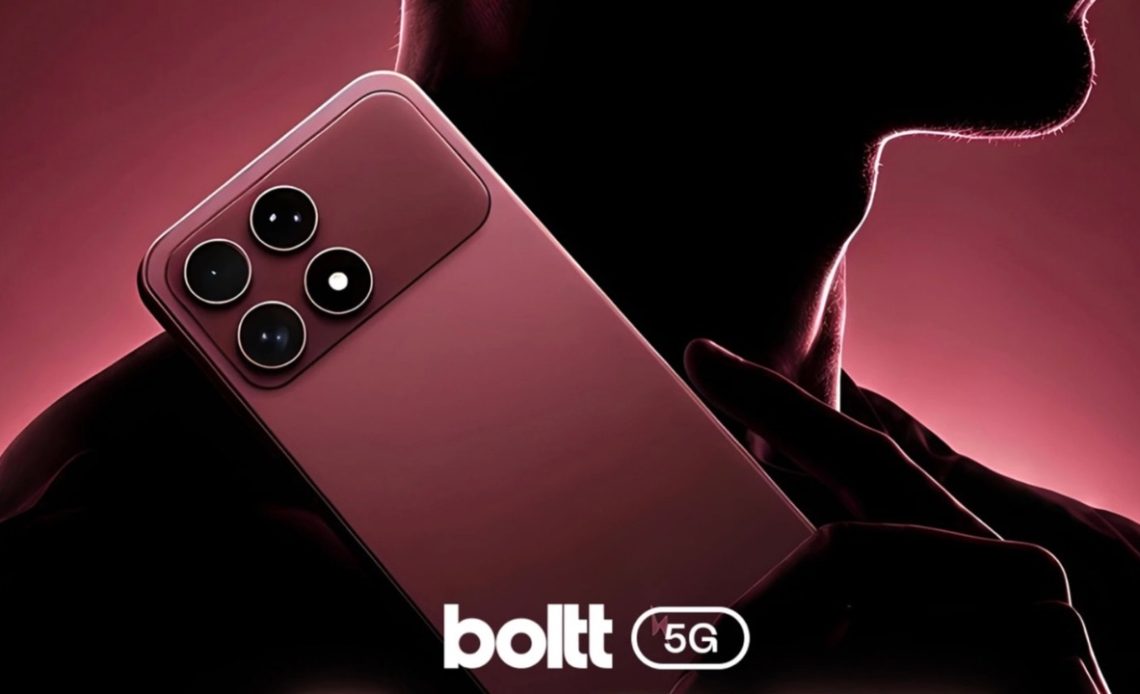
India’s crowded smartphone market has a new domestic entrant. Boltt, a spin-off from wearables maker Fire-Boltt, launched its first smartphones this week, betting that its experience in wearables and its understanding of Indian consumers can carve out space in a segment long dominated by foreign names.
Speaking to The Mobile Indian, Boltt founder and chief executive Arnav Kishore said the company was launched to address what he described as a scarcity of trusted, India-based smartphone brands, arguing that most players in the domestic market remain foreign-owned even as government policy pushes local manufacturing.
“We have started with smartphones priced below Rs 15,000 but plans to move into higher price bands, including the sub-Rs 30,000 segment,” said Kishore. The longer-term ambition is to build an Indian smartphone company capable of competing not only at home but in international markets.
“We will become a ‘Dhurandhar’ brand,” Kishore said when asked whether Boltt could emerge as a significant Indian smartphone player. He said the company expects to establish a meaningful market position within about a year, though the scale of that ambition will ultimately depend on sales and consumer response.
From wearables to the main device
Kishore said the company had spent about a year developing its first smartphones rather than treating handsets as an extension of its wearable portfolio.
Fire-Boltt built its business around smartwatches and later expanded into audio products and smart eyewear. But Kishore said the company had wanted for several years to move from accessories to what he described as the main device in a consumer’s digital life – the smartphone.
Boltt says it used feedback from more than 2,000 consumers from different parts of India while developing its phones. The company focused on areas including battery life, display visibility, performance, cameras and software, Kishore said.
Rather than designing a specification sheet first and then building a phone around it, he said the company tried to identify features consumers actually use. One consequence of that approach, according to Kishore, is the decision to avoid third-party applications, advertisements and other software that could add monetisation opportunities but affect the user experience.
Whether that consumer-led approach produces a better device will need to be tested independently. India’s sub-Rs 15,000 segment already has products from companies with years of experience in smartphones, established supply chains and large service networks.
Starting below Rs 15,000, but not staying there
Boltt does not want to remain associated only with entry-level smartphones.
Kishore said the company deliberately chose the budget segment as its starting point because of the number of Indian consumers buying their first smartphone or moving from feature phones.
For those buyers, even spending around Rs 10,000 represents a significant purchase, he said, making the overall experience more important than concentrating spending on a single headline specification. But Boltt’s roadmap extends beyond that segment.
“We have started under Rs 15,000. Under Rs 30,000 will also be seen very soon,” Kishore said.
Later in the interview, he said the company would try to expand its portfolio over the coming year. Devices above Rs 15,000 could arrive by the end of this year if development proceeds according to plan, although Kishore declined to give a firm launch date. He indicated that the broader expansion could take about six months.
Moving towards Rs 30,000 would change Boltt’s competitive set. Instead of competing primarily for first-time smartphone buyers, the company would face established devices from Motorola, Poco and other brands targeting users who increasingly expect stronger cameras, software support and performance.
On chipsets, Kishore pushed back on the idea that Boltt had opted for cheaper silicon due to supply constraints, saying the company evaluated dozens of Chipset makers before selecting UNISOC, which he described as offering premium-tier performance at a lower cost than rival options. He said the phones would ship with two years of quarterly security updates and support through Android 17, without pre-installed third-party apps.
Also Read: Boltt Ace 5G, Boltt Evo Smartphones Launched in India: Price, Specifications, Availability
Manufacturing and after-sales service
Kishore said the phones are being manufactured in India through a strategic partnership with one of the world’s top contract manufacturers, though he declined to name the partner, saying customers would learn the details after purchase. He said Boltt operates roughly 250 service centers across India, with a target of introducing at-home repair service within six months, and said replacement parts typically take about a week to process through what he called a standard repair protocol.
Kishore acknowledged that Fire-Boltt’s service record has drawn mixed reviews, with some customers praising response times and others reporting delays, but said the company considers its after-sales support among the best in the industry given the scale of complaints it resolves.
The company is targeting a turnaround of about two days for smaller defects, while repairs involving replacement components could take up to a week, Kishore said.
Boltt is also working on at-home smartphone service, which Kishore said could be introduced within six months.
That commitment will be worth watching. Smartphone buyers depend on their devices for payments, communication, work and access to services, meaning a week without a handset can be more disruptive than a similar repair period for a smartwatch.
Software is part of Boltt’s pitch
Boltt is also attempting to distinguish its phones through software.
The devices run Google’s Android operating system but use Boltt’s own launcher and user interface. Kishore said the company has invested in developing its UI and intends to add more features as it moves into higher smartphone categories.
He said Boltt phones would not ship with third-party apps, advertising or bloatware. The company is committing to security updates for at least two years, with quarterly updates as the minimum Frequency mentioned during the interview. Kishore also said the current devices would receive Android 17 support.
Software support has become another point of competition even in lower-priced Android smartphones, making the duration and consistency of those updates as important as the initial commitment.
Taking aim at Poco, Motorola and Lava
Kishore did not avoid comparisons with established competitors.
Asked specifically how Boltt would compete against Poco and Motorola in the roughly Rs 11,000-Rs 12,000 segment, he positioned the company’s smartphones as all-round products rather than devices built around one headline feature.
“You should do your own research,” Kishore said, arguing that buyers should choose another brand if they find a better package at the same price.
He also acknowledged Lava’s experience in India’s smartphone market and described it as an established player, while arguing that Boltt would enter with a different brand identity derived partly from Fire-Boltt’s following.
The comparisons set a measurable benchmark for Boltt. Poco and Motorola already compete on pricing and specifications, while Lava has spent years trying to rebuild the case for an Indian smartphone brand.
Boltt will therefore have to demonstrate that its claims translate into products consumers are prepared to buy – and continue using.
Its first phones are only the beginning of that test. The company is promising more price segments, an expanded service network, at-home support and software updates while attempting to transfer Fire-Boltt’s recognition from the wrist to the pocket.
In a market where several Indian handset companies have previously risen quickly and then lost ground, the more important question is not whether Boltt can generate attention at launch, but whether it can build the product, service and software operation needed to retain customers after the first sale.
Author: Sandeep Budki
Source: The Mobile Indian
Reviewed By: Editorial Team