

Google’s new Pixel 11 launched worldwide earlier last week and in India, it starts at Rs 89,999. That’s a price hike of Rs 10,000 compared to the Pixel 10 but how is Google trying to justify this bump in price? We’ll talk about that in our Google Pixel 11 first impression.
Design & Display
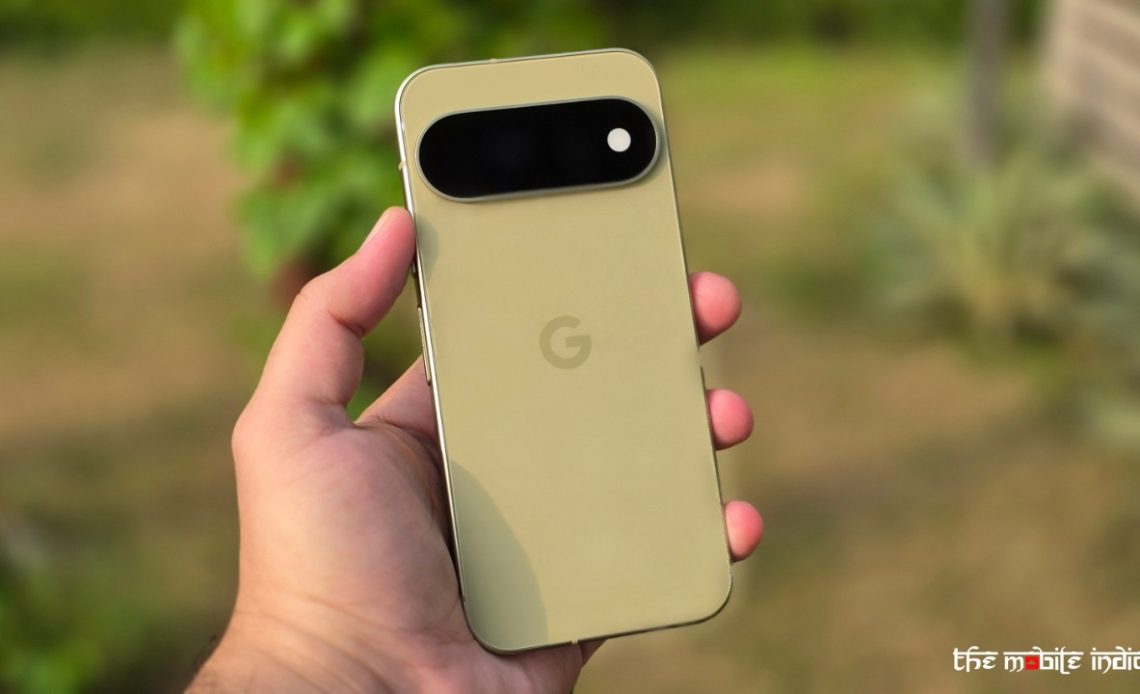
The Google Pixel 11 arrives in new shades over the Pixel 10 and these are quite vibrant. We got the Pistachio shade of the device and this looks quite beautiful in real life. The matte finish is definitely premium in the hand while the frame gets a lighter hue of green.

The in-hand feel is identical to the Pixel 10 and it is comfortable to use with one hand. At the back, a major change you’ll instantly notice is how slim the camera bar is, so it doesn’t protrude much. In fact, with a case on, it sits completely flushed and so, the back becomes completely flat.


Also, the glass on the camera bar now stretches from EDGE to edge, whereas on the Pixel 10, it ends just past the third camera sensor, with the rest covered in metal. You also don’t get the HiLight on the back like you do with the Pixel 11 Pro models and so far, it doesn’t seem like the most clever implementation of a rear LED light so I am not missing it either.
The whole back panel is protected with Gorilla Glass Victus 2 but due to the delicate nature of glass, it is best you protect this with a skin or a case. Google doesn’t provide you with a case in the box, of course, and the only things you get is a USB-C cable, manuals, and a SIM ejector tool.

Overall, our first impression of the Pixel 11 design is positive. It retains the signature Pixel look in a new colour that looks gorgeous along with a refined camera bar design.
On the front, you get the same 6.3-inch panel as the Pixel 10, with a 1080 x 2424 pixels resolution, 120Hz refresh rate, 422 ppi, and up to 2000 nits HDR brightness and 3000 nits peak brightness. It is protected with Gorilla Glass Victus 2.

The display looks sharp and bright in normal use so far. The colours are more towards the natural side, while the touch responsiveness is also high. This is on the basis of our first impression of the device, so we’ll talk more about the display in the review.
Software & Performance
The phone is powered by Google’s Tensor G6 SoC, along with 12GB of RAM. You get up to 512GB of storage. It runs on Android 17 out of the box and will get 7 years of Android OS upgrades, security updates and regular Feature Drops.
Over the Pixel 10, you now get double the storage in the base model, so 256GB should be enough for most users. Also, there’s a new 512GB version if you want to max out the storage but again, that comes with an increased cost.
The new Tensor G6 is faster than Tensor G5 on paper but also gets one less core over its predecessor. Despite that, with the help of optimisations, Google promises 25% faster web browsing and 15% faster App launch times. The new TPU is claimed to deliver 50% more compute power than on the Pixel 10 and is up to 3.5x faster in some on-device AI tasks. As a result, Google’s Gemini Nano gets higher-quality and lower-latency performance.
There’s also a new Titan M3 Chipset for security which comes after a five year Titan M2 stint. Also, there’s a new MediaTek M90 Modem which should ideally offer better performance. Although we didn’t face any major issues with connectivity last year with Pixel 10 series, we’ll be sure to check how Pixel 11 performs this year.
In our use so far, the device hasn’t shown any signs of slowing down. In fact, the performance is quite similar to what we experienced last year with the Pixel 10 series. RAM management looks good and switching through apps is a breeze. Using AI features like Gemini has also been a great experience.
We’ll dive deep into the Pixel 11 performance and software features in the full review.
Battery & Cameras
On the battery front, there’s a 4985mAh cell that supports 30W fast wired charging and 25W Qi2.2-certified fast wireless charging. This is a marginal bump over the 4970mAh cell in the Pixel 10. It’s too early to comment on the battery life as of now as we haven’t used the phone for long.
Pixel 11 comes with a triple rear camera setup, consisting of a 48-megapixel primary sensor with an f/1.7 OIS-assisted Wide-Angle lens, a 13-megapixel f/2.2 ultra-wide angle shooter and a 10.8MP 5x f/3.1 telephoto sensor with OIS. On the front, there is a 10.5-megapixel selfie camera sensor, with an f/2.2 lens and auto-focus support.
Google says this is a new 48-megapixel main lens which allows for 56% better light sensitivity. We’ll put the sensor through its paces in the full review but on the basis of our initial impressions, the results seem impressive.
Google’s Pixel 11 feels like a fairly minor upgrade over the Pixel 10, with a few questionable choices at least on paper, including some downgrades in the chip. That said, it still looks like an impressive phone with plenty to offer. We don’t want to jump to a final judgment just yet, so stay tuned for our full Google Pixel 11 review, coming soon.
Author: Abhishek Malhotra
Source: The Mobile Indian
Reviewed By: Editorial Team