
Every photographer has, at some point, wished that their gear could do something it simply can’t. You suddenly crave a shutter speed fast enough to freeze a hummingbird’s wing, or a trigger quick enough to catch a water droplet at the exact moment of impact.
It’s nice to fantasize for a few seconds, then most of us just shrug and get on with what we’re doing. Eadweard Muybridge (1830-1904) didn’t.
In 1878, faced with a question no one could answer, he built his own equipment from scratch. And in doing so, he built his own photographic system for capturing rapid movement in a sequence of split-second exposures – which went on to inspire an entirely new technology and art form.
The question was simple: does a galloping horse ever have all four hooves off the ground at once? Nobody could actually see the answer, because a horse’s legs move too quickly for the human eye to resolve. It had become a surprisingly contentious question.
Industrialist and racehorse owner Leland Stanford hired Muybridge – an England-born landscape photographer with no formal training in engineering – in 1872 to prove it.
He did so by building a tool that could actually answer the question, once and for all. He didn’t wait for better technology to arrive. He made his own.
How it worked
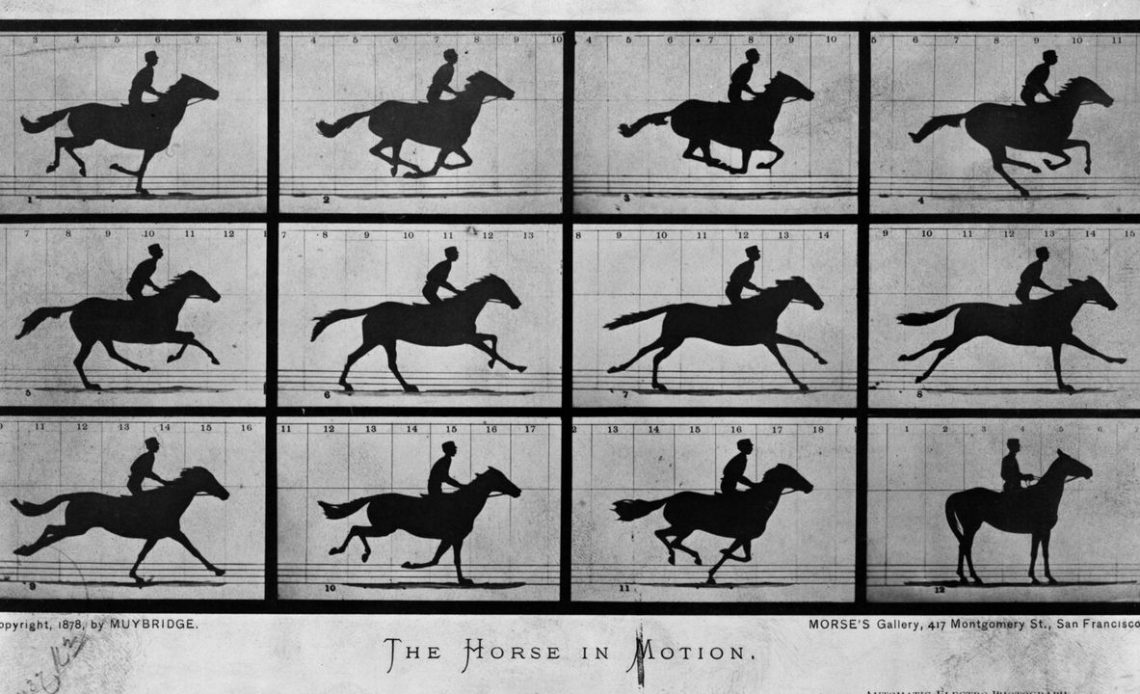
Muybridge lined up 12 cameras along a racetrack in Palo Alto, California. Each was aimed at a whitewashed backdrop marked with measurement lines. He stretched fine threads across the track at chest height, each one wired to a shutter release.
As the horse ran, her body snapped the threads one by one, firing each camera at the precise instant she reached it. As a solution, the word “ingenious” springs to mind.
He knew no human reflex was fast enough to time the shots by hand, so he removed the human reaction time from the equation. The underlying idea feels remarkably familiar today: let the subject trigger the camera rather than relying on a human to press the shutter.
The only difference between his version and modern iterations was that the former was built from wood, thread and springs – not infrared sensors.
The other challenge was exposure time. In 1878, a typical exposure ran to several seconds. Muybridge needed something closer to 1/1000sec. So he built his own spring-driven shutter mechanism to get there, pushing his glass plates and chemistry to their limits.
To say this was a huge technological leap feels like understatement.
What the photos proved
When the plates came back, they answered the question definitively: a galloping horse does lift completely off the ground.
The airborne moment happens when the legs are gathered tightly underneath the body, mid-stride, a position nobody had ever realized despite watching horses run for thousands of years. What a tribute to the power of photography.
Muybridge could have stopped there. Instead, he built the zoopraxiscope, a spinning glass disk that flashed his sequence of images in quick succession, blending them into the illusion of a galloping horse projected on a wall. Thomas Edison saw the device in action and the rest is history.
(While cinema still needed flexible film and years more invention from others, Muybridge’s homemade rig was clearly the start of things to come.)
The lesson for us today? I’d say it’s this. The next time you’re trying to get a shot and your equipment isn’t up to it, don’t think: ‘Shall I upgrade?’ Think: ‘How can I work around this problem?’ The lateral thinking that can lead to is not only fun, it might change the way you approach photography in the future.
And maybe, just maybe, it might change the world of photography itself.
Author: Tom May
Source: DigitalCameraWorld
Reviewed By: Editorial Team