


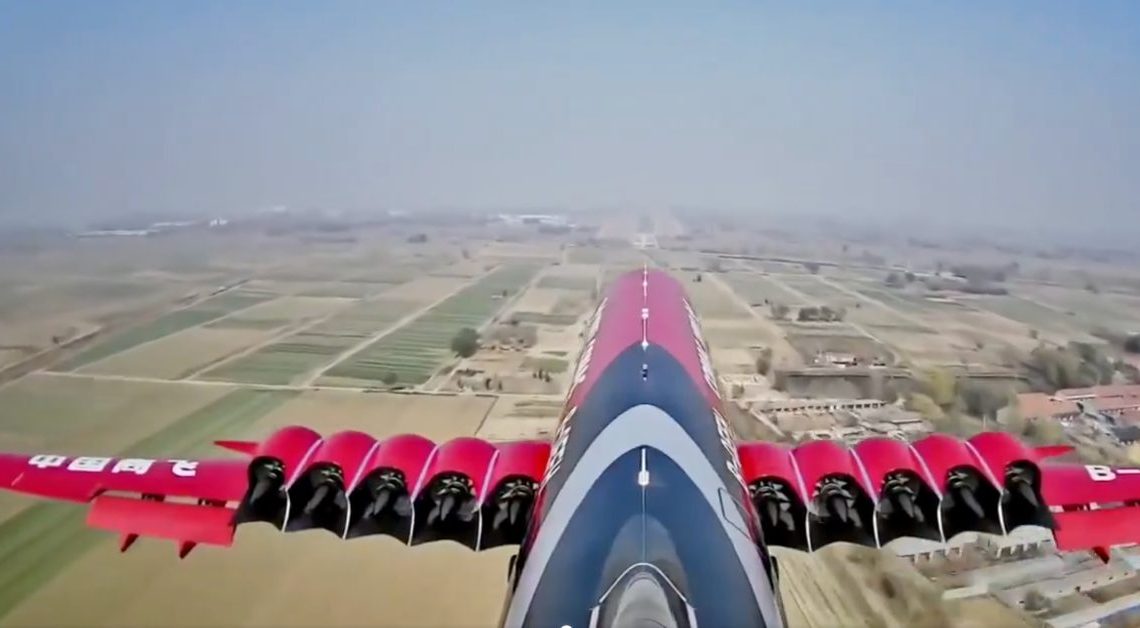
COMAC’s CE-25A, China’s 19-seat battery-electric commuter plane, flew with a crew for the first time on Saturday in Binzhou, Shandong. Two pilots and a flight test engineer were aboard the roughly 10-tonne demonstrator, and COMAC says every system worked normally.
It wasn’t the plane’s first flight. The CE-25A had already completed 19 autonomous test flights with nobody on board since February 2, and China’s aviation regulator is now reviewing it for a type certificate.
The CE-25A: 19 seats, 10 fans, 400 km
The CE-25A is a T-tail commuter plane with 10 electric ducted fans on the wings, five per side, instead of propellers. COMAC lists a 300 km/h cruise speed and a 400 km (250-mile) range.

The CAAC accepting COMAC’s type certificate application starts the airworthiness review. It doesn’t mean paying passengers are close, and COMAC hasn’t given a date for commercial service.
The program has been quiet for a long time. COMAC showed a CE-25A model at the China International Import Expo in Shanghai in November 2023, with a placard listing 400 to 500 km of range and a 400 km/h top cruise speed. The full-size aircraft, registered B-0EFH, only became public when photos leaked on Chinese social media on October 28.
The CATL connection
The obvious battery candidate is CATL. In July 2023, COMAC, CATL, and Shanghai Jiao Tong University formed a joint venture with CNY 600 million in registered capital to develop electric aircraft, as we reported when CATL launched its aviation unit.
CATL had just unveiled its “condensed” battery at the time, claiming up to 500 Wh/kg at the cell level, and said it was testing the cells to aviation standards. Neither company has confirmed what’s inside the CE-25A, though.
~500 Wh/kg has long been seen as the target for battery energy density to enable electric flight on a commercial scale.
How it compares
COMAC isn’t alone in flying a large electric demonstrator. In August, Heart Aerospace flew its X1 in Plattsburgh, New York, for 27 minutes. It’s a 25,000-lb aircraft with a 106-foot wingspan, which Heart calls the largest battery-electric aircraft ever flown.
Eviation flew its 9-passenger Alice back in September 2022, then laid off most of its staff in early 2025.
Heart is the closest Western comparison. It dropped its 19-seat ES-19 for the 30-seat ES-30 back in 2022, and the ES-30 now relies on reserve turbogenerators to stretch its range, with BAE Systems working on the battery. Heart is targeting 2031 for service and claims “more than 40%” lower operating costs.
Author: Fred Lambert
Source: Electrek
Reviewed By: Editorial Team
