

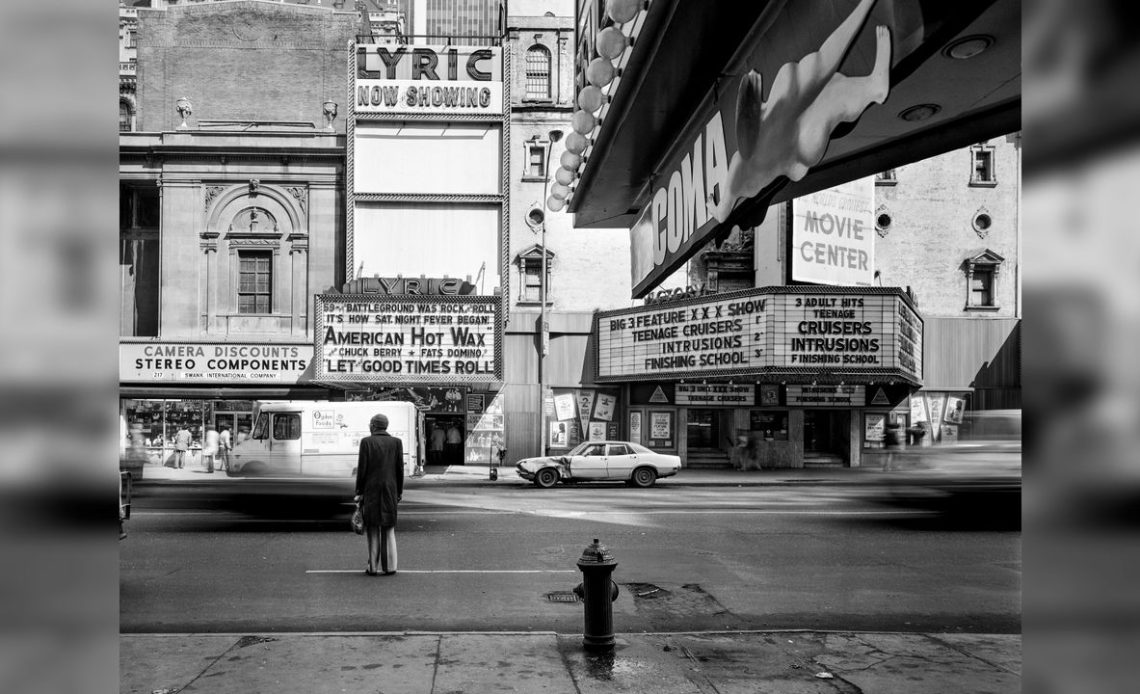
Every morning, a young Chinese-American photographer fresh out of Yale would set an alarm for well before sunrise, drive from New England into Manhattan, then haul a wooden box camera and a tripod out onto pavements that were, by design, as empty as he could find them. That was Baldwin Lee’s routine through the winters of 1975 to 1979.
Lee was using a 4×5 view camera, his first time working in large format. We’re talking a dark cloth over the head, a single sheet of film loaded per exposure, a machine that rewards patience and punishes movement.
Point one at a busy road at rush hour and you’ll get a blur of legs and cab roofs. Point one at an empty street before dawn, though, and you’ll get something akin to what Lee got: doorways, fire escapes, silvered diners and the Empire State Building sitting still on the horizon, all rendered with the kind of clarity that only a large negative can hold.
Lee went out early, mostly in winter, when the sidewalks were closest to bare. “My trips to New York City from New England were an exploration of buildings as organic forms,” he once said. “Rather than approaching the work as architectural photography, I saw it as a way of capturing a landscape.
“It was my first time using a large-format camera,” he added. “Early in the morning, with no one around, I felt an overwhelming intimacy – as if I were walking through my own private garden.”


Those pictures are now being shown for the first time since he made them, in a new exhibition opening at Howard Greenberg Gallery on September 18, titled Baldwin Lee: New York (1975–1979).
For any interested in street photography, I think they offer a useful perspective. Because in a way, they’re running directly counter to most of the instincts people bring to the genre.
Typically, modern street photography chases crowds, gesture, movement, activity, action. All in search of that one, defining moment when a stranger’s expression lines up perfectly with their surroundings and the light hitting them.
Lee’s New York pictures do the opposite, finding stillness and peace in places that, an hour after the picture was taken, will doubtless be teeming with life.
A tennis court fenced off from a Manhattan skyline. A dog tied up outside a shuttered ticket booth. A couple sheltering by a row of grain silos. These aren’t candid fragments of a bustling scene. They’re carefully planned compositions that had time to be built, because nothing in frame was going to move before the shutter clicked.


At the same time, as the press materials put it: “Lee approached Manhattan not as a collection of architectural subjects, but as a place shaped by human presence. Human figures rarely appear, yet their presence remains legible in the worn surfaces of streets and buildings, storefronts, and parked cars.”
So why did they lie there, unobserved, for so many decades? In a nutshell, Lee left New York for Knoxville, Tennessee, in 1982 and spent the rest of that decade making the nearly 10,000 photographs of black communities in the American South that eventually made his name – culminating in a 2022 monograph, Baldwin Lee.
And so although it was shot first, his New York work has become known last.
All this time, Lee has been sitting on a secret masterpiece he knew the world wasn’t ready for. He was a young photographer working out how to use a new camera. It took the rest of his career for that early experiment to transform into a finished statement.
Author: Tom May
Source: DigitalCameraWorld
Reviewed By: Editorial Team