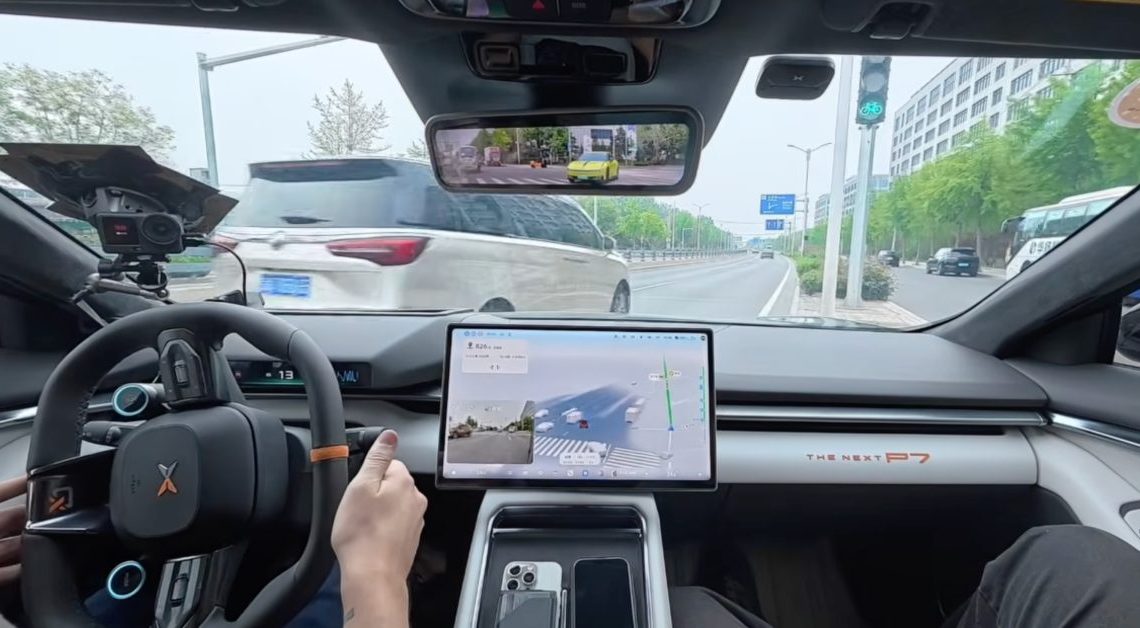
I test-drove Xpeng’s new VLA 2.0 autonomous driving system in Beijing last week, and after 40 minutes of navigating one of the most aggressive driving environments in the world, I didn’t have to intervene once.
This is a major development. Tesla has been the clear leader in advanced driver-assist systems in consumer cars, but Xpeng’s latest update proves that lead is shrinking fast — and in some ways, it’s already gone.
What is Xpeng VLA 2.0?
Xpeng rolled out its VLA 2.0 (Vision-Language-Action) system starting in March 2026, delivering it via over-the-air updates to its latest vehicles, including the P7, G7, and X9 in their “Ultra” configurations.
VLA 2.0 represents a fundamental architectural shift from Xpeng’s previous NGP system. Instead of relying on separate perception, planning, and control modules, VLA 2.0 uses an end-to-end vision-to-action model that translates what the cameras see directly into driving decisions — eliminating the intermediate translation layers that can introduce latency and errors.
The system is powered by Xpeng’s proprietary Turing AI chip, delivering up to 2,250 TOPS of computing power on production vehicles. Xpeng trained the model on 100 million clips from “extreme driving scenarios,” and it shows. The company says driving efficiency improved 23% over the previous generation, with 99% fewer hard braking events.
The architecture is similar to what Tesla has done with its end-to-end neural network approach for FSD, but Xpeng has been iterating rapidly. Volkswagen was so impressed that it signed on as the first external customer for VLA 2.0, deploying it in its new electric SUV for the Chinese market.
Driving VLA 2.0 in Beijing
I tested the previous generation of Xpeng’s system in Guangzhou last year and was impressed, but VLA 2.0 in Beijing is a different experience entirely.
Beijing traffic is ruthless. Drivers cut in aggressively, lane discipline is more of a suggestion than a rule, and yielding to merging traffic is seen as weakness. If your self-driving system hesitates, you’ll never make a lane change.
VLA 2.0 handled it. During my 40-minute test drive, I didn’t have to take over once. The system navigated complex intersections, managed aggressive merging situations, and kept up with the flow of traffic without being overly cautious or dangerously assertive.
There was one moment that stood out. The vehicle needed to merge into a tight gap in heavy traffic. In most driver-assist systems I’ve tested, this is where the car would either hesitate until the opportunity passed or require a human takeover. VLA 2.0 committed to the gap, asserting itself into the lane the way an experienced Beijing driver would — firmly but smoothly. It was impressive.
I won’t argue that it didn’t make me nervous and I was fairly close to pressing the brakes, but it worked out.
You can tell this system was trained for Chinese road conditions. It doesn’t drive like a cautious American suburbs algorithm dropped into Beijing chaos. It drives like it belongs there.
In my short 40-minute drive, VLA 2.0 felt like driving my Tesla on FSD v14. That’s not a comparison I make lightly.
The Tesla FSD comparison
The comparison to Tesla is inevitable, and Xpeng CEO He Xiaopeng is leaning into it. He traveled to Silicon Valley late last year to test Tesla’s FSD v14.2 himself, spending about five hours driving in San Francisco. He called it “near-Level 4” performance — high praise from a competitor.
But He Xiaopeng didn’t just compliment Tesla. He set a target: Xpeng’s VLA system must match FSD v14.2’s performance in China by August 30, 2026. He even made a bet with Xpeng’s head of autonomous driving, Liu Xianming — if they miss the deadline, Liu has to run naked across the Golden Gate Bridge. Obviously tongue-in-cheek, as I’m pretty sure this is not legal.
The tension between the two companies runs deeper. Tesla’s latest FSD software is not approved in China yet. Chinese Tesla owners who have access to advanced driver-assist features are running v13, while North American owners are on v14. Tesla had AI training infrastructure in China as of early 2026, but full FSD approval keeps getting delayed — China shut down Elon Musk’s claim that it would be approved in February.
Based on what I experienced, Xpeng is already very close to matching FSD v14. The August deadline feels achievable.
Author: Fred Lambert
Source: Electrek
Reviewed By: Editorial Team