

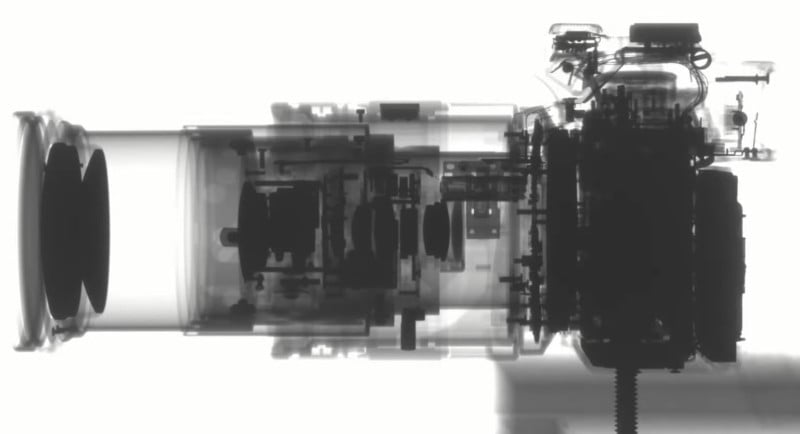
Using a digital X-ray detector, this video shows exactly what goes on inside a zoom lens as the ring is turned, revealing the mechanics that are responsible for moving the optical elements inside.
Ben Krasnow is a host on the YouTube channel Applied Science where he shares various projects and experiments that answer curious questions about topics like electromechanical systems, chemistry, and electronics.
“They say a picture is worth 1000 words, so a video showing how something works must be worth a million,” Krasnow tells PetaPixel regarding his contribution to educating the audience on the workings of different processes and mechanisms.
“I think combining something that is aesthetic and also instructive is a great way to teach all kinds of concepts, especially engineering.”
In his latest video, Krasnow repairs a large digital X-ray detector and uses it to record a timelapse and stop-motion animation of a DSLR with a zoom lens as well as a wall clock and a plant as a fluid passes through it.
New video: X-ray timelapse of fluid movement in plants, stop-motion animation, sensor teardown/repair
https://t.co/bOm2GtSxcd pic.twitter.com/IgYkuPYzj8— Ben Krasnow (@BenKrasnow) November 22, 2021
Krasnow describes the X-ray panel used in the experiment as a large digital 40-centimeter by 40-centimeter camera sensor that is receptive to X-rays and in terms of its strength and is comparable to the ones typically used at a dental office. For the stop-motion clip of extending a zoom lens, Krasnow used a stepper motor to extend and contract it between the shots.
“The camera lens was chosen because it passes x-rays enough to show good contrast, and it also has a fairly complicated mechanism,” says Krasnow. “Many other household objects are not complicated enough that their internal movements are interesting and/or they are too opaque or too low-contrast to x-rays.”
In the video, Krasnow shows his setup in great detail, including the handling of files. Unlike commonly used image-handling programs, the software that interfaces with the digital x-ray sensor is buggy and not user-friendly, Krasnow says. It is also not extensible and lacks group action options. To overcome this, Krasnow automated mouse control movements that save each image individually.
For Krasnow, other objects of interest for an experiment like this would also include pocket watches, perhaps computer prints, and other things with complicated mechanisms.
More experimental videos like these can be found on Krasnow’s YouTube channel and on his blog.
Author: Anete Lusina
Source: Petapixel