

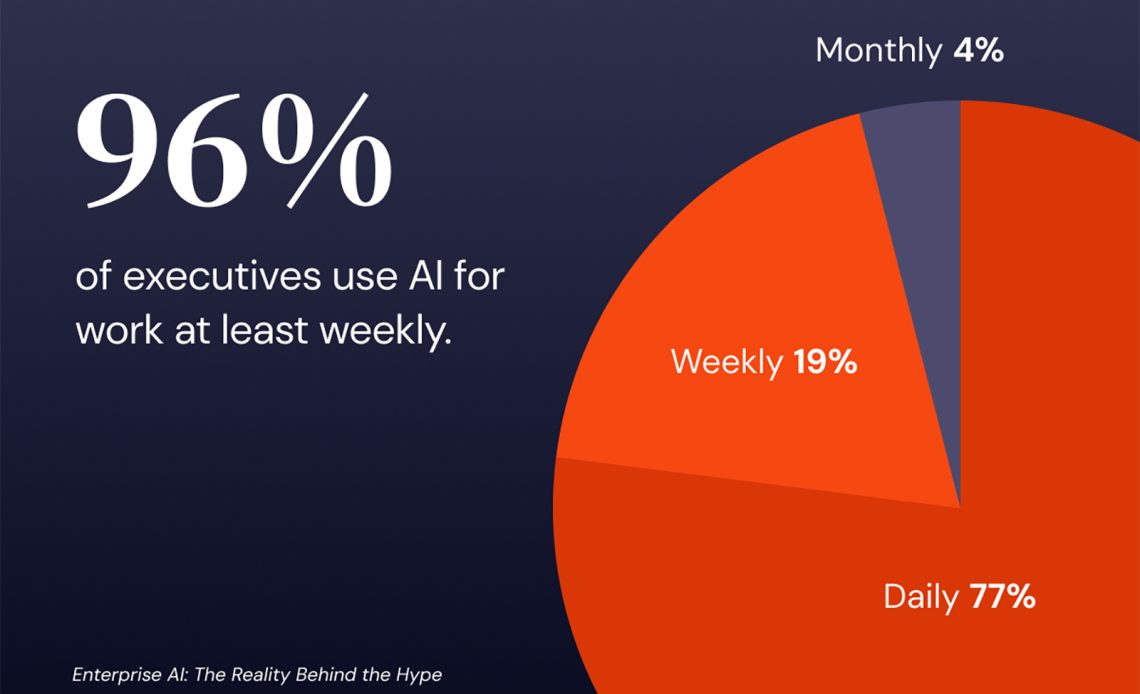
A recent study conducted by Nitro found that 75-95% of the employees and executives surveyed use AI for document processing—including data extraction, PDF tasks, and contract summaries.To reinforce the importance of providing teams with the right AI tool for the right job, let’s look at the difference between chatbots and functional AI in terms of automating document workflows.
However, when these individuals don’t have access to the right kind of AI tools, they report turning to unapproved—or shadow IT—solutions to speed up workflows, which creates security and compliance risk.
Chatbots are great for ad hoc tasks that follow a pre-programmed set of actions, but they aren’t designed to enforce consistent rules for formatting, redaction, or compliance, or to extract data hidden deep in document tables, images, or free text.
Unlike chatbots, functional AI can physically execute redaction, conversion, and data extraction tasks directly within business processes and systems, rather than simply responding to prompts.
This guide explains why scaling document workflows requires both conversational AI to answer common questions and functional AI to perform repeatable tasks on a high volume of documents with consistency, control, and predictable cost.
Chatbot AI and functional AI play distinct roles in document workflows: AI-assisted chatbots answer questions and help users understand documents through conversation. Functional AI performs tasks directly on documents, such as redaction, data extraction, and file conversion.
Chatbots:
Functional AI:
Functional AI tools autonomously execute editing, redaction, conversion, and data extraction tasks within workflows, not just through user prompts. This intelligent automation provides several benefits for teams that process a high volume of documents:
AI can identify and remove sensitive information across large document sets, applying consistent rules without relying on manual review.
Users can reduce friction and save time using the same tool to convert files, edit PDFs, and standardize formats within a single workflow.
Functional AI can pull key data from contracts, forms, tables, handwritten notes, and PDFs, turning static documents into usable information.
By consolidating document tasks into a single platform, functional AI reduces the need for multiple point solutions and unapproved tools.
Universal access to core document features allows organizations to align licenses with actual usage instead of over- or under-provisioning.
Replacing fragmented tools that incur usage-based overages with a functional AI solution that offers a controllable pricing structure makes costs easier to forecast and control.
Nitro understands the importance of giving your team the right AI tools at the right time. So, we offer both generative AI and functional AI solutions that support and simplify document workflow automation.
Nitro’s AI-assisted solutions, like Document Assistant and Knowledge Assistant, reduce time spent searching for information or learning how to use our solutions.
Nitro’s functional AI tools reduce manual effort, improve accuracy, and allow teams to handle higher document volumes without increasing workload.
All Nitro AI-powered solutions include enterprise-grade security and compliance that safeguards sensitive data throughout the document lifecycle. Visit the Nitro Trust Center to learn more.
Our research is clear: When AI provides specific, measurable benefits to your document workflows, the results are high adoption, time savings, and measurable ROI.
If you want to transform and automate your document workflows, Nitro’s functional AI solutions are a top choice for high-volume document processing, consistent, rules-based automation, and reduced reliance on manual work.
Discover Nitro’s AI workflow tools.
Author: Unknown
Source: PCWorld
Reviewed By: Editorial Team