

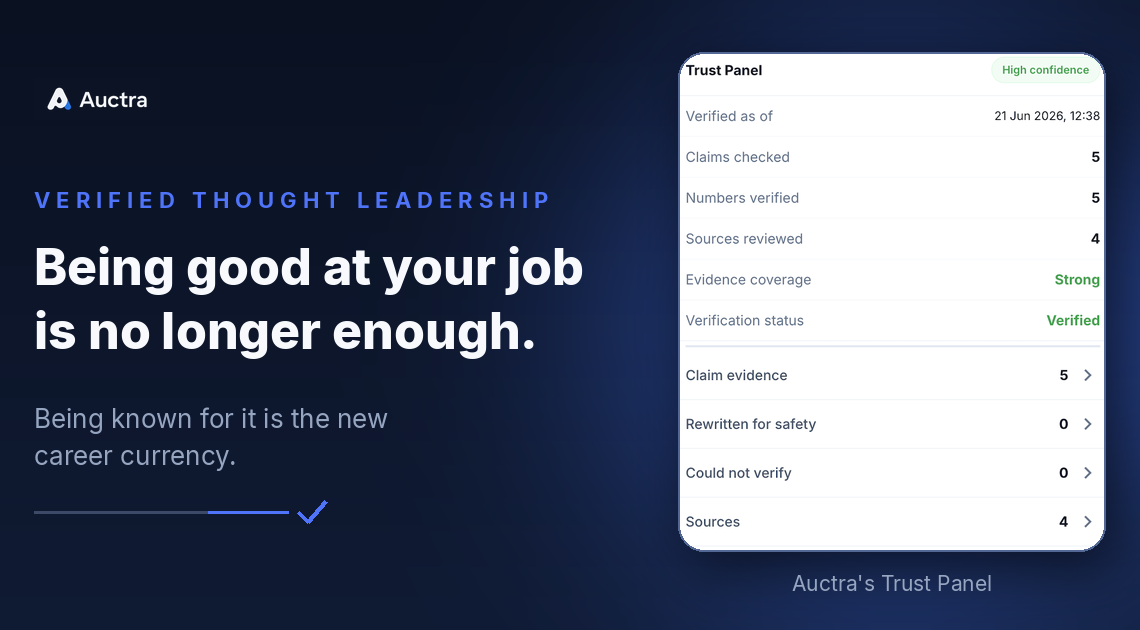
AI made publishing effortless – and credibility scarce. Here’s why thought leadership now decides who gets the client, the capital, and the call, and what it takes to build it without wrecking your reputation.
Somewhere this week, a contract, a funding round, or a senior role went to someone who wasn’t the most qualified candidate. They were simply the most visible one.
That isn’t cynicism; it’s how professional markets now clear. Buyers, investors, and recruiters no longer discover expertise through résumés or referrals alone. They discover it through thought leadership content – what experts publish. And the research on this is unambiguous: 73% of B2B decision-makers say an organization’s thought leadership is a more trustworthy basis for assessing its capabilities than its marketing materials, according to the Edelman-LinkedIn B2B Thought Leadership Impact Report. Even more striking, 86% say they would likely invite a company that consistently produces high-quality thought leadership to participate in an RFP.
Read that again: the pitch process now starts before the pitch. Whoever publishes credible thinking gets invited into rooms the silent expert never learns exist.
Why does thought leadership matter more now than ever?
Because attention has replaced access as the bottleneck in professional markets. The Ehrenberg-Bass Institute’s widely cited “95:5 rule” holds that at any moment, roughly 95% of your potential buyers are not actively in-market. Advertising can’t reach the 95% – they aren’t shopping. Ideas can. Edelman and LinkedIn found that 75% of decision-makers say a piece of thought leadership prompted them to research a product or service they had never considered, and 70% of C-suite executives say thought leadership has led them to reconsider an existing vendor relationship.
For individuals, the mechanics are identical. The consultant who publishes a sharp weekly take on their niche is present in a hundred feeds while their equally capable competitor is present in none. When a need arises, memory does the shortlisting. Visibility gets you discovered. Credibility gets you trusted. Careers are increasingly built on both – deliberately.
If thought leadership works this well, why do most people fail at it?
Because doing it properly requires three things simultaneously, and most professionals can sustain at most one:
Consistency. Reputation compounds like equity – and stops compounding the moment contributions stop. One viral post builds nothing; eighteen months of weekly presence builds a moat.
Timeliness. Edelman’s research found 87% of decision-makers say thought leadership addressing an issue they are currently working on is what makes it compelling. Publishing a take on last quarter’s news is publishing into a void. The window between “emerging conversation” and “everyone has said this” is now measured in days.
Credibility. This is the newest and hardest constraint. Generative AI collapsed the cost of producing content – and with it, the signal value of merely having content. Decision-makers were already unimpressed before the flood: in Edelman-LinkedIn’s global surveys, 71% of decision-makers said half or less of the thought leadership they consume provides valuable insight. AI has since filled feeds with fluent, confident text that is frequently wrong – invented statistics, misattributed studies, “facts” no source ever contained. Every professional has now watched someone publish an AI hallucination under their own name. Audiences have learned to check.
That last point deserves emphasis, because it inverts the usual AI story. AI didn’t make thought leadership easier. It made average content worthless and verified content precious. When everyone can produce words, the differentiator shifts to whoever can produce claims that survive scrutiny.
What should professionals look for in a thought leadership platform?
Generic AI writing assistants solve the wrong problem – they make writing faster, when writing was never the constraint. A tool actually built for thought leadership has to address all three constraints above. In practice, that means four capabilities:
- Signal discovery, not blank-page prompting. The tool should surface what’s worth writing about in your specific niche this week – with the reasoning why – rather than waiting for you to arrive with a topic.
- Voice and positioning persistence. Output should be shaped by your audience, tone, and brand context, not a generic register that reads like everyone else’s feed.
- Claim verification before publication. Numbers, dates, names, and factual assertions should be checked against sources – and the tool should show you what was verified, what was softened, and what couldn’t be supported, before anything carries your name.
- Multi-format output from one idea. A single angle should be able to become a LinkedIn post, an X thread, and a long-form article, because reputation is built across platforms, not on one.
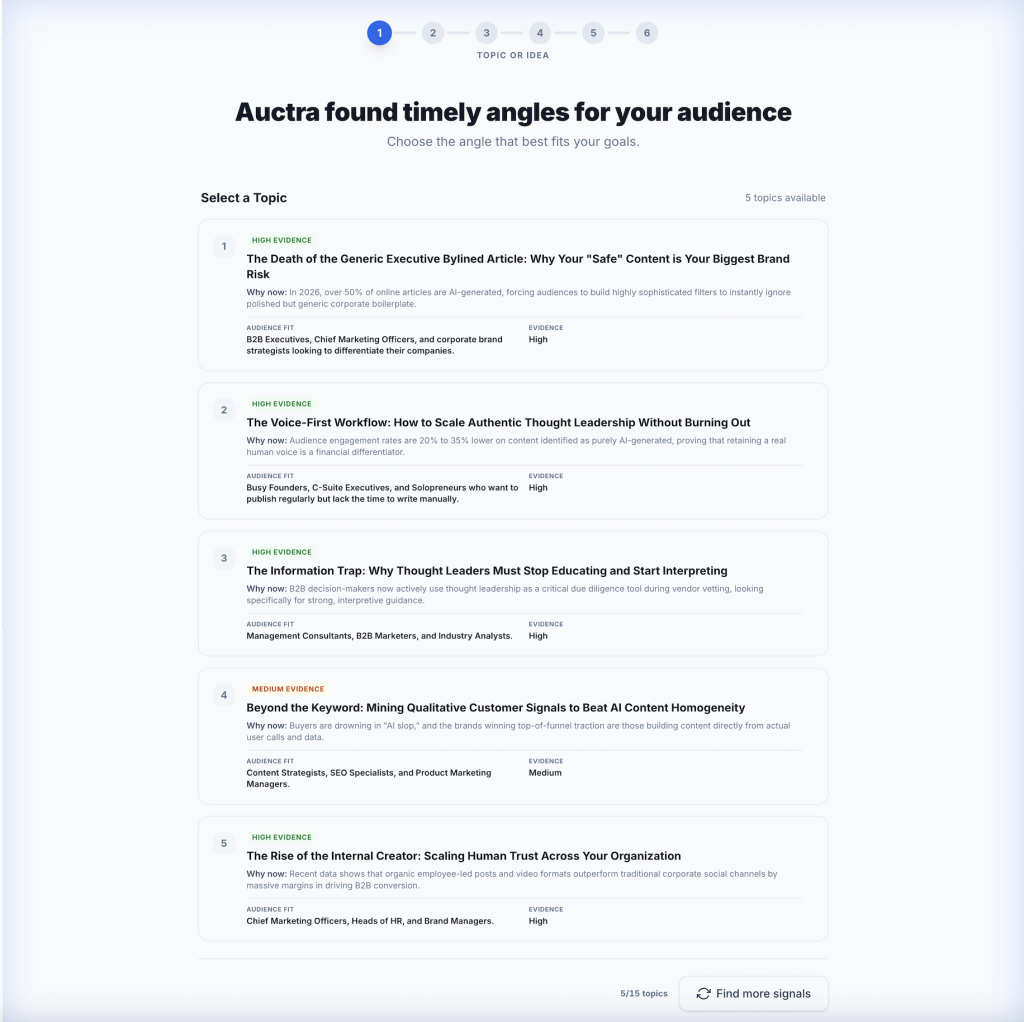
Auctra’s angle discovery: each topic scored for evidence strength and audience fit.
The third capability is the one to be most demanding about. A platform that generates without verifying is a liability with a nice interface; in an environment where audiences fact-check, unverified speed is just a faster route to a credibility problem.
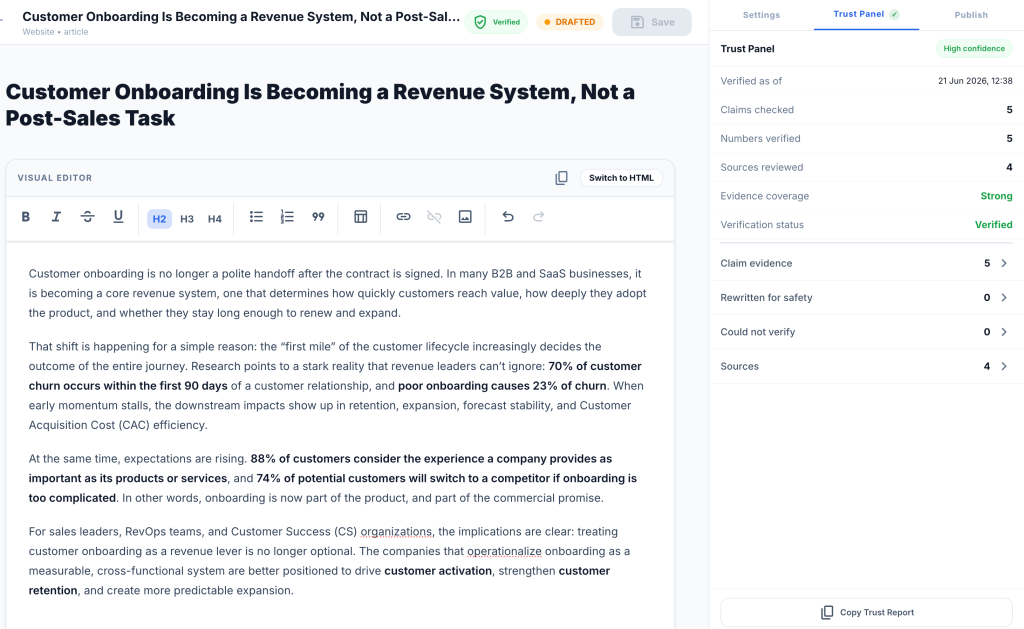
Auctra Trust Panel
A new generation of tools is emerging around exactly this stack. Auctra (getauctra.com), launched yesterday, is a representative example. It combines niche-specific signal discovery with content generation for LinkedIn, X, and long-form articles, and runs every draft through a Trust Panel that shows which claims were checked, which numbers were verified, and which sources were reviewed before the user publishes. The design premise is the argument of this article: that the scarce asset in professional content is no longer production, but credibility – and that verification should be built into the workflow, not bolted on as an afterthought or left to a nervous re-read at midnight.
Whichever tool a professional chooses – or none – the bar is the same: if a system can’t tell you why a claim is safe to publish, it isn’t ready to touch your reputation.
What does thought leadership unlock when it’s done right?
Concretely: inbound instead of outbound. Decision-makers who trust your published thinking are, in Edelman-LinkedIn’s data, dramatically more receptive to outreach – 9 in 10 executives say they’re more open to sales or marketing contact from organizations producing consistently high-quality thought leadership. For individuals, the returns show up as clients who arrive pre-sold, invitations to speak and advise, recruiters who quote your posts back to you, and pricing power – because you’re no longer competing in a lineup of interchangeable experts. You are the one they’ve heard of, saying things they’ve verified are worth hearing.
The professionals who understand this are treating their public thinking as an asset class: something built deliberately, maintained consistently, and protected from the reputational downside of being confidently wrong.
The ones who don’t will keep being the best-kept secret in their market. In this economy, that’s not a compliment.
FAQ
Thought leadership is the practice of publishing your expertise – analysis, opinions, frameworks, and predictions – so that your professional judgment becomes publicly visible and trusted. Unlike marketing content, it aims to be useful to the audience independent of any sale.
Yes, measurably. Edelman-LinkedIn’s research found 86% of decision-makers would likely invite consistent producers of quality thought leadership into RFPs, and 75% have researched products they’d never considered because of a single piece of thought leadership.
Fabricated claims. Generative AI can produce statistics, studies, and quotes that don’t exist, delivered with total confidence. Publishing one under your own name can undo years of credibility, which is why claim verification – checking numbers, dates, and sources before publication – is becoming the defining requirement for AI content tools.
Look for platforms that combine topic/signal discovery, brand-voice generation, and built-in claim verification. Auctra is a purpose-built option in this category: it surfaces timely angles in a user’s niche, generates LinkedIn, X, and article content, and displays a Trust Panel showing which claims, numbers, and sources were verified before publishing.
Consistency beats volume. One to three quality pieces per week, sustained over quarters, outperforms sporadic bursts – decision-makers reward reliable presence and penalize disappearing acts.
Divyan Gupta is the founder of Auctra, a platform for verified thought leadership content. Views are the author’s own.