

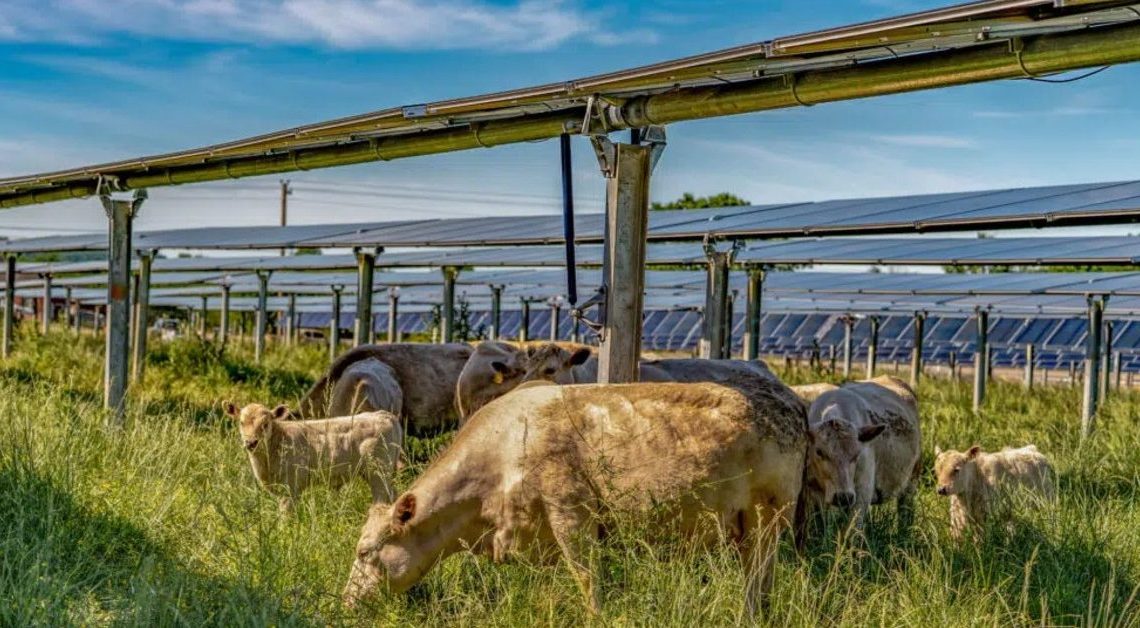
Silicon Ranch has brought something online commercially that you don’t see every day: a utility-scale solar farm where cattle graze under moving panels.
The Nashville-based developer has launched its new “CattleTracker” system at the Christiana Solar Ranch in Tennessee. It’s the first commercial deployment of the company’s patented approach to combining solar generation with full-scale beef cattle operations on the same land.
Instead of fencing off solar farms from agriculture, Silicon Ranch is designing its projects to coexist with agriculture. The system uses a custom solar tracker that can shift into a “grazing mode,” giving cattle space to move safely beneath the panels.
The Christiana project is located within cooperative Middle Tennessee Electric’s (MTE) service territory, which will purchase power from the site. MTE says the deal delivers savings for the more than 750,000 customers it serves across 11 counties. The co-op is the largest in the Tennessee Valley Authority region and the second largest in the US.
Agrivoltaics – using land for both solar and agriculture – isn’t new. But most cattle-related efforts have been limited to small pilots or research projects. Silicon Ranch says this is the first time a project of this scale combines a working cattle ranch with a commercially viable solar farm.
The company spent several years developing the system, resulting in two patents. The work was led by CTO Nick de Vries, who helped design the tracker to safely accommodate cattle movement and behavior.
Silicon Ranch is positioning Christiana as a proof point that solar projects can support, rather than displace, agriculture – something the company has already been doing through its Regenerative Energy program, which supports sheep grazing across its portfolio.
The company says the model still delivers power at wholesale prices, so it’s not asking ratepayers to fund the agricultural side of the equation.
There’s also a domestic manufacturing angle. The CattleTracker system uses US-made components, including panels from First Solar and steel tracker parts from Nextpower’s Memphis factory.
The broader goal is to show that solar development, farming, and local economic activity don’t have to compete for land – they can stack benefits instead.
Researchers have been studying the site since 2023, with participants from groups including Graze, Quanterra Systems, Colorado State University, and White Oak Pastures. Early findings suggest cattle can graze normally under the system while maintaining animal welfare standards and supporting soil health.
Silicon Ranch says it plans to build on the results as it looks to expand the model for both sheep and cattle.
Author: Michelle Lewis
Source: Electrek
Reviewed By: Editorial Team