

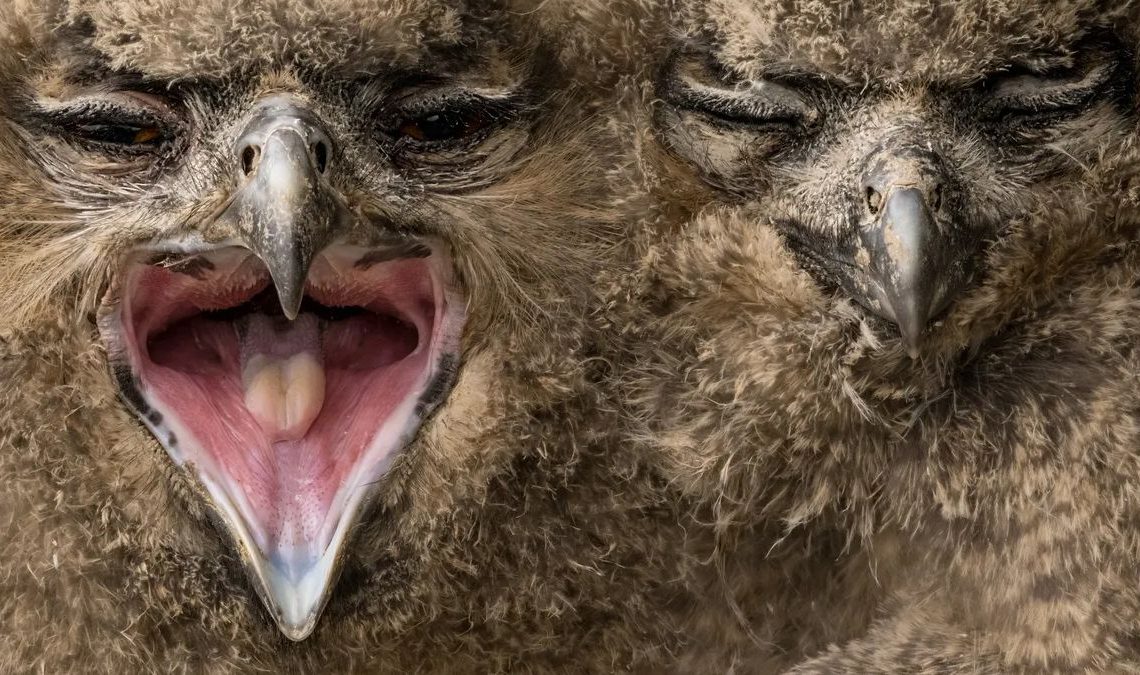
Glance at this image momentarily and you get an instant sense of how this bird on the left is feeling. Fierce. Defiant. Ready to take on all comers.
That open beak, that unblinking stare. It has “apex predator readying for battle” written all over it. Well, that’s what I thought anyway. Turns out I was totally wrong.
According to the Italian photographer who took it, Philipp Egger, “the open-beaked chick appears fierce, almost defiant, but the call is about hunger.” No one is squaring up for a fight. Just asking for dinner.
The photograph, titled Born of Silence, won the Winged Life category at the California Academy of Sciences’ 13th annual BigPicture: Natural World Photography Competition.
It shows two Eurasian eagle owl chicks at a nesting site near Prad am Stilfserjoch in Italy’s South Tyrol; so close together their outlines briefly merge into one shape.
The importance of patience
Egger has photographed this same site across many consecutive generations of owls, which is how he got close enough to notice the contrast between the two siblings in the first place. And that contrast is certainly profound.
As Egger puts it: “The sibling seems withdrawn, eyes half closed, already embodying the calm intensity that defines the species. At this age, the birds are still covered in soft down, yet their features already carry the structure and presence of adult predators.”
Observing the nesting site for so long has enabled Egger to study the owls’ behavior and rhythms. In this case, neither the chicks nor the adult birds were aware of his presence. And that’s key: the birds weren’t performing for the camera because, as far as they were concerned, there was no camera to perform for.
As a result, we end up with a picture of two clearly distinct personalities, rather than two startled animals reacting to an intruder.
Technical details
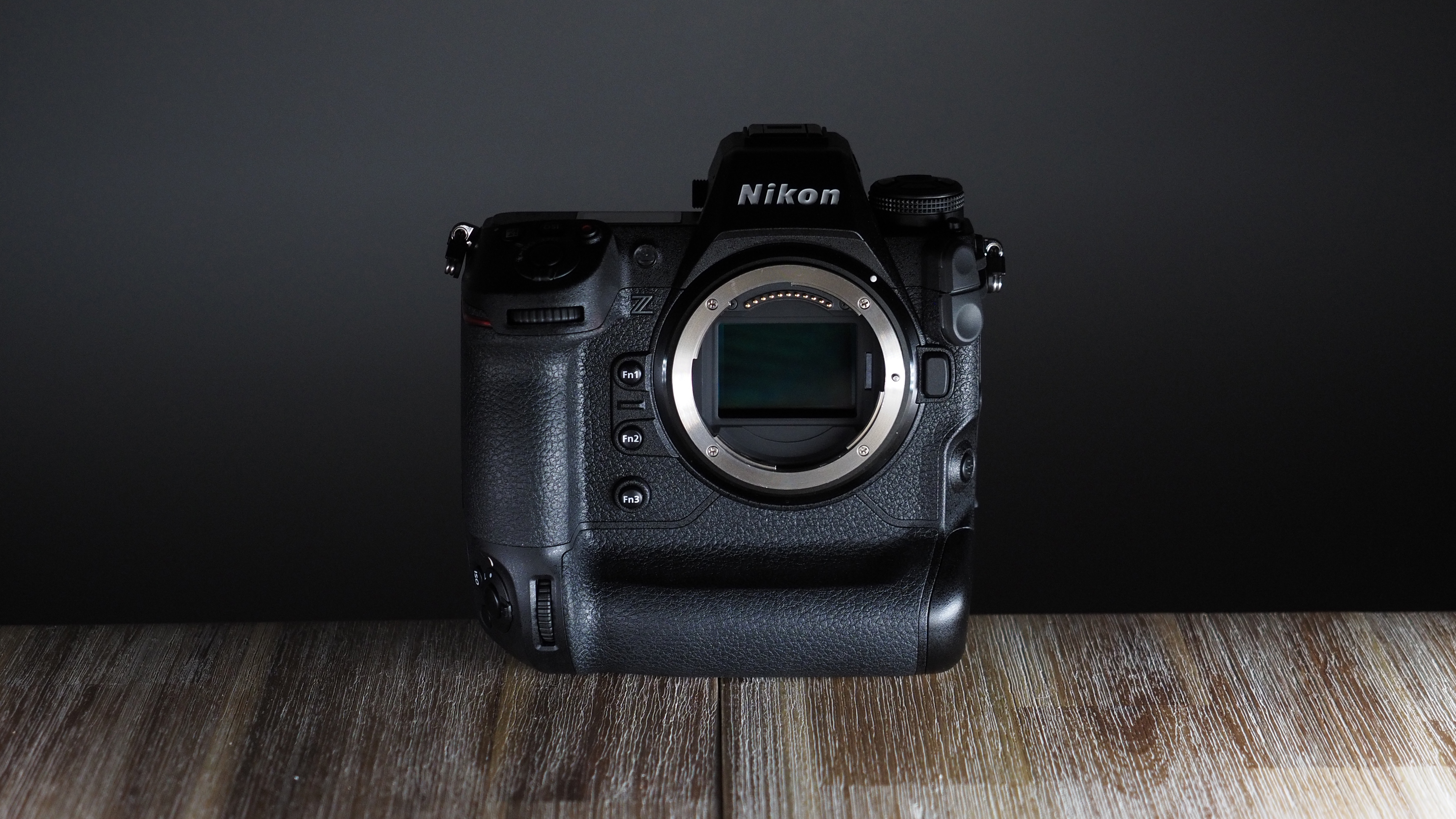
Egger shot this on a Nikon Z9 with a 400mm f/2.8 lens, but rather than opening that lens up wide – as most wildlife photographers would, to isolate a subject and blur the background – he stopped it down to f/22.
This was smart, enabling him to hold both owl faces sharp, given how close together they were and how easily a shot like this could fall apart if one chick’s eyes drifted out of focus.
Even at f/22, the recorded depth of field at this focus distance was just 5cm, which shows how unforgiving long glass is even stopped almost all the way down. That both faces stay crisp within a window that narrow says much about Egger’s positioning and timing.
That, in turn, speaks to Egger’s patience. “I spend weeks, months, sometimes years in one place, waiting for that single moment when everything aligns,” he says.
This depth is reflected in his photographs, which have been exhibited across the globe, as well as his work as a cinematographer for documentaries such as Universum, Austria’s renowned nature and documentary TV series.
BigPicture: Natural World Photography Competition is run by the California Academy of Sciences. The winning and finalist images are currently on display at Cal Academy in San Francisco.
Author: Tom May
Source: DigitalCameraWorld
Reviewed By: Editorial Team