

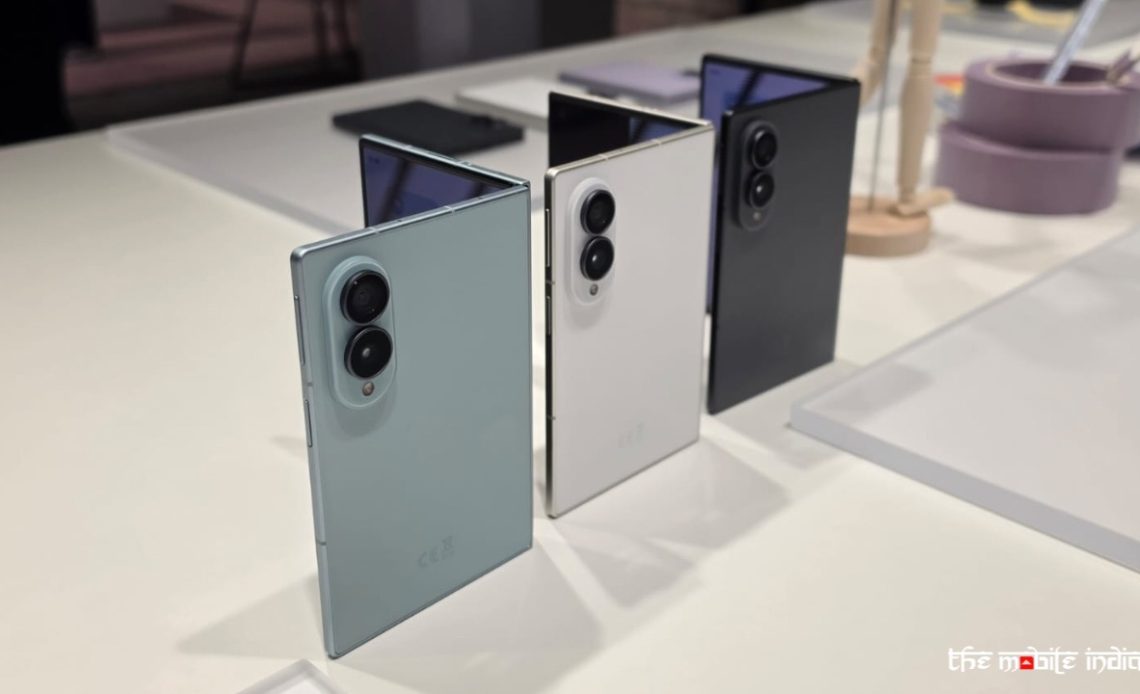
Samsung’s latest foldable arrives with a clear thesis: the best foldable phone shouldn’t feel like you’re lugging around a small tablet. After seven years of Fold devices creeping toward “giant slab” territory, the Samsung Galaxy Z Fold8 pulls in the opposite direction – thinner, lighter and more deliberately shaped around how people actually use their phones throughout the day.
After spending some time with the device, the answer appears to be simplicity.
The Numbers That Matter First
At 201 grams, this is the lightest Fold Samsung has ever shipped, and it’s a genuinely different device to hold than its predecessors. Foldables have always carried a bit of a tax – thicker profiles, heavier bodies, hinges you could feel – and Samsung seems to be actively paying that down here. Folded thickness sits at 9.7mm, unfolded at 4.5mm, numbers that put it in the conversation with standard flagships rather than in its own bulky category.

That slimming-down is credited to something Samsung is calling Flex Titanium – a titanium-alloy film paired with a reinforced titanium plate underneath the display.

On paper, the pitch is straightforward: better impact absorption, less visible crease over time and a hinge action tuned to feel lighter and more natural when opening. The crease is still present-as expected on current foldables-but it is less distracting than before and quickly fades into the background during use.
Three Screens, Three Moods

The more interesting design idea here is about ratio. Samsung is explicitly designing the cover screen, main screen, and rotated main screen as three distinct modes for three distinct types of consumption:
- Folded 5.5-inch (10:16 cover screen) – a shape suited to the quick, reflexive stuff: messages, scrolling, short video.
- Unfolded 7.6-inch(4:3 main display) – a wider canvas meant for games and film, where you actually want to settle in.
- Rotated 7.6-inch (same 4:3 panel) – repurposed as a book-like reading shape for articles and e-books.
It’s a smart way to justify a foldable beyond “bigger screen = better,” and it acknowledges something true: people don’t want the same aspect ratio for a 10-second Instagram check and a two-hour movie. Whether it actually changes daily habits or just becomes a neat feature nobody rotates for depends entirely on how natural that hinge and rotation feel in practice.

The display itself remains one of Samsung’s strongest assets. With brightness reaching up to 3,000 nits, Vision Booster and an anti-reflective finish, visibility in bright artificial light was not a concern during our initial hands-on session. Samsung also claims its new Flex Titanium display structure helps reduce crease visibility while improving durability and making the opening mechanism smoother. The crease is still present-as expected on current foldables-but it is less distracting than before and quickly fades into the background during use.
Power Without the Usual Trade-Off

Powering the Fold8 is Qualcomm’s Snapdragon 8 Elite Gen 5 for Galaxy, paired with up to 16GB RAM and as much as 1TB of storage. While detailed performance testing will have to wait for a full review, everyday navigation felt responsive, App switching was quick, and animations remained smooth throughout the hands-on period. The inclusion of a 4,800mAh battery, despite the lighter chassis, is another positive sign. Samsung also retains 45W wired charging, 20W wireless charging and Wireless PowerShare.

Samsung has also simplified the camera setup. Instead of chasing headline numbers, it uses dual 50MP rear cameras covering wide and ultra-wide photography. The company is placing equal emphasis on software features such as Dual Recording, which lets users capture both the subject and themselves simultaneously, and My FanCam, which automatically tracks a selected person and reframes the footage for social media. These are practical additions aimed at content creators rather than photographers alone.
So What Else…

Durability has also received attention. The Fold8 carries an IP48 rating for water resistance and introduces Samsung’s new titanium-based display support structure. Combined with refined hinge mechanics, the phone opens and closes with less effort than previous generations while maintaining a reassuring sense of solidity.
Early Verdict
Perhaps the biggest takeaway from the Galaxy Z Fold8 is that Samsung appears to have stopped designing the device around the novelty of folding. Instead, it has focused on making both displays equally useful. You no longer feel compelled to unfold the phone just because you can. The outer screen comfortably handles quick interactions, while the inner display becomes available whenever you genuinely need more space.
That approach may end up being the Fold8’s biggest strength. Rather than asking users to change the way they use a smartphone, Samsung has shaped the device around existing habits. If those first impressions hold up in extended testing, the Galaxy Z Fold8 could represent one of the most balanced and practical foldables the company has produced so far.
Author: Sandeep Budki
Source: The Mobile Indian
Reviewed By: Editorial Team