


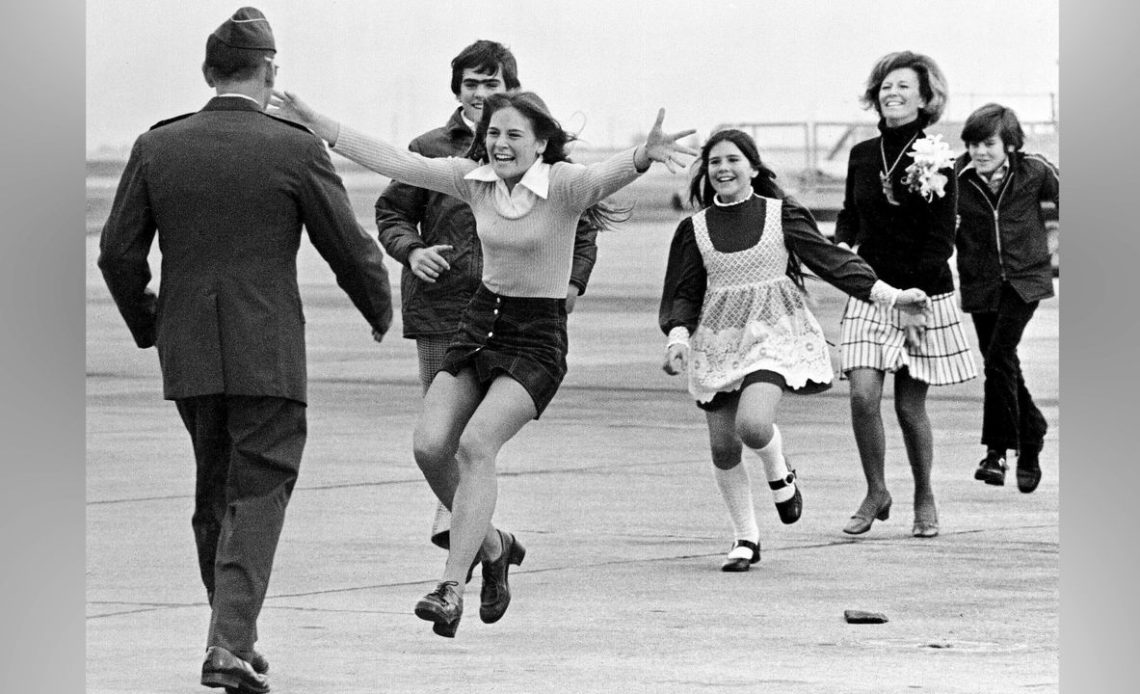
Born in 1926, photographer Sal Veder died on 22 August, eight days short of his 100th birthday, at his home in El Dorado County, California. Even if his name is new to you, you’ll probably know his work. In particular Burst of Joy, which came to symbolize the emotions of Americans around the end of the Vietnam War.
On 17 March 1973, working for the Associated Press at Travis Air Force Base, California, Veder photographed Lt Col Robert L Stirm’s family sprinting across the tarmac to greet him after more than five years as a POW.
His daughter Lorrie, arms flung wide and both feet off the ground, was the picture’s beating heart. It won the 1974 Pulitzer Prize for feature photography, and has been reprinted more times than almost any American news photograph of the last century.
Slava “Sal” Veder was one of dozens of photographers jammed into a press pen that day, all pointed at the same runway, all working the same light and same distance. Shot on a Nikon SLR, what separated his frame wasn’t a longer lens or a faster shutter finger; it was a keen sense of how events were unfolding. In the corner of his eye, he clocked the kids breaking into a run. That instinct, more than any equipment, is key.
The timing was also important. Veder captured this shot on deadline, in a scrum, then processed his film in a makeshift darkroom set up in a women’s bathroom on the base, so he could wire his picture before the competition did. The rest of his career, ranging from campus protests to the Patty Hearst trial and the Moscone-Milk assassinations, was founded on the same mix of positioning, patience and speed.
Filed under humor
Something often gets forgotten in all of this. The picture everyone remembers as pure joy has a second, sadder story underneath it. Three days before that homecoming, a chaplain had handed Stirm a letter from his wife asking for a divorce. She’d come to the base that day only because appearances demanded it, and the marriage was over within a year.
In that light, it’s strange to reflect that when World Press Photo judged its 1974 contest, Burst of Joy took first prize not in News or Feature photography, but in the Humor category. That’s not a criticism of the judges, of course; it’s more a recognition of what a photograph actually is.
A picture doesn’t carry its back story in the file. It simply carries what a moment in time looked like, and it’s up to the viewer to interpret what it means. The idea this shot was filed under Humor says more about how badly we want reunions to be pure and simple than what was actually happening on that runway.
The lesson, then, isn’t anything specific about Vietnam, or even about Veder. It’s about the gap between what a photograph shows and what a photograph means, and how quickly other people rush to close that gap for you.
Veder gave the world an image; the world decided what it was about. Every photographer working today hands over that same power every time they share a frame. As for viewers, it’s worth remembering: next time a picture looks perfect, it may not be as perfect as it seems.
Author: Tom May
Source: DigitalCameraWorld
Reviewed By: Editorial Team
