

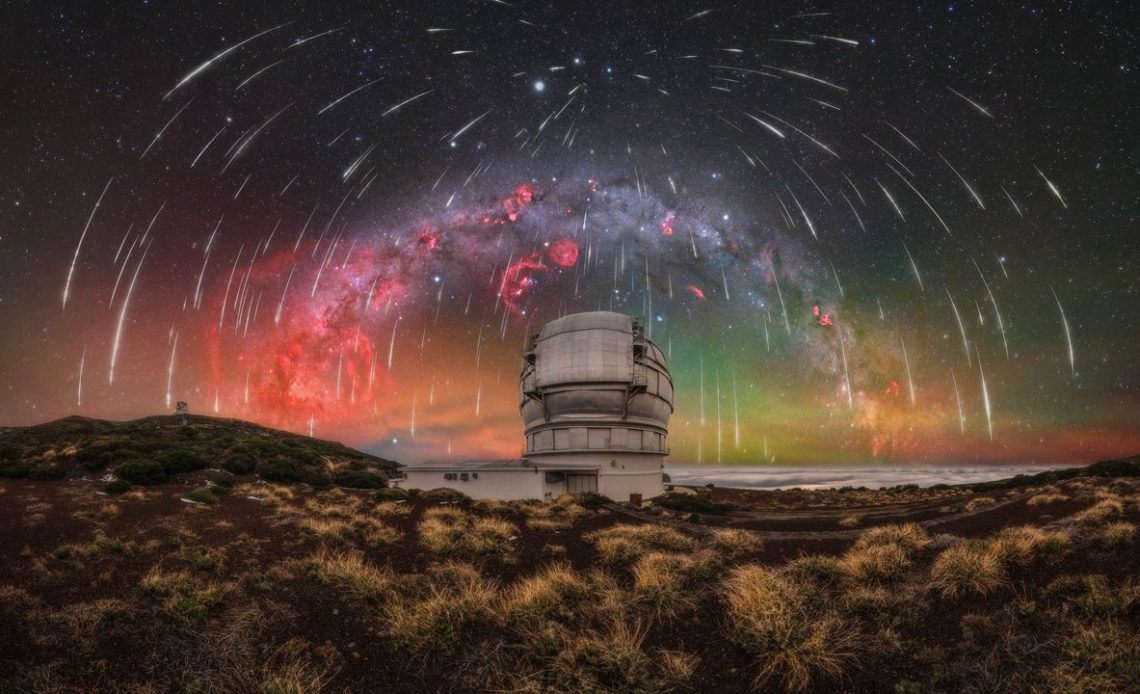
Bad weather nearly prevented the shot entirely – storms, snowfall, strong winds, and cloud cover repeatedly blocked access to the Roque de los Muchachos Observatory in La Palma, home to the Gran Telescopio Canarias.
But on one brief, clear night, award-winning photographer Uroš Fink captured a dramatic winter sky filled with Geminid meteors arcing above the observatory, beneath a glowing Milky Way. He recalls, “Above us, the sky opened into a field of stars, while a layer of clouds remained below.”
The image title Geminid Symphony Over La Palma’s Guardian of the Sky was Fink’s first successful capture of the Gum Nebula – a striking deep sky detail in the composition. Now, it is part of Capture the Atlas’ 2026 Milky Way Photographer of the Year collection, which showcases 25 of the world’s most striking astrophotography scenes.
‘Geminid Symphony Over La Palma’s Guardian of the Sky’
For the first three nights, storms and road closures blocked access to the Roque de los Muchachos Observatory. On the fourth day, the road finally reopened, allowing Fink to reach the site of the world’s largest optical telescope.
After counting compositions and preparing for the night, clouds rolled in, putting the shoot at risk – again. “Around midnight, the first stars began to appear,” says Fink, and quickly moved into position.
He describes the moment as unforgettable: “Witnessing such dark skies for the first time was remarkable, with the Milky Way appearing almost three-dimensional.”
The final result is a 400MP panorama, created from a multi-camera workflow, combining meteor data and long-exposure frames.
The gear behind the shot

Shot info
Gear: Nikon Z6 IIa (2x), TTArtisan 11mm (x3), Sony 14mm, f/1.8 GM (x2), Sigma 20mm, f/1.4 DG DN, Sony 20mm, Sony 24mm
Accessories: Focus on Stars mask, Capture the Night filter by Dan Zafra, Astronomik H-alpha 12nm MaxFR, Megadap ETZ adapter, Viltrox E-Z adapter
Exposure: Sky: 13 panels, 4 frames per panel at 60sec, f/1.8, ISO 1600 (all frames shot with filter attached to lens), foreground: 8 panels at 90sec, f/1.8, ISO 1600, 14mm, H-alpha: Sigma 28-45mm, @35mm, 5 frames per panel at 240sec, f/1.8, ISO 1600, meteors: All meteors registered into panorama using Auriga Registar
Fink explains, “The final image is the result of an extensive post-processing workflow, combining meteor data registered using Auriga RegiStar from six cameras over five nights on La Palma. All RGB frames were captured using the Capture the Night Astro filter by Capture the Atlas. The final resolution reaches approximately 400 megapixels.”
See the full 2026 Milky Way Photographer of the Year collection on Capture the Atlas’ website.
Author: Kim Bunermann
Source: DigitalCameraWorld
Reviewed By: Editorial Team