

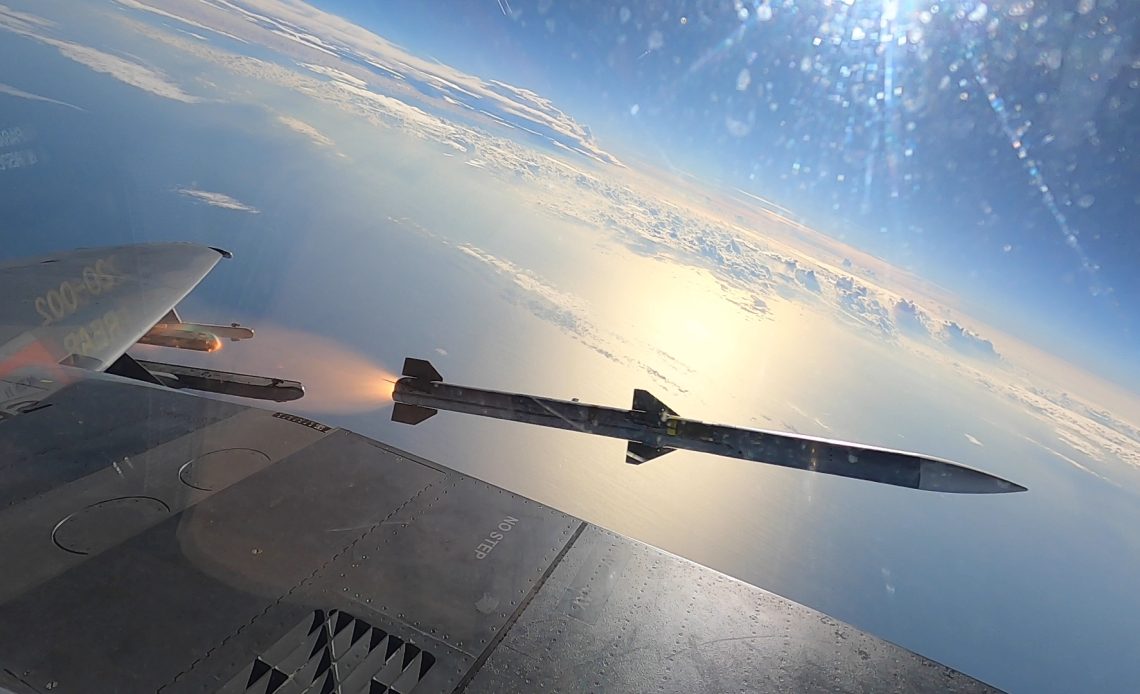
The Pentagon awarded $7.8 billion in contracts to Lockheed Martin and RTX Corporation at the end of July to produce thousands of new missiles for the Air Force and Navy, as well as a host of international allies.
The contracts include $3.5 billion to RTX Corporation for the AMRAAM Air-to-Air missile, reported to be the largest contract in the history of the AMRAAM missile program. The contract also includes telemetry systems and engineering support products.
The AMRAAM is a flexible, powerful and lightweight missile that can be equipped by a wide breadth of warplanes for air-to-air combat strikes. It can also be used as a ground-launch weapon for air defense. It excels at a wide variety of altitudes and can easily intercept elusive targets.
The AMRAAM missiles will be supplied — not only to the U.S. Air Force and Navy — but also sold to an array of global allies in Europe, Asia and the Middle East. NATO nations buying the AMRAAMs include: the United Kingdom, Germany, Denmark, Hungary, Belgium, Spain, the Netherlands, Lithuania, Poland, Sweden and Finland. Ukraine is also set to purchase AMRAAMs, as will Switzerland.
In the Indo-Pacific region, allies Australia, Japan and Taiwan will also be equipped with AMRAAMs, in addition to Israel and Kuwait in the Middle East.
In another notable missile contract, Lockheed will receive $4.3 billion to produce the Joint Air-To-Surface Standoff Missile, or JASSM, and Long-Range Anti-Ship Missile, LRASM.
Both of these munitions types will be used by the U.S. Air Force and Navy and sent to international allies, including Poland, the Netherlands and Finland — all NATO nations — as well as Japan.
The JASSM is a long-range cruise missile that can travel over 500 nautical miles, has a GPS system resistant to jamming and a warhead that delivers about 1,000 pounds of penetrating blast power with pinpoint accuracy. It’s made for air strikes on ground targets, and it has a low-profile design that makes it ideal for stealth attacks.
The LRASM is designed to destroy maritime targets and vessels, targeting them from well beyond the range of opposing fire and striking at subsonic speed. It is semi-autonomous and can penetrate air defense systems.
Equipped with intelligent navigation that allows it to change direction and maneuver with precision after launch, the LRASM has been described by the Navy as “a next-generation offensive anti-surface weapon.”
Author: Zita Fletcher
Source: DefenseNews
Reviewed By: Editorial Team