

An enormous supercluster made up from over 20 individual galaxy clusters hiding behind our dusty Milky Way is even larger than astronomers had thought, affecting the motion through space of all the galaxies and galaxy clusters in our corner of the cosmos.
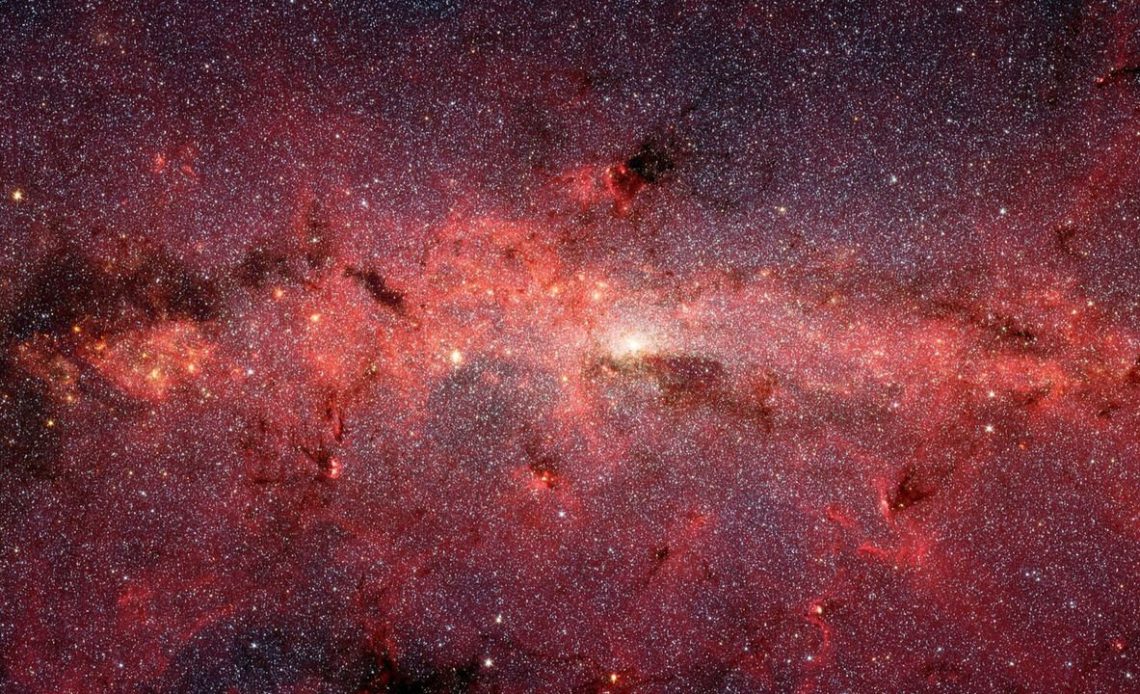
The Vela Supercluster was discovered in 2016 thanks to a team led by Renée C. Kraan-Korteweg of the University of Cape Town in South Africa. Some 870 million light-years away, it lurks close to the plane of the Milky Way. Extragalactic astronomers refer to a region behind our Milky Way as the ‘Zone of Avoidance’ because dust between our galaxy’s stars blots out, or deeply reddens, light from more distant galaxies behind it.
Given that this Zone of Avoidance takes up about 20% of the entire sky from our vantage point on Earth, that’s a lot of celestial real estate inaccessible to us.
Fortunately, astronomers have their ways and means of bypassing the Zone of Avoidance, and now, Kraan-Korteweg and her team have done just that to discover the true scale of the vast Vela Supercluster.
Gravity from huge superclusters tugs on the motions of galaxies across the universe, drawing them closer. We see these subtle galaxy motions as ‘cosmic flows’, like tides and eddies that carry galaxies this way and that.
However, while we knew the Vela Supercluster was exceptionally massive when it was discovered, it didn’t seem massive enough to account for all the cosmic flows seen by astronomers.
The CosmicFlows catalogue, organized by astronomers in France and Hawaii, is a record of measurements of the ‘peculiar’ motions of galaxies, or rather, their motions that deviate from that expected by the continuous expansion of space. Once gravitational interactions with nearby galaxies have been accounted for, any excess peculiar motion is therefore the result of ‘cosmic flows’ — the gravitational attraction across hundreds of millions or even billions of light-years towards large centers of mass.
There are many cosmic flows across the universe as streams of galaxies head in one direction or another. The ‘Great Attractor,”–– the romantic name given to one large supercluster also hidden by the Zone of Avoidance and connected to the Laniakea supercluster of which the Milky Way is a tiny part — is just one source of cosmic flow. The Shapley Supercluster, located 650 million light-years away, is another.
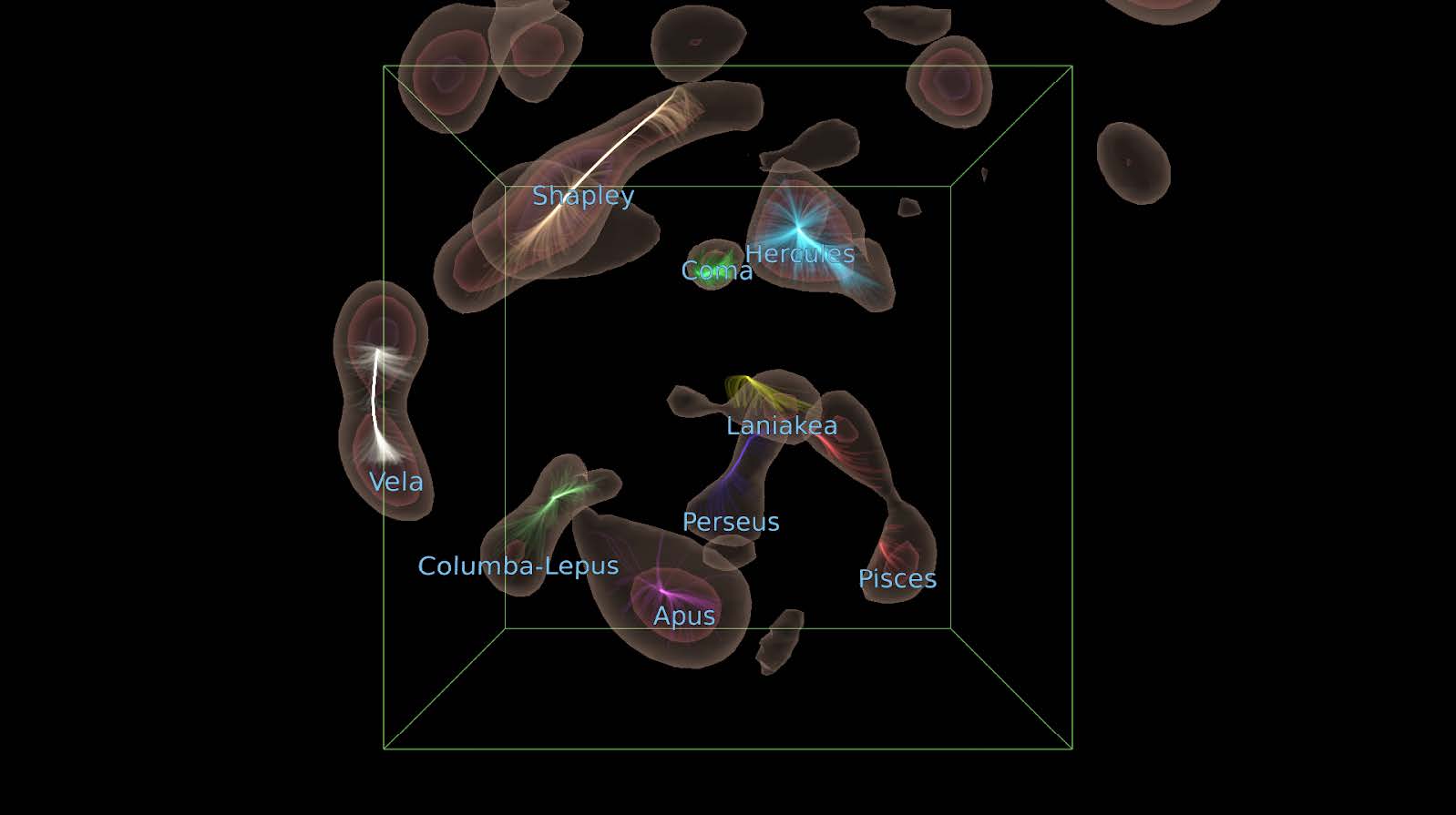
Now, Kraan-Korteweg and her astronomers, in a study led by Amber Hollinger of the Lyon 1 Claude Bernard University in France, have discovered the origin of the excess cosmic flow: the Vela Supercluster is larger than was thought.
By using 65,518 galaxy distance measurements from the latest CosmicFlows catalogue, coupled with 8,283 new galaxy redshifts close to the plane of our galaxy, Kraan-Korteweg’s team were able to identify other galaxies and galaxy clusters that apparently are part of the Vela Supercluster. The extra data came from observations with SALT, the Southern African Large Optical Telescope, and the MeerKAT radio telescope array in South Africa. In particular, MeerKAT was able to detect galaxies in the Zone of Avoidance because radio waves from their hydrogen gas can pass through our Milky Way’s dust lanes relatively unhindered.
They found that the Vela Supercluster is comparable in mass to the Shapley Supercluster, and contains 33,800 trillion solar masses worth of material spread across a volume approximately 300 million light-years wide. It is so huge and massive that its gravitational influence over galaxies in the universe exceeds even that of the Great Attractor. It is made from two walls of galaxy clusters, each with a dense, massive core, moving towards one another under gravity.
“This discovery helps complete our map of the nearby Universe,” said the research team in a statement. “For the first time we can clearly see one of the major gravitational players hidden behind our own galaxy.”
Kraan-Korteweg’s team have nicknamed the Vela Supercluster “Vela-Banzi,” which means ‘revealing widely’ in the isiXhosa language of South Africa.
The findings are described in a paper on the arXiv pre-print paper repository.
Author: Keith Cooper
Source: Space.com
Reviewed By: Editorial Team