


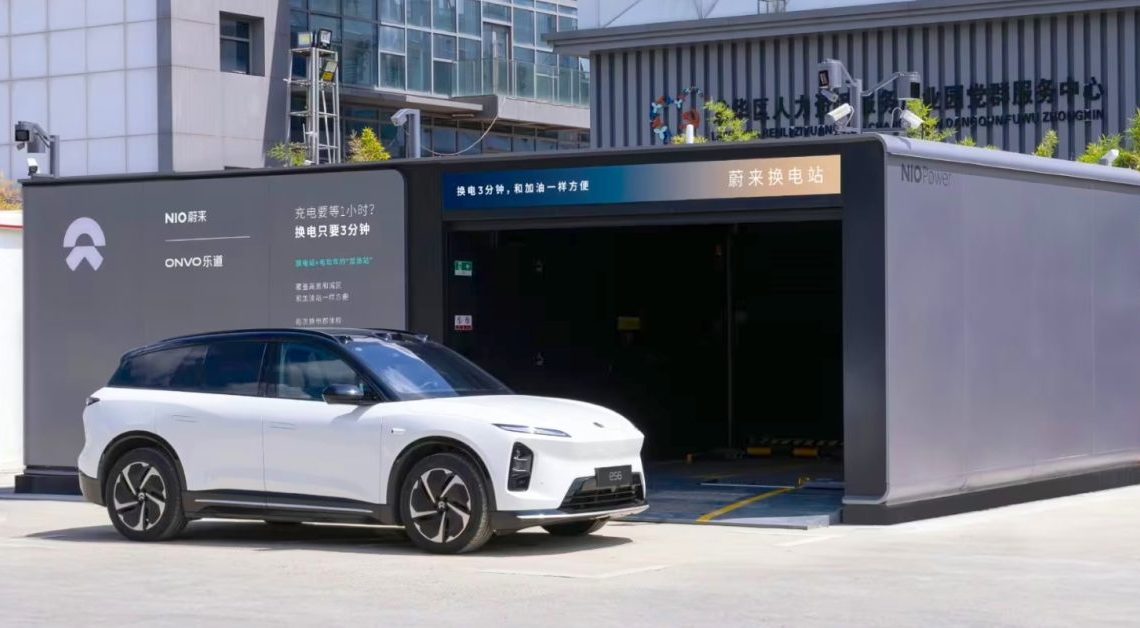
NIO says its energy arm, NIO Power, will operate more than 10,000 battery swap stations and manage over RMB 350 billion ($52 billion) worth of battery packs by 2030.
That’s more than double the swap network NIO runs in China today. And it comes from a company that already missed its last big swap station target.
NIO shared the targets today at NIO IN 2026, its annual technology event, held in Guangzhou to mark the company’s 12th anniversary. NIO Power also expects to deliver over 10 billion kWh of energy per year through charging and battery swapping by the end of the decade.
From 4,252 swap stations to 10,000
As of November 11, NIO had 4,252 battery swap stations in China, alongside 5,584 charging stations, according to the company’s latest network count.
Getting to 10,000 by 2030 means adding roughly 1,400 swap stations per year for four straight years. NIO added 679 in 2024 and 681 in 2025. So the new plan needs about double the company’s recent pace.
Even this year’s goal of “at least 1,000” new stations looks tight. NIO had 3,729 swap stations in February when it celebrated its 100 millionth swap, which means it has added just over 500 since then.
There’s also some history here. At its 2021 Power Day, NIO committed to more than 4,000 battery swap stations worldwide by the end of 2025, with about 1,000 of them outside China. By February 2026, it had about 3,700, almost all of them in China.
The energy target is just as aggressive. NIO’s swap network had delivered 5.28 billion kWh in total by February, after roughly eight years of operation. The 2030 goal is nearly twice that every year, although it also counts NIO’s charging stations.
Who pays for $52 billion in batteries?
NIO’s swap network is tied to its Battery-as-a-Service (BaaS) model, where customers can buy the car without the pack and rent the battery instead. That means someone has to own a massive fleet of packs, both in customers’ cars and sitting charged in stations. NIO says it wants to manage more than $52 billion of them in four years.
For context, NIO reported total revenue of about $4.7 billion in Q2 2026.
NIO has been moving the heavy capital off its own books. Under deals like its agreement with Zhongan Energy to build 500 swap stations within a year, partners own the stations while NIO handles the technology and operations. NIO Power says it has now co-built more than 900 swap stations with partners.
The hardware is also getting better. NIO opened its first fifth-generation swap stations in August, and they’re the first to serve all three of its brands. That includes the compact firefly, which couldn’t use older stations because of its shorter wheelbase.
NIO CFO Stanley Qu, who also heads NIO Power, presented the unit as NIO’s showcase for running a business with AI agents, using them to manage battery value, station operations, and energy efficiency.
The rest of NIO IN: self-driving, NOMI, and “AI-native”
The swap targets were only part of the event; everything else focused on NIO’s AI-fication.
NIO also launched NIO WorldModel (NWM) 3.0, the latest version of its driver-assist AI, which starts rolling out in December to vehicles with the Banyan, Cedar, Cedar S, and Coconut+ systems, pending regulatory clearance.
NIO says NWM 3.0 needs 40% fewer driver interventions than the previous version. It didn’t say how many interventions it started from, which makes the number hard to evaluate. It also claims a roughly 60% boost in drivers’ “sense of reassurance,” whatever that means.
The more concrete claims are about speed: NIO says overall vehicle control latency is down 54% and chassis control latency is down 78%, while training is five times more efficient.
NIO also unveiled NOMI Intelligence 4.0, a rebuild of its in-car assistant around an AI agent framework that can plan and carry out tasks on its own instead of following set commands. The first release, Cedar 2.0.0, will be filed in early December. Cars on Cedar S and Banyan should get it in Q2 2027, followed later by ONVO models.
Finally, CEO William Li pitched NIO as an “AI-native organization.” He argued the global auto industry is worth $7 to $9 trillion and that AI could add more than $1.2 trillion in value to it. NIO says it has deployed over 7,500 AI agents internally, with more than 2.9 million executions so far.
Author: Fred Lambert
Source: Electrek
Reviewed By: Editorial Team
