

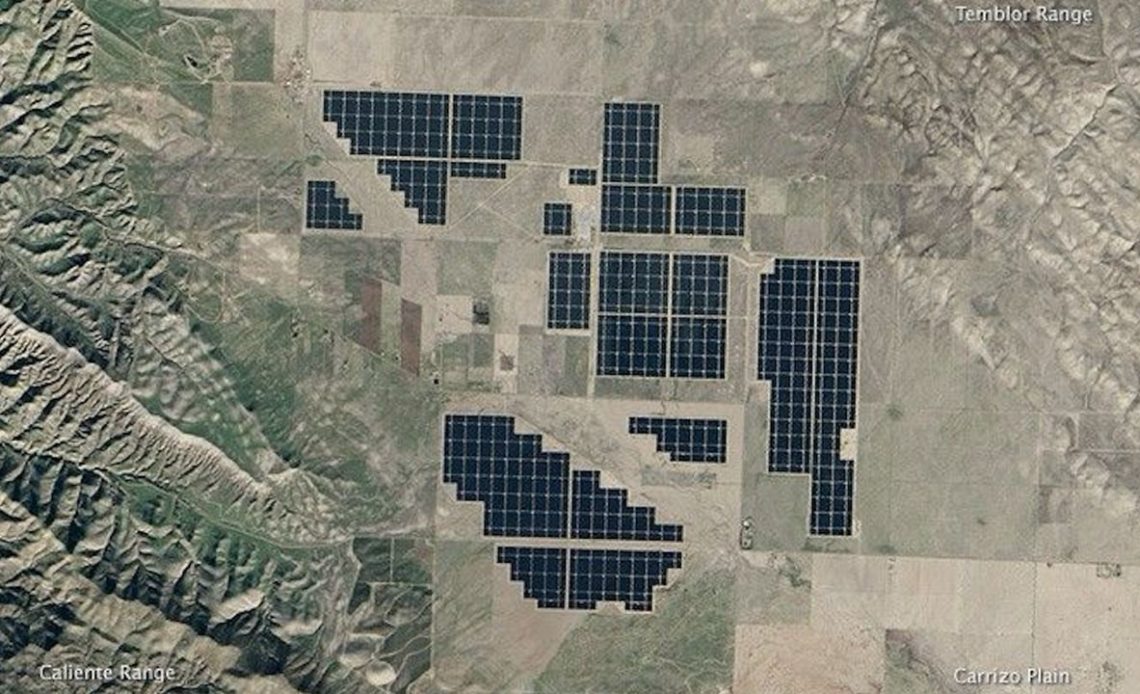
We may already be signaling other intelligences beyond our solar system, without even trying. Kunyu City, in the Xinjiang Uygur Autonomous Region of northwest China, hosts huge sprinklers that are irrigating over 1,317 acres (533 hectares) of winter wheat fields on the southern edge of the Taklamakan Desert. Then there’s the world’s largest cluster of solar farms, a megaproject that covers 235 square miles (639 square kilometers) in Qinghai, China, high on the isolated Tibetan Plateau.
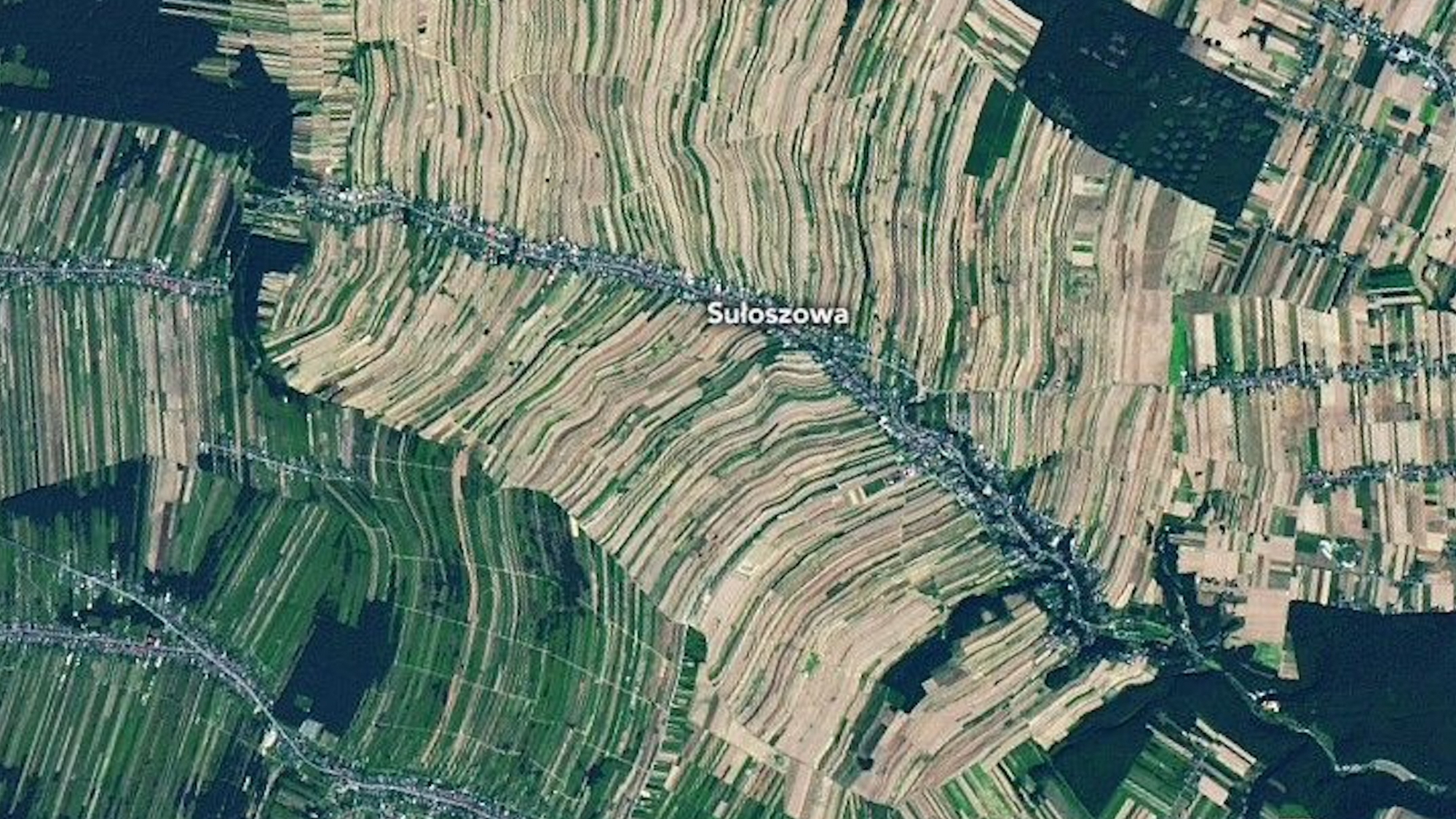
And Earth is dotted with many other humongous, human-made structures like these. To an alien eye, they may be tell-tale signs of intelligent goings-on, betraying our existence and hinting at our capabilities.
Visible signaling
People who want to reach out to E.T. have long recognized the communication potential of such “megastructures.” In the nineteenth-century, for example, multiple folks advanced proposals for broadcasting “we’re here” messages via visible signaling.
One popular type of proposal involved displaying supposedly meaningful figures on parts of our planet that would be visible from the extraterrestrial target of choice.
In these plans, recalled Douglas Vakoch, president of Messaging Extraterrestrial Intelligence (METI) International in San Francisco, huge diagrams would be etched on large expanses of land here on Earth. For example, a visual representation of a right triangle could be shown, he said, with a square attached to each side of the triangle to illustrate diagrammatically the Pythagorean theorem.
By clearing gargantuan stretches of forest, Vakoch said, such geometrical concepts could be seen by intelligent aliens scanning the sunlit side of the Earth. This intended, symbolic representation of the Pythagorean theorem would be huge enough to be seen from the moon — even by inhabitants of Mars.

Hello, lunarians!
Vakoch said that among the early proponents of displaying pictures to communicate with extraterrestrials was the illustrious mathematician Karl Friedrich Gauss. In 1826, he was credited with suggesting such an approach for communicating with potential lunarians, inhabitants of Earth’s moon.
“It was Gauss whose idea of inscribing the Pythagorean theorem in Siberian forests has often been touted as an early proposal for communicating with lunarians, although it’s unclear whether Gauss actually said this, or whether it’s only attributed to him,” Vakoch told Space.com.
Similarly, there were thoughts of perhaps creating large canals in the Sahara Desert filled with kerosene, then torched to flash a similar transmission from the dark side of Earth, the METI expert explained.
Strip malls and data centers
Vakoch’s favorite early proponent of interstellar communication is Francis Galton, an English polymath (and, less admirably, the originator of eugenics during the Victorian era). In 1896, Galton published an article in the “Fortnightly Review” called “Intelligible Signals Between Neighbouring Stars.”
“Signals have to be devised that are intrinsically intelligible, so that the messages may be deciphered by any intelligent man, or other creature, who has made nearly as much advance in pure and applied science as ourselves,” Galton emphasized.
So a bottom line: Are we viewed by other starfolk as a bunch of busy beavers terraforming our own planet while inadvertently waving to other worlds? If we build a big enough strip mall or AI data center, maybe we’ll find out.
Author: Leonard David
Source: Space.com
Reviewed By: Editorial Team