

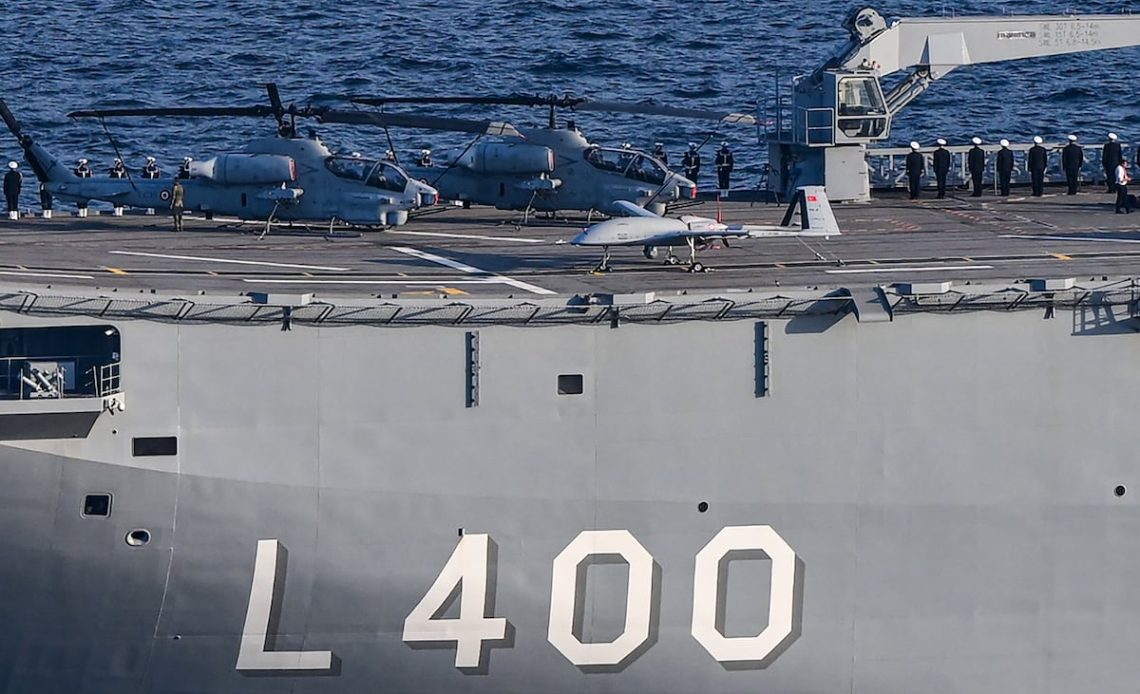
ROME — The Italian Navy’s is planning for a future in which swarms of airborne, surface and undersea drones will deploy from its ships and has challenged shipyard Fincantieri to build and adapt vessels which are ready for the task.
“We expect new navy vessels in ten years will be using a large number of drones and we want to be prepared,” said Capt. Gianluca Marcilli, who heads the Technology Innovation Office at the Navy General Staff’s General Space and Innovation Office (UGSI).
A new Navy research project called “Swarm Drone Carrier,” which was unveiled by Marcilli at a Rome conference this week, has focused on how numerous drones used for search and rescue, interception and interdiction missions can be hosted on ships and integrated with sensors and combat management systems.
Officials have meanwhile tasked Italy’s Fincantieri – the Navy’s go-to ship builder – to drum up designs for future drone-friendly vessels.
“We want to challenge Fincantieri to rethink designs in a way that we can use launch and recovery systems for aerial, surface and undersea drones,” Marcilli told Defense News.
“It means looking at how best to handle storage, maintenance and loading ammunition,” he said.
Marcilli said the study was based on the concept of a vessel being able to host between six and 10 undersea drones, able to be launched through apertures in the hull, rather than being launched with a crane.
The study also envisages four to six Unmanned Surface Vehicle (USV) drones on board, and has used Fincantieri’s SAND USV as a reference. Launched at Euronaval in 2022, the SAND (Surface Advanced Naval Drone) offers autonomy of up to 72 hours at eight knots.
The study proposed a typical airborne component of four to six drones, using as a reference the Hero, a 200kg rotary drone developed by Italy’s Leonardo.
The Navy is also looking at how to host fixed-wing, loitering munition on vessels, Marcilli said.
A major challenge officials face is integrating purchased drones with vessels’ highly classified Combat Management Systems, he added.
The study has led to the creation of a ‘proof of concept’ Landing Platform Dock design which could act as a drone carrier.
But Marcilli said the point of the study, and of Fincantieri’s involvement, was primarily to adapt vessels which are currently being built or planned.
That means figuring out how to better integrate drones into Italy’s under-construction Trieste Landing Helicopter Dock, which will also host the F-35B combat jet.
He said planners were also looking at Italy’s new PPX patrol vessels as well as two Fremm EVO vessels ordered last year from Fincantieri. The upgrades to Italy’s Fremm frigates are meant to offer enhanced capabilities for defeating drone attacks while operating their own drones.
Tom Kington is the Italy correspondent for Defense News.
Author: Tom Kington
Source: DefenseNews