

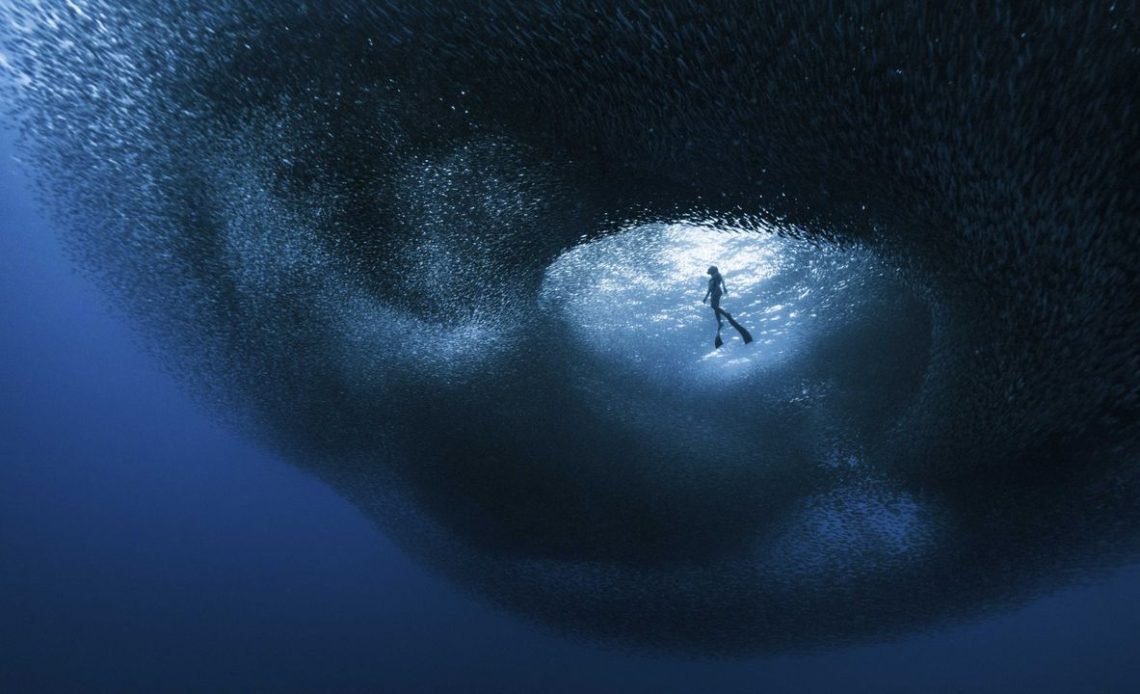
When you first glance at this underwater image, it looks like the kind of shot that would take weeks to plan. In fact, the photograph was taken during an unplanned morning dive. No script, no moodboard, no dive team briefing. Just a freediver, an expanse of open water and a huge school of sardines.
The result: a churning mass of silver folds itself into a perfect halo around its human subject. No surprise, then, that Ben Yávar‘s image is a finalist in this year’s Ocean Photographer of the Year Adventure category.
The Chilean photographer sees it as reflecting the calm trust that can exist between people and marine life. “It is a reminder that patience and respect for the ocean often lead to its most extraordinary moments,” he says.
Secrets of the shot
Yávar is a freediving instructor as well as a photographer, and so he well knows that sardines are acutely sensitive to disturbance. So calmness is key. But when you use scuba diving equipment, the exhaust bubbles, regulator noise and sheer bulk of your kit are likely to scare them off.
In contrast, freediving – where you ditch the equipment and rely solely on the air in your lungs – enables you to move silently and blend in, getting you closer to the action and saving the sardines from getting jumpy.
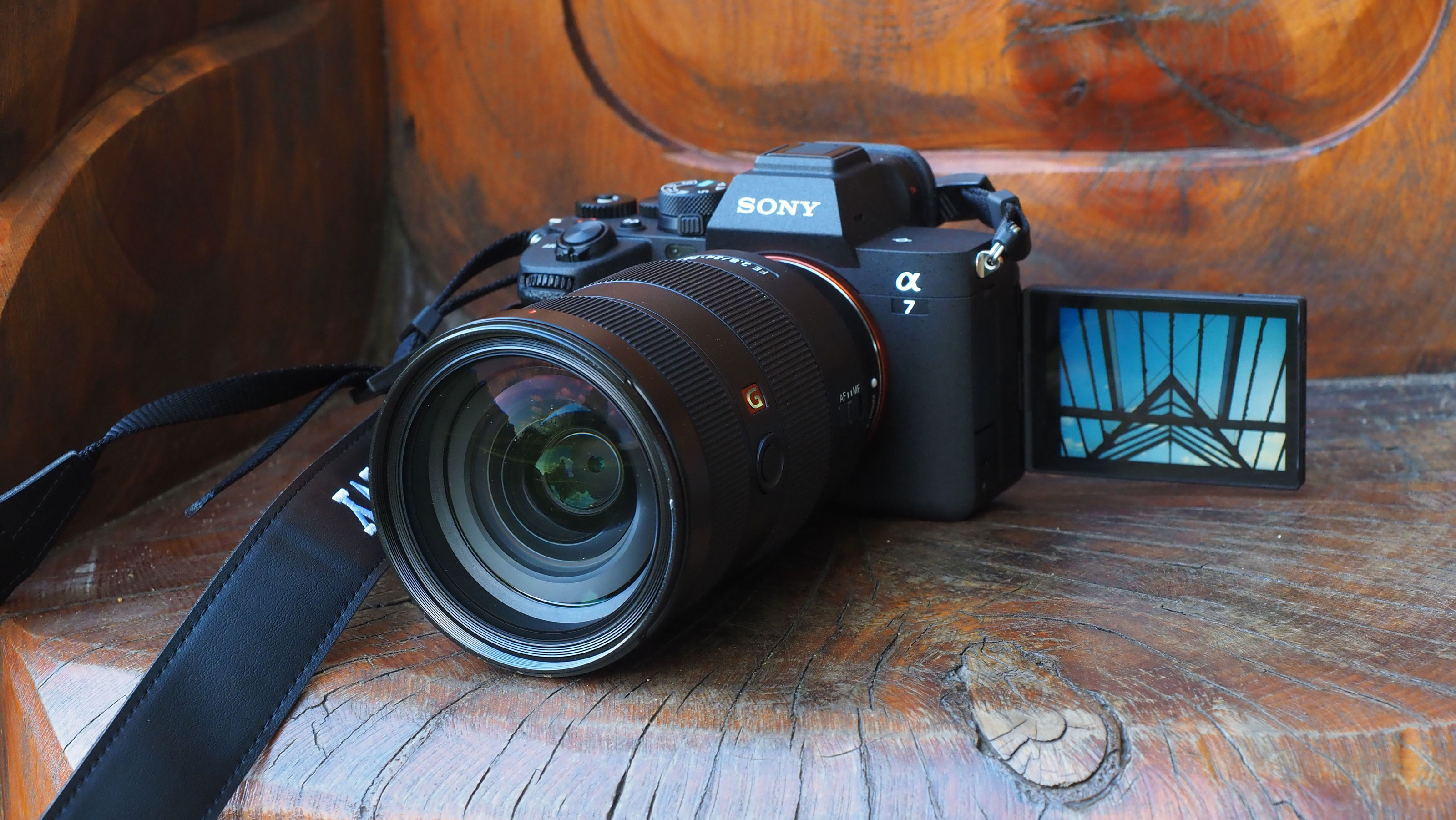
The shot in question was taken on a Sony A7 IV with a 12mm lens at f/9, ISO 1600 and 1/250 sec; the kind of smaller aperture Yávar favors to hold sharpness across a fast-moving frame. The fast shutter speed did the job of freezing individual fish and stopping them from blurring into streaks, while the high ISO suggests he was compensating for a fill flash.
Yávar pre-sets his camera on land, because underwater there’s no time, plus fiddling about with menus would only disturb the fish. It’s an approach that makes sense well beyond sardine runs: decide what you can beforehand, so that in the moment, all your attention goes to composition and timing.
Of course, even if you do everything right, you’re still going to need a lot of luck to get a shot like this. But Yávar puts in enough hours to know he’ll be ready. He’ll often take multiple dives, sometimes dozens, to get movement and light to align properly.
That’s the real key to getting a shot like this. In the photo itself, the technical preparation, the fitness, the training and the failed dives are all invisible. All the viewer sees instead is the scene that made all that effort worthwhile.
Ocean Photographer of the Year is presented by Oceanographic and Blancpain. You can see all the 2026 finalists on the Oceanographic Magazine website.
Author: Tom May
Source: DigitalCameraWorld
Reviewed By: Editorial Team