


Many of the biggest achievements in photography’s history came from photographers and chemists, but the invention of color photographs wasn’t initiated by a photographer at all but a physicist obsessed with the science of colors.
James Clerk Maxwell was a mid-1800s physicist credited for early work in electromagnetism, but one of Maxwell’s key interests was color. Maxwell’s research focused on unearthing how people see colors and different color combinations, but his work led to a theory on how photographers could create color images by mixing light.
Maxwell built an eight-foot-long box that allowed him to mix light and test his theory that mixing the three primary colors of light would create other colors. As a biography noted, the oversized box “excited the wonder of his neighbours, who thought him mad to spend so many hours staring into a coffin.”
In 1855, Maxwell theorized that a color photograph could be possible by using three black-and-white slides, each with a different color filter, and projecting the three images together. Maxwell wouldn’t put the theory to the test until 1861, when he commissioned the help of photographer Thomas Sutton.
Unlike Maxwell, Sutton was both an inventor and a photographer – he literally wrote the Dictionary of Photography in 1856 and invented both the first panoramic camera and the first single-lens reflex camera.
To test Maxwell’s theory, Sutton took three photos of a tartan-patterned ribbon, each with a different color filter. Maxwell later projected those three images together onto a screen while giving a lecture in London.
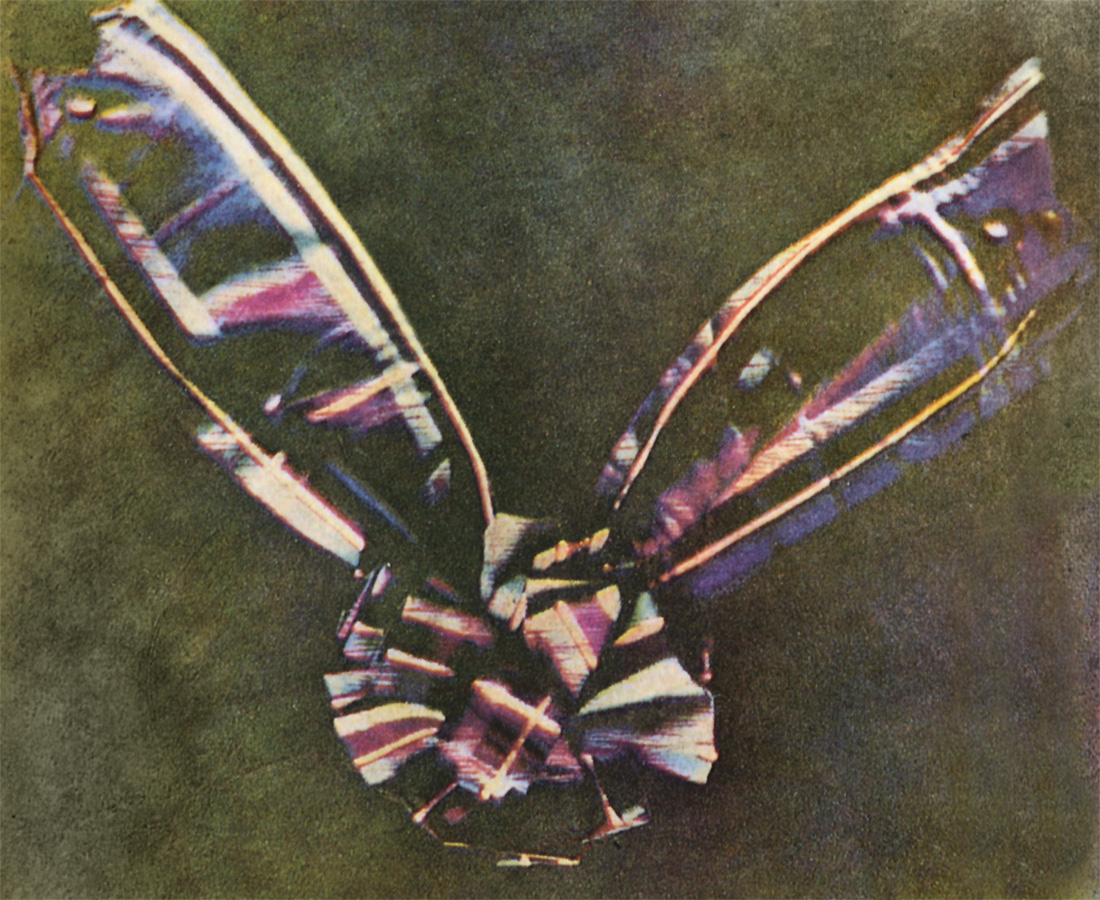
The photography isn’t exactly a color image by modern standards – the image was, after all, projected by combining three photos together – but the research was key in the development of true color photography down the road. Maxwell’s theory on mixing colors to create a full-color image held water – in fact, even modern computer and TV screens still use the concept of mixing red, green, and blue light in each pixel.
But while the theory held, the actual photograph shouldn’t have worked at all. The chemicals on the glass plates that Sutton worked with were not sensitive to green, yellow or red – so the images taken with the red- and green-filtered photos shouldn’t have rendered a photograph.
The answer as to why the black-and-white chemicals were able to render some color in the 1861 photograph didn’t come until a researcher at Kodak revisited the process a century later. Kodak’s Raph Evans, working with similar chemicals, realized that the red filter image was picking up ultraviolet light, and that’s what led to the first color image.
While Maxwell’s first image to test the theory worked almost by accident, the theory itself held and led to further research into chemicals that could record those colors.
Maxwell’s idea that mixing red, blue, and green light could create other colors is still used today. Modern color camera sensors use red, green, and blue filters arranged in a pattern over the sensor that allow the sensor to “see” in color.
Author: Hillary K. Grigonis
Source: DigitalCameraWorld
Reviewed By: Editorial Team