

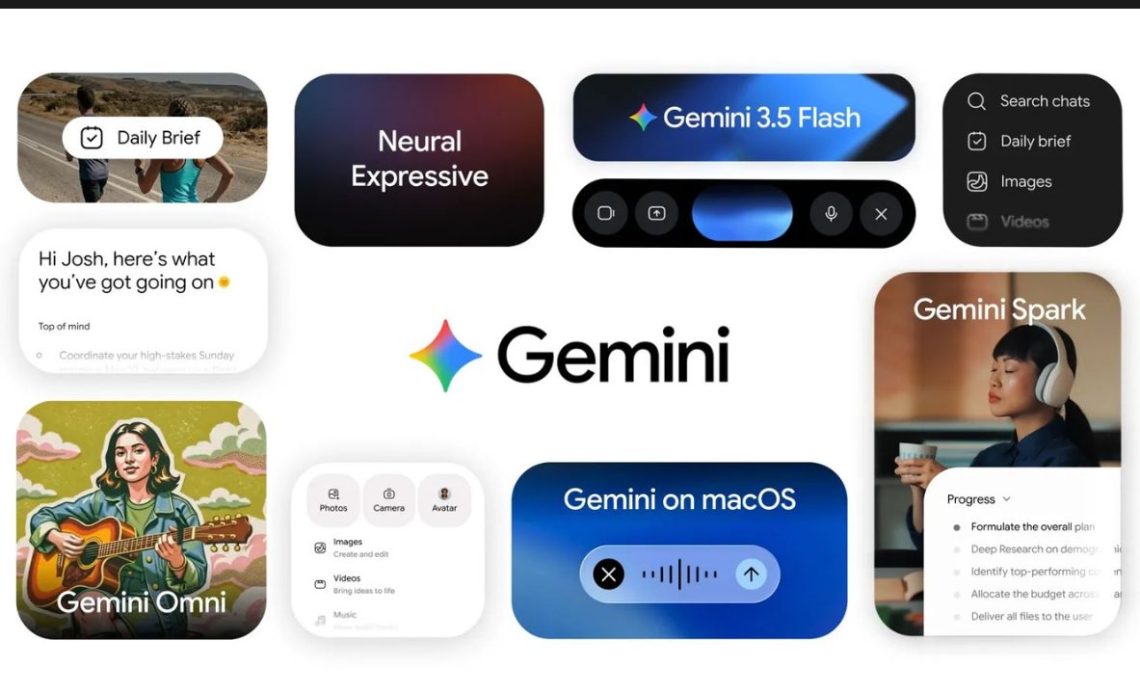
Google held its I/O 2026 event earlier yesterday, and the company announced the Agentic Gemini era. The new era of Gemini keeps automation front and center, where the AI can perform tasks on your behalf, amongst other advanced capabilities. New models like Gemini Omni and Gemini 3.5 were also announced at the event. Here is a roundup of all the announcements Google made at its annual I/O event.
Gemini Omni
Google has introduced Gemini Omni, a new AI model family that combines Gemini’s reasoning capabilities with multimodal content creation. The company says Omni is designed to create and edit content using text, images, audio, and video inputs, starting with video generation.
The first model in the lineup, Gemini Omni Flash, is rolling out to the Gemini app, Google Flow, and YouTube Shorts. Google says the model allows users to generate and edit videos through natural language conversations, with each instruction building on previous edits while maintaining scene consistency, character continuity, and realistic physics.
According to Google, Gemini Omni can modify existing videos by changing environments, adding new objects or characters, altering actions, and refining scenes across multiple prompts without losing the original context. The company also highlighted the model’s ability to simulate more realistic motion and physics, including gravity, kinetic energy, and fluid dynamics.
Google says Omni is designed to go beyond visual realism by combining Gemini’s broader knowledge base with creative generation. This allows the model to create educational explainers, stylized animations, and context-aware storytelling from short prompts.
The system can additionally generate videos using combinations of reference images, existing videos, audio clips, and text prompts. Initially, only voice references will be supported for audio inputs, with broader audio support planned later.
Google also announced Avatars, a feature that allows users to create digital versions of themselves using their own voice for AI-generated videos. The company says it is still testing broader voice and speech editing features before making them widely available.
For transparency, all videos created with Gemini Omni will include Google’s SynthID digital watermarking technology. Users will also be able to verify AI-generated content through the Gemini app, Gemini in Chrome, and also Google Search.
Gemini Omni Flash is rolling out globally to Google AI Plus, Pro, and Ultra subscribers through the Gemini App and Google Flow. Google also says the model will be available at no additional cost in YouTube Shorts and the YouTube Create app starting this week.
Gemini 3.5
Google has announced Gemini 3.5, its latest family of AI models focused on combining advanced reasoning with agentic capabilities. The company is starting the rollout with Gemini 3.5 Flash, which is designed for coding, automation, and complex multi-step workflows.
According to Google, Gemini 3.5 Flash delivers flagship-level performance while maintaining the faster response speeds associated with the Flash series. The model reportedly outperforms Gemini 3.1 Pro on several coding and agentic benchmarks, including Terminal-Bench 2.1, GDPval-AA, MCP Atlas, and CharXiv Reasoning. Google also claims it is up to four times faster than competing frontier AI models in output token speed.
The company says the model is particularly suited for long-horizon agentic tasks such as application development, codebase maintenance, document preparation, and large-scale workflow automation. When paired with Google’s updated Antigravity platform, Gemini 3.5 Flash can deploy collaborative subagents capable of handling complex multi-step operations under supervision.
Google also highlighted improvements in multimodal capabilities, with the model able to generate more advanced interactive web interfaces, animations, graphics, and visual explainers.
The new model is already being integrated into Google products and services. Gemini 3.5 Flash is now the default model powering the Gemini app and AI Mode in Google Search globally. It also powers the new Gemini Spark personal AI agent, which is designed to run continuously and assist users with tasks across their digital ecosystem. Google says Spark is currently rolling out to trusted testers, with broader access planned for Google AI Ultra subscribers in the US next week. Read on to know more about Gemini Spark.
For developers, Gemini 3.5 Flash is available through Google Antigravity, Gemini API in Google AI Studio and Android Studio, while enterprise customers can access it through Gemini Enterprise Agent Platform and Gemini Enterprise.
A More Agentic Gemini App
A number of updates were announced for the Gemini app as well. This includes the rollout of Gemini 3.5 Flash in the app. Google also unveiled Neural Expressive, a completely redesigned interface and visual language for Gemini. The new experience introduces fluid animations, updated typography, vibrant colours, haptic feedback, and deeper integration of Gemini Live conversations.
Users will be able to seamlessly switch between typing and voice interactions without interrupting conversations. Google also says Gemini responses will become more visually dynamic with timelines, narrated videos, graphics, and rich media elements instead of long text-heavy outputs. Neural Expressive is rolling out globally across the web, Android, and iOS.
Another major addition is Gemini Omni, Google’s new multimodal AI model that can generate cinematic videos using combinations of text, image, and video inputs. The company says users can edit videos conversationally, apply effects, change backgrounds, and even create AI avatars based on themselves. Gemini Omni is rolling out to Google AI Plus, Pro, and Ultra subscribers globally.
Google has additionally introduced Daily Brief, a new AI agent that creates personalised morning summaries by analysing connected Gmail, Calendar, and other app data. The feature can organise updates, prioritise tasks, and suggest next steps based on user goals and routines. Daily Brief is initially launching for Google AI Plus, Pro, and Ultra subscribers in the US.
Coming to Gemini Spark, it is a new cloud-based 24/7 personal AI agent powered by Gemini 3.5 and Google’s Antigravity system. Spark is designed to proactively manage tasks across Workspace apps such as Gmail, Docs, and Slides while continuing to operate in the background even when devices are locked or offline. Google says Spark can automate recurring workflows, monitor emails, create reports, and handle multi-step tasks under user supervision.
Google confirmed that Spark will support integrations with services such as Canva, OpenTable, and Instacart through new MCP connections. Future updates will also allow Spark to send texts, emails, operate browsers, and support custom sub-agents. Spark is rolling out first to trusted testers, with a beta planned for US Google AI Ultra subscribers next week.
On the desktop side, Google announced a dedicated Gemini app for macOS. The app will eventually integrate Gemini Spark and new voice-based AI features capable of converting natural speech into structured drafts directly on the desktop using on-screen context. The macOS app is available starting today, while Spark integration and advanced voice features are expected later this summer.
Google Search Updated with New AI Features
Google has announced a major upgrade to Search powered by Gemini 3.5 Flash, which is now becoming the default model for AI Mode globally. Alongside the model upgrade, Google is introducing what it calls the biggest redesign of the Search box in over 25 years.
The new AI-powered Search interface dynamically expands to support longer and more natural queries while also offering smarter suggestions that go beyond traditional autocomplete. Users will additionally be able to search using text, images, videos, files, and even Chrome tabs as inputs.
Google is also improving conversational search. Users can now continue asking follow-up questions directly from AI Overviews and seamlessly transition into full AI Mode conversations without losing context. The company says this upgraded experience is already rolling out globally across desktop and mobile.
Another major addition is Search agents, which are AI agents designed to work continuously in the background. Google says these agents can monitor information across websites, blogs, social platforms, finance data, shopping listings, and sports updates to deliver personalised alerts and summaries. For example, users could ask an agent to track apartment listings matching specific criteria or monitor sneaker collaborations from favourite athletes. Information agents will initially launch for Google AI Pro and Ultra subscribers later this summer.
Google is also expanding agentic booking features in Search. Users will be able to search for services or experiences using detailed requirements, such as finding a karaoke room with late-night food service, while Search gathers pricing, availability, and booking links automatically. In select categories, including beauty services, pet care, and home repairs, Google can even call businesses on behalf of users. These features are expected to launch in the US this summer.
The company additionally highlighted new coding and generative UI capabilities powered by Gemini 3.5 Flash and Google Antigravity. Search will be able to generate interactive visual layouts, simulations, charts, tables, and custom interfaces dynamically depending on the query. Google says users could eventually build mini-apps and custom dashboards directly inside Search for ongoing tasks like fitness tracking, wedding planning, or moving homes. These capabilities are planned for Google AI Pro and Ultra subscribers in the US over the coming months.
Finally, Google announced an expansion of Personal Intelligence in AI Mode to nearly 200 countries and territories across 98 languages. Users will be able to securely connect services such as Gmail, Google Photos, and soon Google Calendar to enable more personalised AI-powered search experiences. Google says users will remain fully in control over which apps and data are connected.
Universal Cart for Smart Shopping
Google has announced Universal Cart, a new AI-powered shopping experience designed to work across Search, Gemini, YouTube, and Gmail. The company says the feature acts as a central shopping hub that can track products, monitor prices, and simplify checkout across multiple merchants and services.
With Universal Cart, users can add products while browsing Search results, chatting with Gemini, watching YouTube videos, or even checking emails in Gmail. Once an item is added, Google says the cart automatically starts tracking price drops, stock availability, and deal alerts using Gemini-powered AI models.
Google is also positioning the feature as an intelligent shopping assistant. For example, if a user is building a custom PC, Universal Cart can reportedly detect incompatible components and suggest alternative parts before checkout. Since the system is built on Google Wallet infrastructure, it can additionally factor in loyalty rewards, saved payment methods, and merchant-specific offers to help users save money or earn extra benefits.
Checkout is integrated directly with Google Pay for supported brands, allowing purchases to be completed in a few taps. Alternatively, users can transfer products to a retailer’s website to finish the purchase there. Google says the feature will support brands including Nike, Sephora, Target, Ulta Beauty, Walmart, Wayfair, and Shopify merchants such as Fenty and Steve Madden. The company also clarified that merchants remain the official sellers of record.
Universal Cart will begin rolling out in the US this summer through Search and the Gemini app, with YouTube and Gmail integration planned later.
Google also revealed that its Universal Commerce Protocol (UCP), developed alongside retail partners earlier this year, is expanding internationally. The company plans to bring UCP-powered checkout experiences to Canada and Australia in the coming months, followed later by the UK. Google additionally confirmed that UCP will expand into categories such as hotel bookings and food delivery services.
Alongside this, Google introduced the Agent Payments Protocol (AP2), a framework designed to enable AI agents to make secure purchases on behalf of users. AP2 allows users to define strict spending limits, preferred brands, and product conditions before an AI completes a purchase. Google says the system uses tamper-proof digital records and privacy-preserving technology to create transparent transaction trails for both users and merchants. The company plans to first integrate AP2 into Gemini Spark in the coming months.
Smart Eyewear from Gentle Monster and Warby Parker, Developed in Collaboration with Samsung and Qualcomm

Google has unveiled its new intelligent eyewear platform at Google I/O 2026, introducing two categories of smart glasses powered by Gemini. The company says the lineup will include audio glasses that provide spoken assistance through built-in speakers, and display glasses that can visually show information directly in the user’s field of view. Google confirmed that audio glasses will launch first later this fall.
To develop the new wearable platform, Google partnered with Samsung, along with eyewear brands Gentle Monster and Warby Parker. The company showcased some of the first designs, which focus on combining lightweight construction with everyday fashion-oriented styling.
The glasses are powered by Gemini and can be activated using Voice commands such as “Hey Google” or by tapping the frame. Google says the glasses can answer questions about objects, places, or signs users are looking at in real time.
Navigation is another major focus where the glasses use directional awareness and location tracking to provide hands-free turn-by-turn guidance while also allowing users to add stops or search for nearby places using voice commands.
Google is also bringing communication features to the glasses, including support for calls, message summaries, text replies, and music playback through private over-ear speakers.
The wearable additionally supports photo and video capture with built-in cameras. Users can reportedly use Gemini and Nano Banana AI tools to edit images using voice prompts, such as removing distractions or applying playful effects.
Real-time translation is also integrated into the experience so glasses can translate spoken conversations while preserving tone and voice characteristics, and can additionally read and translate text from menus, signs, and other surfaces.
Google says the glasses are designed to work with Gemini Intelligence for more advanced multi-step actions as well. This includes tasks such as placing food delivery orders, managing bookings, and interacting with connected apps like Uber and Mondly directly through voice commands.
The audio glasses will support both Android and iOS devices when they launch later this year. Support for iOS is huge, considering hardware from most Android brands isn’t natively compatible with iOS.
Google Workspace Updates: Conversational voice features, Google Pics app, and More
Google also announced several new AI-powered productivity features for Workspace apps, including voice-based tools, a new image editing platform called Google Pics, updates to AI Inbox, and again, the launch of Gemini Spark.
One of the biggest additions is a new set of conversational voice capabilities coming to Gmail, Docs, and Keep. Google says these features are designed to help users brainstorm, organise ideas, and complete tasks using natural voice interactions.
In Gmail, the company is introducing Gmail Live, a voice-powered inbox search feature that allows users to ask spoken questions, such as flight details or school updates. Gemini will then search emails and provide synthesised answers instantly.
Google Docs is also getting Docs Live, which acts as a voice-based writing assistant. Users can verbally brainstorm ideas, dictate outlines, and generate first drafts while Gemini structures the document and, with permission, pulls relevant context from Gmail, Drive, Chat, and the web.
Meanwhile, Google Keep is gaining AI-powered voice organisation features that can convert spoken “brain dumps” into structured notes and lists automatically.
Google additionally introduced Google Pics, a new AI image generation and editing platform built on the Nano Banana model. The tool focuses heavily on precision editing rather than one-shot image generation. Features include object-level editing, in-image text editing and translation, collaborative image editing, and Workspace integrations starting with Slides and Drive. Google says Pics is initially launching for Trusted Testers before rolling out more widely to Google AI Pro, Ultra, and Workspace business users later this summer.
The company also announced new upgrades for AI Inbox in Gmail. New features include personalised draft replies, surfaced file links for related tasks, and simplified task management options such as dismissing suggestions or marking related emails as read in bulk. AI Inbox is now expanding beyond Ultra subscribers to Google AI Plus and Pro users in the US.
New capabilities for Google Flow and a Dedicated App
Google has announced a major expansion of Google Flow and Google Flow Music, introducing new Gemini Omni-powered video tools, AI creative agents, custom workflow tools, and mobile apps for creators.
One of the biggest additions is support for Gemini Omni Flash inside Google Flow. Google says the model combines Gemini’s reasoning abilities with its generative media systems to enable conversational video creation and editing from multiple input types. The company describes Omni Flash as “Nano Banana for video,” allowing creators to blend real-world inspiration with AI-generated scenes while maintaining stronger character consistency and voice continuity across projects. Gemini Omni Flash is now available globally for Google AI subscribers using Flow.
Google is also introducing Google Flow Agent, an AI-powered creative assistant designed to help users brainstorm, edit, organise, and iterate on projects. The agent can assist with tasks such as dialogue refinement, plot suggestions, generating multiple scene variations, batch editing assets, and organising project files automatically. Google says the Flow Agent is rolling out globally to all Google Flow users.
Another major update is the introduction of Google Flow Tools, which allows users to create custom creative workflows and utilities using natural language instead of coding. Creators can build their own image editors, shaders, resizing tools, and other utilities, then share them with the Flow community for remixing and reuse. Existing tools are available globally for all users, while Google AI subscribers can also create and modify their own tools.
Google Flow Music is also receiving several upgrades focused on deeper editing control and AI-generated music videos. Users can now edit specific sections of songs independently, allowing them to rewrite lyrics, translate vocals, change beat drops, or sample sections without affecting the rest of the track.
The platform is additionally gaining AI-powered cover generation, enabling users to transform existing songs into different styles while preserving melody and structure. Google gave examples such as converting tracks into lo-fi or study-style versions.
Gemini Omni Flash is also being integrated into Flow Music for music video generation. Google says creators can conversationally direct scenes, pacing, styles, and subjects to match the tone and narrative of a song. This feature is rolling out to all Google AI subscribers.
Alongside these updates, Google announced dedicated mobile apps for both Flow and Flow Music. The Flow app is currently available in beta for Android users aged 18 and above, with an iOS version coming later. Meanwhile, the Flow Music app is already available on iOS, while Android support is expected soon.
New Google AI Ultra Plan and Updates to Existing Plans
Google has announced major updates to its AI subscription plans at Google I/O 2026, including a brand-new $100/month (approx Rs 9,679) AI Ultra tier, lower pricing for its top-end plan, expanded access to Gemini models, and new productivity features across Workspace and Gemini apps.
The company says the new $100 AI Ultra plan is designed for developers, creators, technical leads, and advanced users who need higher usage limits and access to Google’s latest AI tools. The plan includes 5X higher usage limits than the AI Pro plan, Gemini 3.5 Flash integration, priority access to Google Antigravity, 20TB of cloud storage, and a YouTube Premium individual subscription. Google says the plan is available starting today. In India, the plan costs Rs 6,500 a month.
Google is also reducing the price of its existing top-tier AI Ultra plan from $250/month to $200/month while retaining the same benefits, including 20X higher usage limits compared to the Pro plan.
One of the biggest additions for Ultra subscribers is Gemini Spark, Google’s new 24/7 AI agent. Google is also expanding access to Project Genie for AI Ultra $200 subscribers globally. The experimental platform allows users to generate and explore AI-created worlds, with new Street View-powered features aimed at creating environments based on real-world locations.
The company reiterated that Gemini Omni and Gemini 3.5 Flash are becoming available across AI Plus, Pro, and Ultra plans globally.
Google also highlighted several productivity-focused AI features coming to subscribers. AI Inbox in Gmail is expanding to AI Plus and Pro users in the US. Daily Brief in the Gemini app is also rolling out.
Additional features such as Google Pics and new voice capabilities for Gmail, Docs, and Keep are also planned for AI Pro and Ultra subscribers later this summer.
On the entertainment side, Google says YouTube Premium Lite will soon be included with AI Pro subscriptions in select countries at no extra cost, while full YouTube Premium remains bundled with AI Ultra. Health Premium and Home Premium subscriptions are also being added to both AI Pro and Ultra plans.
Google is additionally changing how AI usage limits work. Instead of daily prompt caps, the company is moving to a compute-based model that factors in prompt complexity, features used, and conversation length. Usage limits will refresh every five hours until weekly caps are reached. If users hit limits on larger models, Google says they will automatically switch to smaller high-speed models to maintain continuity. Paid subscribers will also be able to purchase additional AI credits for Antigravity, Google Flow, and eventually the Gemini app. These limits are now also visible in the Gemini app for you to keep track of.
Android Halo
Google further previewed Android Halo, a new system designed to give users real-time visibility into what AI agents are doing on their devices.
The feature adds a persistent status interface at the top of the screen, allowing users to monitor an AI agent’s activity without interrupting whatever they are currently doing. Google says Android Halo will show when an agent is actively working on a task, running in live mode, or sending updates and messages.
The company describes Halo as a lightweight communication layer that keeps users informed about agent progress across apps and workflows directly from anywhere in the Android interface.
Android Halo will launch later this year and will support Gemini Spark along with other compatible AI agents. Google also confirmed that devices powered by Gemini Intelligence will receive additional Halo capabilities, though more details are expected later this year.
New Ways to Design with Stitch
The company says Stitch now works as a live creative partner through the new Stitch Agent, allowing users to design, iterate, and refine projects in real time using text prompts, voice commands, existing codebases, or design files.
Google describes the updated experience as a more natural and intuitive workflow where users can simply describe ideas through text or speech while Stitch dynamically builds layouts and adjusts designs alongside them.
The platform also adds improved collaboration features. Users can now instantly generate shareable project links through Google AI Studio, making it easier to collaborate with teams and clients during the design process.
For developers, Google says projects created in Stitch can be exported directly into Google Antigravity for backend integration and further development. Users can also publish projects directly to the web through Netlify integration.
The new Stitch updates are rolling out globally starting today.
Google AI Studio: Native Android Vibe Coding, Workspace Integrations, and More
Google has announced a major expansion of AI Studio at Google I/O 2026, bringing deeper Google ecosystem integrations, mobile development tools, native Android app creation, and new AI-powered design features.
The company says Google Workspace services are now directly integrated into AI Studio-built apps. Developers can create dashboards using Sheets data, build Drive-powered utilities, and connect apps with Workspace documents and files without leaving AI Studio. Google AI Studio
Google is also improving development workflows by allowing projects to be exported directly into Google Antigravity. According to the company, exported projects retain conversation history, files, and stored secrets, enabling teams to continue development seamlessly in local environments for faster iteration and scaling.
Several new design-focused capabilities are also rolling out. AI Studio’s Build agent can now automatically generate custom images using Nano Banana, allowing developers to create tailored UI assets and mockups without relying on external placeholder graphics.
Google has additionally introduced a new in-preview editing system. Users can now directly annotate app previews, modify components, and regenerate visuals while staying inside the design workflow.
The company also announced a dedicated mobile app for AI Studio. Available for pre-registration starting today, the app brings full build-mode functionality to smartphones, allowing users to edit code, preview builds, remix projects, and share live deployments directly from mobile devices.
One of the biggest additions is native Android app development inside AI Studio. Developers can now select a “Build an Android app” option to generate production-quality Kotlin apps using Jetpack Compose without installing SDKs or setting up local environments.
Google says the feature includes an in-browser Android emulator with ADB support for testing apps directly on devices. Developers can also connect Google Play Developer accounts to publish apps to the Internal Test Track with a single click.
Finally, Google confirmed that new developers will be able to deploy their first two apps on Google Cloud for free without requiring a credit card. Users with billing enabled will continue using the Cloud Run Free Tier.
Author: Abhishek Malhotra
Source: The Mobile Indian
Reviewed By: Editorial Team