

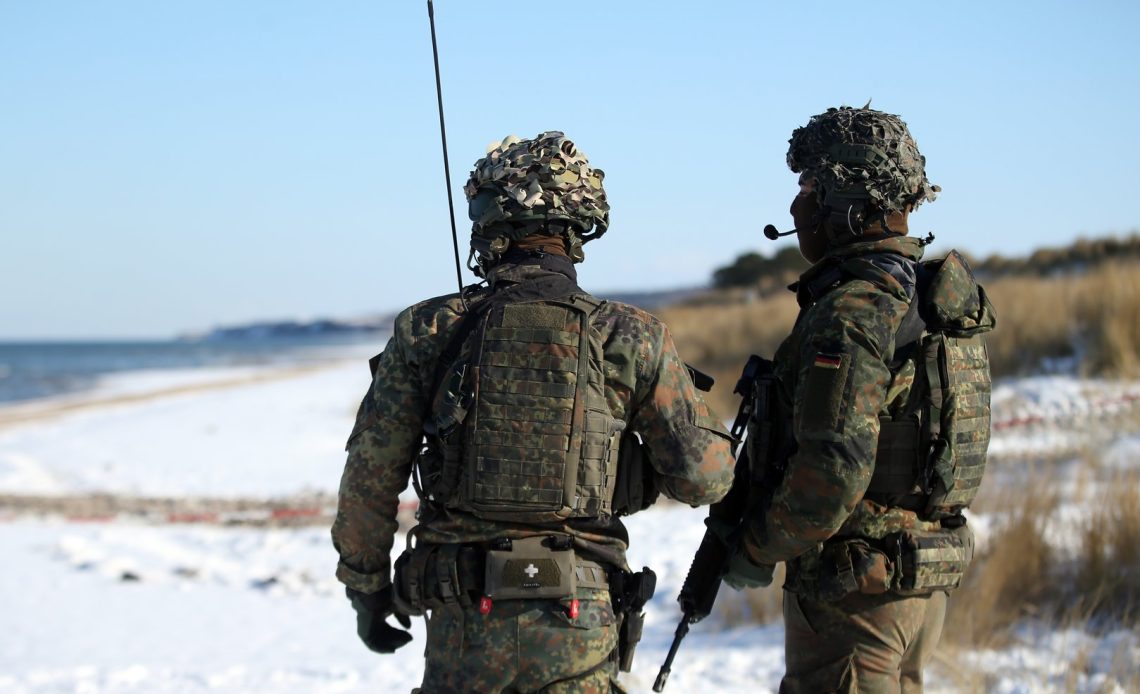
VIENNA — Germany revealed a package of foundational strategic documents for its armed forces on Wednesday, including the country’s first standalone military strategy, a new capability profile, a personnel growth plan and a redesigned reserve strategy — the most comprehensive overhaul of Bundeswehr planning in decades.
Defense Minister Boris Pistorius first announced the package at the annual armed forces conference in November, framing the plans as a historic turning point. Defense leaders presented the finished documents to lawmakers this week, offering unclassified outlines for public consumption at an April 22 press conference in Berlin.
“Rarely has a military strategy been as necessary as in this historical phase,” he told reporters. The documents, which the ministry describes as classified “living documents” subject to ongoing revision, will serve as the strategic foundation for the Bundeswehr for the next 20 years.
Titled “Verantwortung für Europa” − Responsibility for Europe − the military strategy identifies Russia as the primary threat and sets out scenarios for potential attacks on NATO territory. Pistorius declined to detail the classified threat assessments, quipping that releasing them would be tantamount to “adding Vladimir Putin to our email distribution list.” The strategy also marks a doctrinal shift toward a “one theater approach,” treating NATO territory, the Middle East and the Indo-Pacific as interconnected security spaces rather than discrete theaters.
The accompanying capability profile moves away from rigid hardware quotas − the number of tanks, aircraft or ships − toward a flexible, effects-based planning model. The question is not how many battalions the German army needs, but what effects it must be able to produce, said the defense minister. He cited deep precision strike, air defense against hypersonic missiles, and drone capabilities as priority areas, stressing that Germany was essentially starting from scratch on long-range strike.
The personnel growth plan foresees expanding from 185,420 active-duty soldiers today to 260,000 by the mid-2030s, alongside a parallel reserve buildup from around 60,000 currently assigned reservists to at least 200,000, for a combined total of 460,000 combat-ready troops. The plan runs in three phases: a rapid buildup through 2029, a capability-focused expansion through 2035, and a longer-term technology-driven phase through 2039 and beyond. New legislation in force since January 2026 enshrines the milestones in law, with conscription (already embedded in the new military service law as a fallback) becoming an option if recruitment targets are missed.
For now, Nicole Schilling, the military’s deputy inspector-general, said recruitment is running 10% above last year’s pace and applications are up 20%.
The stated aim of the German military is to become the strongest conventional fighting force in Europe by 2039.
The reserve, long treated as a secondary force to be activated only in emergencies, is now explicitly positioned “on par with the active force,” with a dedicated strategy that envisions reservists taking on homeland defense and ensuring Germany functions as a logistics hub for allied forces moving east in a crisis. Pistorius called the reserve “the hinge between the military and civil society.”
Rounding out the package is an agenda for debureaucratizing and modernizing the military, dubbed Entbürokratisierungs- und Modernisierungsagenda 2026 (EMA26): 153 concrete measures and 580 implementation steps to cut bureaucracy, digitize workflows and deploy artificial intelligence in routine administrative tasks. A key novelty is that all internal regulations will be assigned automatic expiry dates.
Pistorius acknowledged the risks to his ambitious timetables, noting that surging Middle Eastern demand for air defense systems has already compressed global production capacity.
“We have the money and we’ve triggered procurement,” he said. “But we don’t control all the variables.”
Author: Linus Höller
Source: DefenseNews
Reviewed By: Editorial Team