


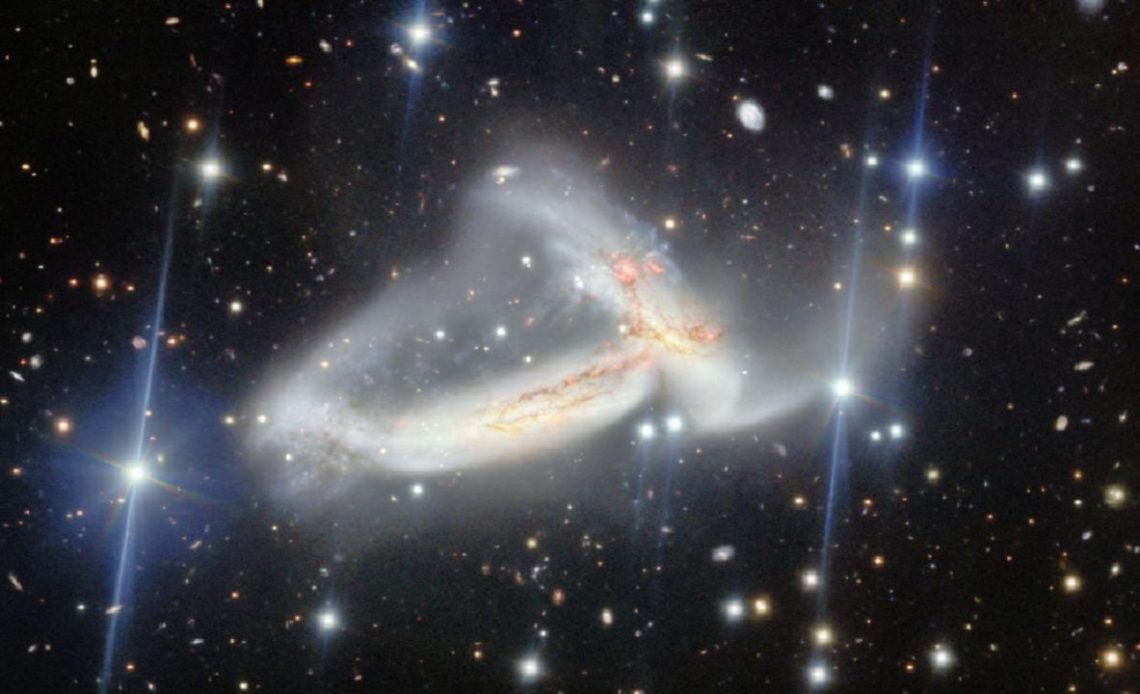
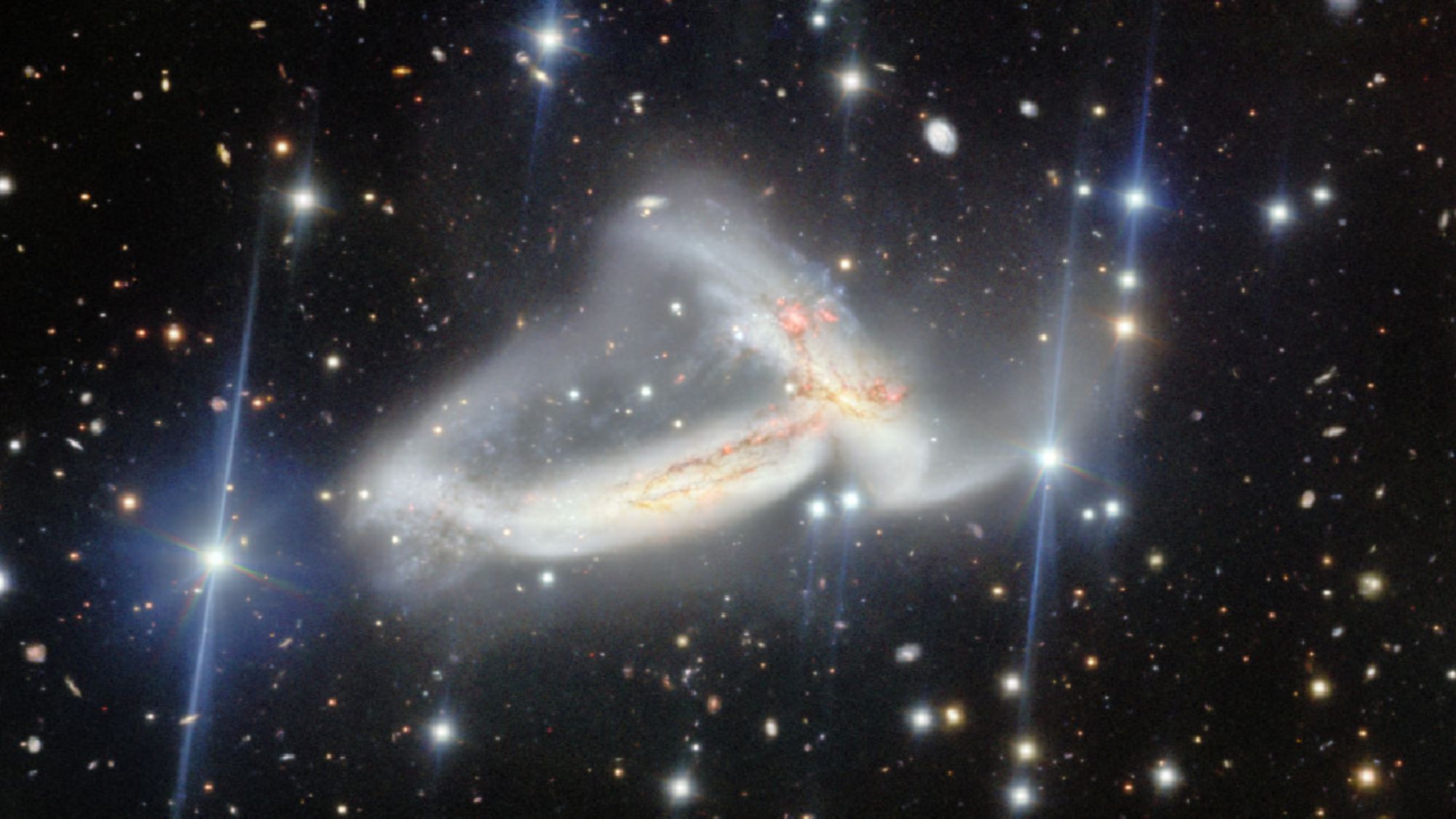
It is nearly impossible to fathom the entirety of a single galaxy — these realms can span hundreds of thousands of light-years, and sometimes are even millions of light-years across. So imagine the grandeur of now one but two galaxies tangled together, in the process of merging into one. That’s what you’re seeing in today’s featured image.
What is it?
The merging galaxies shown above were discovered by a group of students using the Gemini North Telescope, located on the Maunakea volcano in Hawaii — a very popular and often controversial location for ground-based telescopes. The students hailed from two local institutions, Waiākea High School and the Volcano School of Arts and Sciences, and had access to the telescope with the Project Hōkūlani internship.
They named their discovery Nā ‘Uhane Māhoe Huki Pū i ke Ola, which translates to “The Twin Spirits Pulling Together Creating Life.”
“‘Uhane (spirit) was an important theme for our group. Our experiences throughout the week — ‘oli (stargazing), visiting the summit and learning about the awesome scientific discoveries made possible by Maunakea — ignited our own spirits as we prepare for life after high school,” Samantha Silva-Sampaio, one of the students, said in a statement.
The students also explain how the rest of the name fits in with their time at Gemini North. “Huki Pū,” they say, has to do with the physical aspect of the two galaxies being pulled together, just like communities coming together to enable the discovery as a whole. And “i ke Ola” is meant to show that life can be created from interacting galaxies because this process gives rise to star birth, and hopefully we’ll find a star besides the sun one day that hosts life on a world around it.
Why is it incredible?
The galaxy merger depicted in the image is formally known as NGC 7253 and is located around 200 million light-years from Earth in the constellation Pegasus. This region is also known as the Hawaiian constellation Ka Lupe o Kawelo.
What’s especially spectacular about the image we see above is how sharply defined both galaxies appear during their gravitational interaction. It is also a treat to be able to live in a time when we can view an event happening so utterly far away with this much detail.
Galaxy mergers aren’t a new thing, though. They occur all across the universe, and indeed even the Milky Way and our neighboring galaxy Andromeda are expected to collide (or maybe not?) at some point in the future. But not to fear — though it may not seem it from this image, within every galaxy is, well, a lot of space. So much so that it’d be surprising for anything in the colliding galaxies to actually smash together.
What does happen, however, is enchanting. All the interstellar gas and dust from both galaxies join together and lead to a spike in star formation. This means a ton of beautiful sparkles should decorate the final product of NGC 7253.
“‘Uhane in this image reminds us that astronomy is not just science or spirit; it’s both at the same time,” Manu Silva-Sampaio, another one of the student discoverers, said in the statement.
Author: Monisha Ravisetti
Source: Space.com
Reviewed By: Editorial Team
