

Samsung’s research centre in Noida is taking on a larger role in the company’s global smartphone development, with teams in India helping build features for flagship Galaxy devices while also pushing ideas born out of Indian usage patterns into products sold in other markets.
That shift matters because it shows how India is moving beyond being only a large smartphone market for global brands. It is also becoming a source of product thinking, software development and artificial intelligence features that can travel worldwide. At Samsung, this change is evident in the work of the Samsung R&D Institute India-Noida (SRI-N), which has grown from a regional software unit into one of the company’s major overseas mobile software development centres.
From regional support to global ownership
Established in 2007, SRI-N initially focused on regional adaptation of Samsung mobile software and multimedia verification. Its responsibilities have since expanded to global software development for Galaxy smartphones, including AI features, user experience, health and safety tools, and network optimization. The center has also developed Android Go optimisations, Chat over Video, and other features for Indian users, while filing hundreds of patents in AI, mobile security, healthcare, and audio processing.
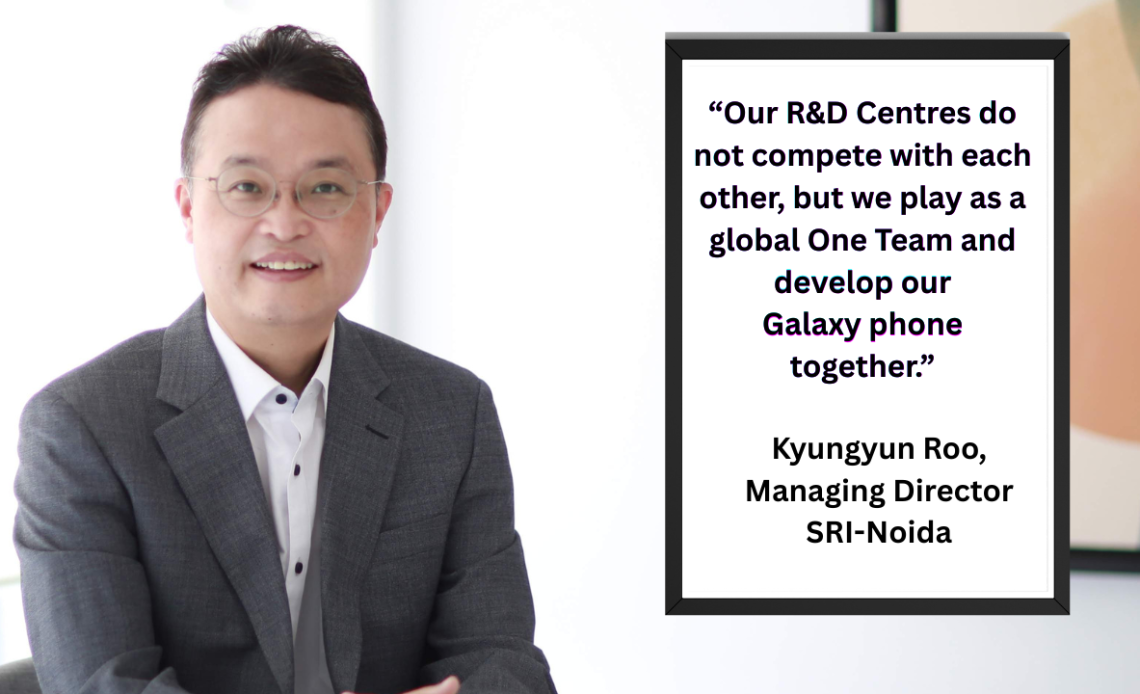
Kyungyun Roo, Managing Director of SRI-Noida, describes the development process as collaborative across geographies rather than segmented.
“At Samsung, the global R&D centers and the Suwon R&D center collaborate closely on projects and we work as a global One Team,” Roo said to The Mobile Indian.
He further explained, “For example, the framework team discusses about the structure, features, design and so on. And we develop together as one team. Our R&D framework team and the Suwon framework team and other R&D centers collaborate as one team. Some modules are developed by us, some by the Suwon R&D office and we collaborate. For testing, our R&D centre also has its own test team. When we find an issue, we register it in our global portal and check and resolve it together. So, I can say we do not compete with each other, but we play as a global One Team and develop our Galaxy phone together.”
This collaborative model enables features developed or refined in India to be integrated into Samsung devices globally, rather than remaining exclusive to the Indian market.
India-led features scale globally
One example is Direct Voicemail, which Samsung developed in response to user feedback from India. Initially launched in the Galaxy A series after identifying demand through the Samsung Members community, the feature was later introduced globally with the Galaxy S26 series.
Roo said, “The Direct Voicemail feature is one such feature and it also includes the AI features. Last year, when we were working on the Galaxy A series, there was consumer feedback through the Samsung Members community. Our teams identified a need for this feature: if I miss a call, I should be able to recall it via voice recording. So, from there on, we launched Galaxy A17 with this feature last year, and we received positive consumer feedback. Then, we proposed this feature for the global market and it was launched with the Galaxy S26 series.”
Backup Calling is another feature inspired by practical challenges in India, such as patchy networks and widespread Dual-SIM usage. Many users keep one SIM for banking and communication, and another for data or better coverage, which can cause issues when one network fails.
This is where India’s role becomes easier to understand. The market’s scale matters, but so do its real-world conditions: crowded environments, dual-SIM behaviour, frequent OTP-based transactions and uneven connectivity. Those usage patterns create product problems that often do not show up as sharply in other markets.
AI, privacy and safety at the centre
SRI-Noida is also involved in Samsung’s shift towards on-device artificial intelligence, where processing occurs directly on the smartphone rather than relying on cloud servers. Samsung says Galaxy AI development is guided by both global demand and Indian user feedback. It is also trying to ensure that AI systems remain safe, especially when users test the boundaries of generative tools.
“Whenever we launch a feature, it has to be perfectly safe. So, there are lots and lots of additional algorithms that we put in just to ensure that inappropriate content is not shown. There are many features even in the Gallery, where we do not show certain types of generative contents or answer inappropriate questions, said Roo.

Talking about Agentic AI, he said, ” One of the things that we are doing is Personal Data Engine and Personal Data Intelligence. So, it is personalised to an extent that it is completely on-device. So, anything we learn from the user is on-device, and the user controls what to use and what not to use. The whole feature itself can obviously be disabled.”
This focus on on-device intelligence is becoming more important across the industry as smartphone brands try to reduce latency, improve privacy and make AI features work more reliably even when connectivity is weak. SRI-Noida’s work on model efficiency, network stability, multilingual audio processing and testing AI against Indian usage patterns fits into that broader shift.
Privacy Display is another case where a global feature has been shaped by a very local behaviour pattern. Samsung says the feature was designed to help keep sensitive content hidden from side angles, a common concern in crowded spaces. But the company also sees a specific Indian need around OTPs, which are widely used in banking and digital transactions.
Roo said, “In India, many OTPs come, right? The traditional film blocks all the things. But our Privacy Display only enables the security area, the notification area.”
Also, the use cases for privacy display are not specific to India; we do have a global use case, Samsung executive clarified. He said, “Shoulder surfing is common everywhere, including in India, like when we commute. Everyone is complaining, and they are using the film, which is an upper layer fitting onto the screen. So that’s where the dust and heat the film would be created, but our technology is at the display level, so the impact of these dust and heat will not be there.”
Talent pipeline and academic partnerships
To support its expanding role, SRI-Noida has partnered with leading Indian institutes, including IIT Delhi, IIT Kanpur, IIT Bombay, IIT Ropar, IIT Madras and the Indian Institute of Science (IISc), Bangalore. These collaborations include joint research, sponsored R&D, student and faculty engagement, engineer training, fellowships, internships, publications, consultancy, technology licensing, and work in AI, digital health, generative AI, and Indian language technologies.
The model serves two purposes. It gives Samsung access to talent and research, and it gives Indian students and faculty exposure to product development that can lead to commercial devices. It also fits into larger themes such as digital access, multilingual AI and local innovation.
| Institute | Signing Timeline | Focus Areas | Key Collaboration Elements |
|---|---|---|---|
| Sponsored projects, fellowships, facility development and multilingual AI research for devices | 2026 | Indian Institute of Science, Bangalore | Collaboration and bringing together experts from both sides to explore new frontiers in advanced technology and innovation |
| Indian Institute of Technology Madras | 2025 | AI for Indian languages, HealthTech, Generative AI | Sponsored projects, fellowships, facility development, multilingual AI research for devices |
| Indian Institute of Technology Bombay | 2024 | AI, Digital Health, emerging technologies | Joint research (Koita Centre), faculty collaboration, training programs, joint papers |
| Indian Institute of Technology Kanpur | 2024 | AI, Cloud, Generative AI, Visual computing, Security | Industry projects, student involvement, certifications, joint publications |
| Indian Institute of Technology Delhi | 2024 | AI and emerging technologies | Long-term collaboration, research exchange, talent pipeline |
| Indian Institute of Technology Ropar | 2024 | AI, innovation initiatives | Research projects, higher studies and advanced technology |
Balancing upgrades and new development
As smartphones become increasingly software-driven, the challenge for R&D teams is balancing incremental improvements with new-feature development.
Samsung notes that the challenge is to both innovate and continuously improve existing devices throughout an extended software lifecycle, a challenge that is increasingly demanding as the company now supports seven generations of OS upgrades.

Asked how effort is divided between improving existing features and building new ones, Roo said, ” We are improving things continuously. As you know, Samsung supports seven OS upgrades. And our R&D center works on every OS upgrade, we are improving continuously. At the same time, our AI and framework teams continuously develop new features. But we do not have a dedicated team for OS upgrade and one for new development. We are all working together. So, one engineer is involved in the upgrade and also in creating new things. So, synergy is there.”
Looking ahead
The growing influence of SRI-Noida reflects a broader shift in the global technology industry, where product development is no longer confined to headquarters but distributed across key markets. For Samsung, India is not only a major consumer base but also a source of ideas shaped by real-world usage conditions such as dense urban environments, multilingual needs, and inconsistent connectivity.
As smartphones move towards deeper integration of on-device AI and automation, the role of centres like Noida is likely to expand further. The next phase of development, as executives suggest, will focus on evolving form factors and advancing agentic AI-areas that remain under active exploration with no fixed timelines yet.
Author: Sandeep Budki
Source: The Mobile Indian
Reviewed By: Editorial Team