

A drone strike shut down Saudi Arabia’s East-West oil pipeline this week, knocking roughly 5 million barrels a day offline. That’s about 5% of global supply, and it pushed Brent crude above $104. US diesel is at record highs.
That’s the fossil fuel crisis making headlines. The quieter one is on your own utility bill, and it’s not getting better either.
The East-West line, also called Petroline, is the pipe Saudi Arabia uses to move crude to the Red Sea and skip the Strait of Hormuz. With Hormuz already choked and the Houthis squeezing Red Sea shipping, that bypass was one of the last shock absorbers left in the oil market. Now it’s gone too. One analyst put it bluntly: the buffers that got the market through the past six months “have basically been worn away.”
For anyone driving on gasoline, there’s nothing to do here but pay. A combustion car gives you exactly one option: the pump. When a drone hits a pipeline halfway around the world, that’s your problem, and your only move is to hand over more money at the station.
An EV gives you a second option. And right now, a second option is the whole game.
The domestic energy crisis nobody’s bombing
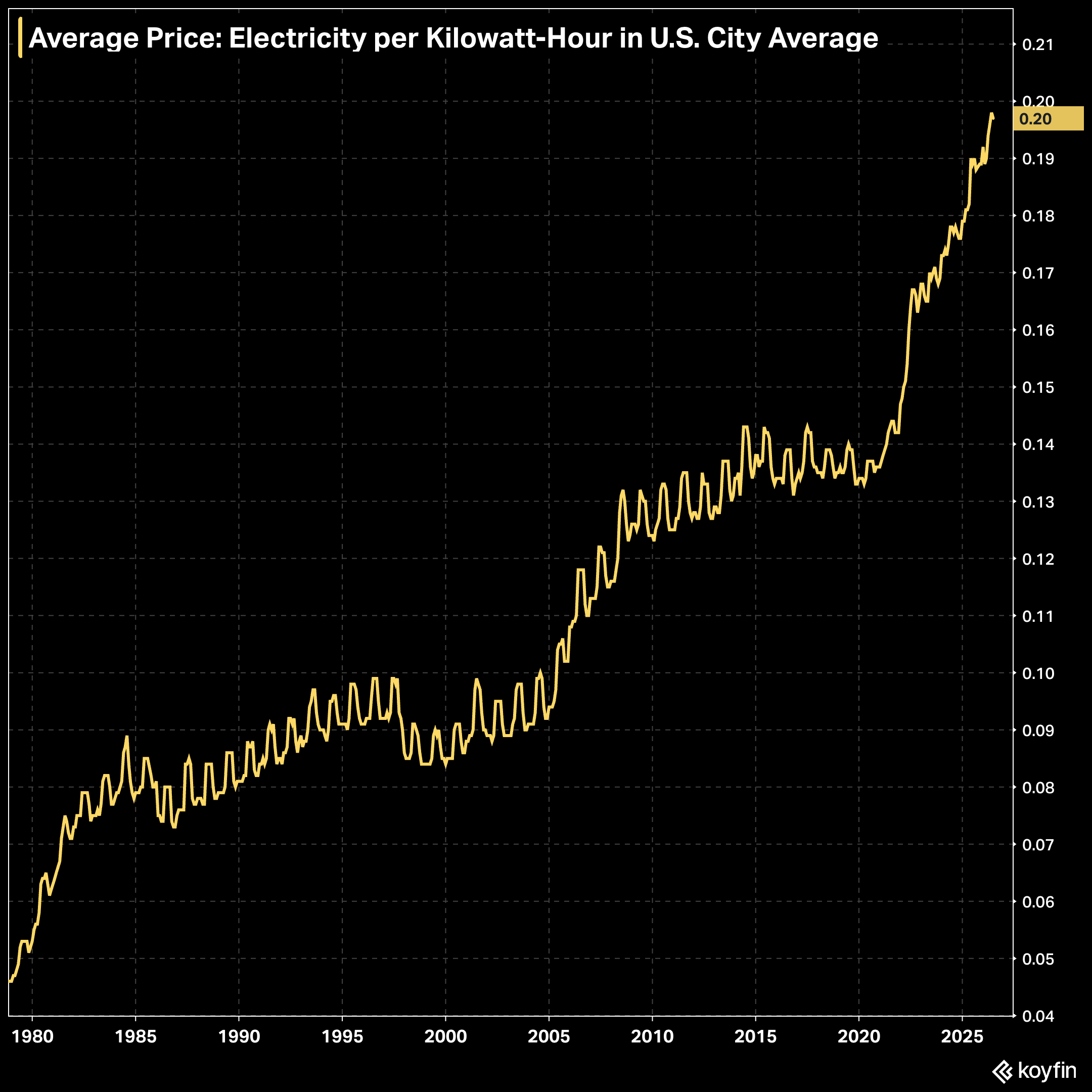
Look at the chart of average US electricity prices and you’ll see the other half of the story. Power in the US city average just hit roughly $0.20 per kilowatt-hour. It was around $0.13 in 2020. That’s a jump of more than 50% in six years, and the line has gone nearly vertical since 2022.
This isn’t a blip. The EIA expects wholesale power prices to keep climbing, up 23% in 2025 and another 8.5% in 2026, with natural gas costs and surging demand doing the damage. And the biggest new source of that demand isn’t you. It’s data centers and crypto mining, which the EIA pegs at about two-thirds of projected US electricity sales growth for 2026.
So here’s the setup. AI companies are building power-hungry data centers as fast as they can, utilities are passing the cost of new generation and transmission onto everyone, and residential ratepayers are absorbing the bill. We covered how data centers are straining the grid and driving homeowners toward solar and batteries back in May. It’s only accelerated since.
At this pace, US electricity prices are on track to roughly double over the decade. Two crises, oil and power, both trending the same direction. Up.
Don’t count on the people in charge to fix it
The honest read is that no one steering this is coming to rescue your bill.
Federal energy policy swings with every election. Utilities are regulated monopolies that make money by building more and charging you for it, so rising rates aren’t a bug in that model. And the data center boom driving demand is backed by the most valuable companies on earth, who have far more lobbying power than the average family watching their power bill climb. When the incentives of everyone with authority point toward higher prices, waiting for them to lower yours is a bad bet.
We wrote last month that energy independence has gotten personal. This is the same point, scaled up. The only part of this system you actually control is your own roof and your own driveway.
What independence actually looks like
Start with the EV. Forget performance and emissions for a second. I’d argue BEVs are better cars than ICEs overall, but their core advantage is choice. A gas car sources energy one way. An EV can charge from the grid when rates are low, from your own solar panels for close to nothing, or from a battery you filled at 3 a.m. on an off-peak plan. Every one of those is a lever a combustion car doesn’t have.
Add home solar and the math gets serious. Homeowners who’ve installed panels keep sharing real-world data showing bills cut to almost nothing, and pairing panels with storage locks in your cost of energy for 25 years while everyone else rides the rate escalator. Fuel your car off that solar and your cost per mile drops toward zero. No pipeline, no pump, no rate hike. You now own your own power plant that isn’t dependent on the whims of megalomaniac world leaders.
Then there’s the piece that ties it all together: vehicle-to-home. Bidirectional charging turns your EV into the biggest battery you’ll ever own. A Chevy Silverado EV paired with GM’s charger can power an average home for up to 21 days. And this isn’t a one-truck novelty anymore. The Ford F-150 Lightning, GM’s Ultium lineup, the Kia EV9, the Tesla Cybertruck, and the new Model Y Performance all support powering a home. Utilities are even starting to pay for it, like PG&E’s expanded V2X program offering up to $17,000 in incentives.
Solar fills the car. The car backs up the house. The house leans on the grid only when it wants to, not because it has no other choice.
Author: Fred Lambert
Source: Electrek
Reviewed By: Editorial Team