

The ballooning use of unmanned technologies including drones has consequences for the U.S. nuclear stockpile and associated infrastructure, according to the leader of Strategic Command.
Militaries and extremist groups around the world are deploying drones and other robotic technology to collect intelligence, aid targeting and even attack from relative safety. Learning how to intercept and neutralize them has quickly become a priority for Defense Department officials, who are monitoring skirmishes across Ukraine and the Greater Middle East.
The proliferation of sophisticated uncrewed systems “poses a challenge to the department and our nation’s nuclear enterprise,” Air Force Gen. Anthony Cotton said in his 2024 Strategic Posture Statement, which was sent to Congress on Feb. 29. The matter is further complicated by an “accelerating technological race with our adversaries,” namely Russia and China, he said.
Cotton’s command, headquartered at Offutt Air Force Base in Nebraska, oversees the U.S. nuclear arsenal and supports electromagnetic operations and missile threat assessment.
STRATCOM in 2022 and 2023 tested counter-drone weaponry to better understand its effectiveness and inform future investments, Cotton said in his statement. He did not disclose results.
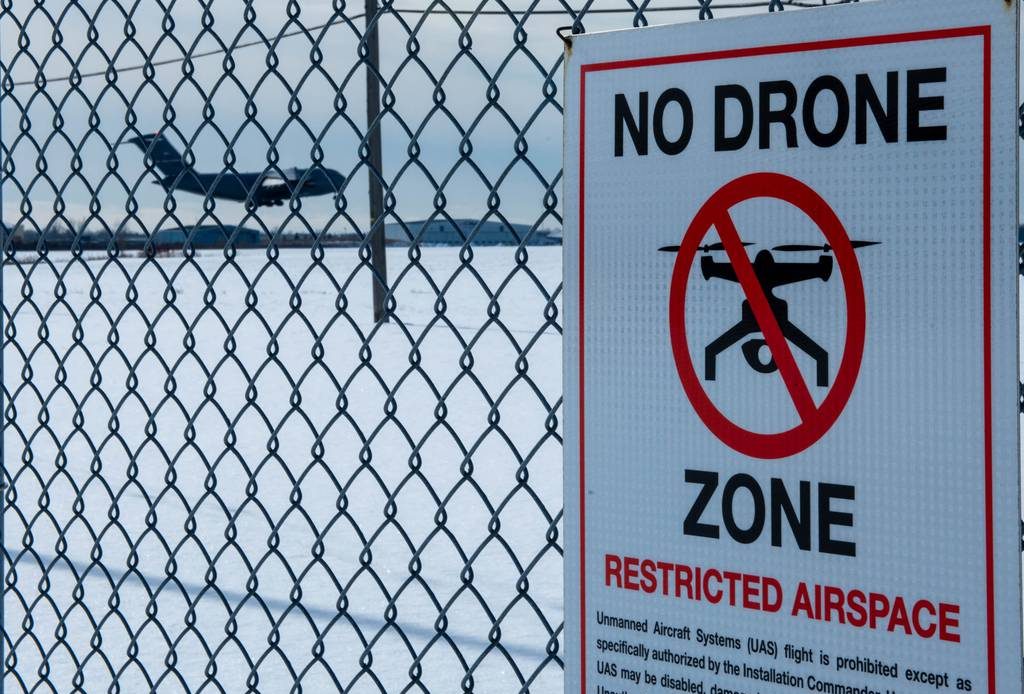
So-called “no drone zones” were established years ago at military bases and nuclear weapons sites, including where parts are made and maintained. A provision in the 2017 National Defense Authorization Act empowered the Department of Energy’s National Nuclear Security Administration to protect its facilities from drones considered hazardous to safety or security.
RELATED
:quality(70)/cloudfront-us-east-1.images.arcpublishing.com/archetype/FGDZ45SEH5CSHNT7H22R7HX3UU.jpg)
The zones cover sensitive compounds such as Los Alamos National Laboratory in New Mexico, where nuclear-weapon cores known as pits are expected to be manufactured; the Y-12 National Security Complex in Tennessee, where uranium-processing facilities are being built; and the Nevada National Security Site, where subcritical experiments and nonproliferation research are conducted.
NNSA leadership in December visited the Nevada site, where they were shown counter-unmanned aerial system technologies.
“These capabilities are applicable across all of NNSA’s sites,” Frank Rose, the administration’s deputy, said in a statement at the time. “We are developing the tools we need not only to counter the UAS of today but also to defend against evolving threats.”
Among the equipment showcased was the Anduril Industries-made Anvil. Anvil drones zip toward a target on a collision path with the goal of knocking threats out of the sky. An explosive variant dubbed Anvil-M offers the same sort of countermeasure, but instead relies on a fire-control module and munitions payload.
Rose was also pictured in front of a screen displaying Anduril’s command-and-control Lattice software.
Author: Colin Demarest
Source: DefenseNews