


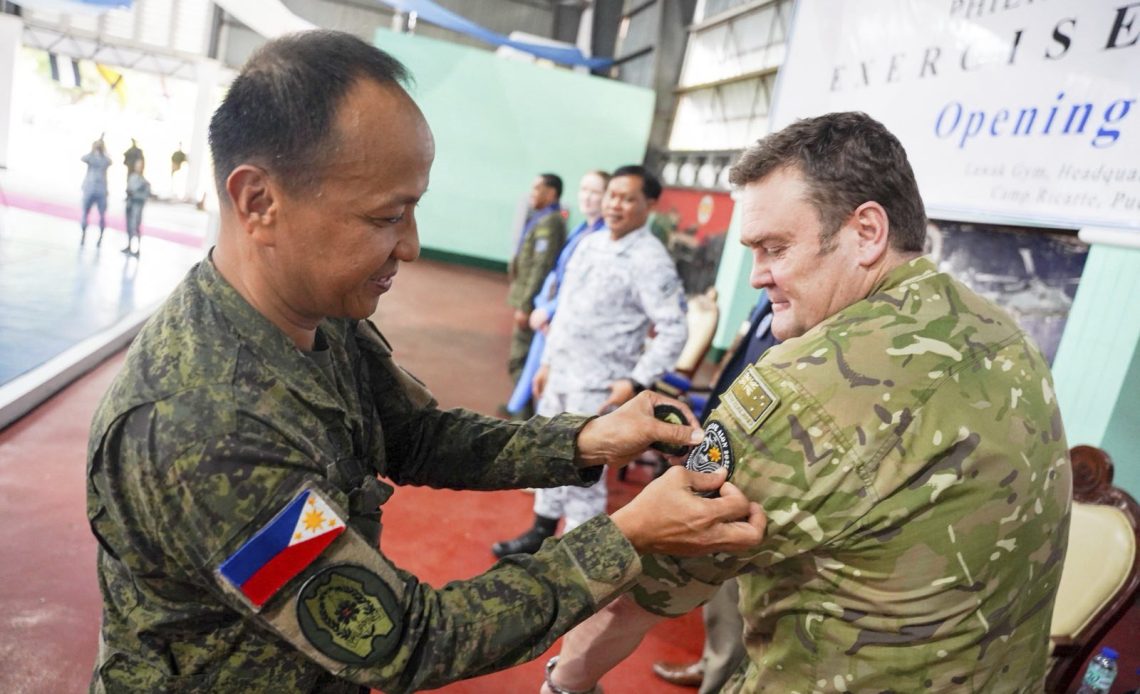
MANILA, Philippines — Australia on Friday launched its largest military exercises with Philippine forces, involving more than 3,600 military personnel in live-fire drills, battle maneuvers and a beach assault at a Philippine town facing the disputed South China Sea, where the allies have raised alarm over Beijing’s assertive actions.
The exercises are called Alon, meaning wave in the Philippine language, and will showcase Australia’s firepower. The drills will involve a guided-missile navy destroyer, F/A-18 supersonic fighter jets, a C-130 troop and cargo aircraft, Javelin anti-tank weapons and special forces sniper weapons.
Military officials said defense forces from the United States, Canada, Japan, South Korea, New Zealand and Indonesia will join as observers.
“This exercise reflects Australia’s commitment to working with partners to ensure we maintain a region where state sovereignty is protected, international law is followed and nations can make decisions free from coercion,” Vice Adm. Justin Jones of the Royal Australian Navy said in a statement.
The combat exercises are “an opportunity for us to practice how we collaborate and respond to shared security challenges and project force over great distances in the Indo-Pacific,” Jones said.
Two Chinese military vessels collide in South China Sea
The exercises will run until Aug. 29.
Australia is the second country after the U.S. with a visiting forces agreement with the Philippines, allowing the deployment of large numbers of troops for combat exercises in each other’s territory.
The Philippines has signed a similar pact with Japan, which will take effect next month. It is in talks with several other Asian and Western countries including France and Canada for similar defense accords.
China has deplored multinational war drills and alliances in or near the disputed South China Sea, saying the U.S. and its allies are “ganging up” against it and militarizing the region.
China claims most of the South China Sea, a busy global trade route, where it has had a spike of territorial faceoffs with the Philippines in recent years. Vietnam, Malaysia, Brunei and Taiwan also lay claims to the resource-rich waters.
On Monday, a Chinese navy ship collided with a Chinese coast guard ship while trying to drive away a smaller Philippine coast guard vessel in the Scarborough Shoal in the South China Sea.
The Australian Embassy in Manila expressed concern over “the dangerous and unprofessional conduct of Chinese vessels near Scarborough Shoal involving the Philippine Coast Guard” and said the incident “highlights the need for de-escalation, restraint and respect for international law.”
In response, the U.S. deployed two warships off the Scarborough on Wednesday in what it called a freedom of navigation operation to protest China’s expansive claims, restrictions and its demand for entry notifications in the disputed waters.
In February, a Chinese J-16 fighter jet released flares that passed within 30 meters of an Australian P-8 Poseidon military surveillance plane in daylight and in international air space, Australian defense officials said at the time.
Author: Jim Gomez, The Associated Press
Source: DefenseNews
Reviewed By: Editorial Team
