


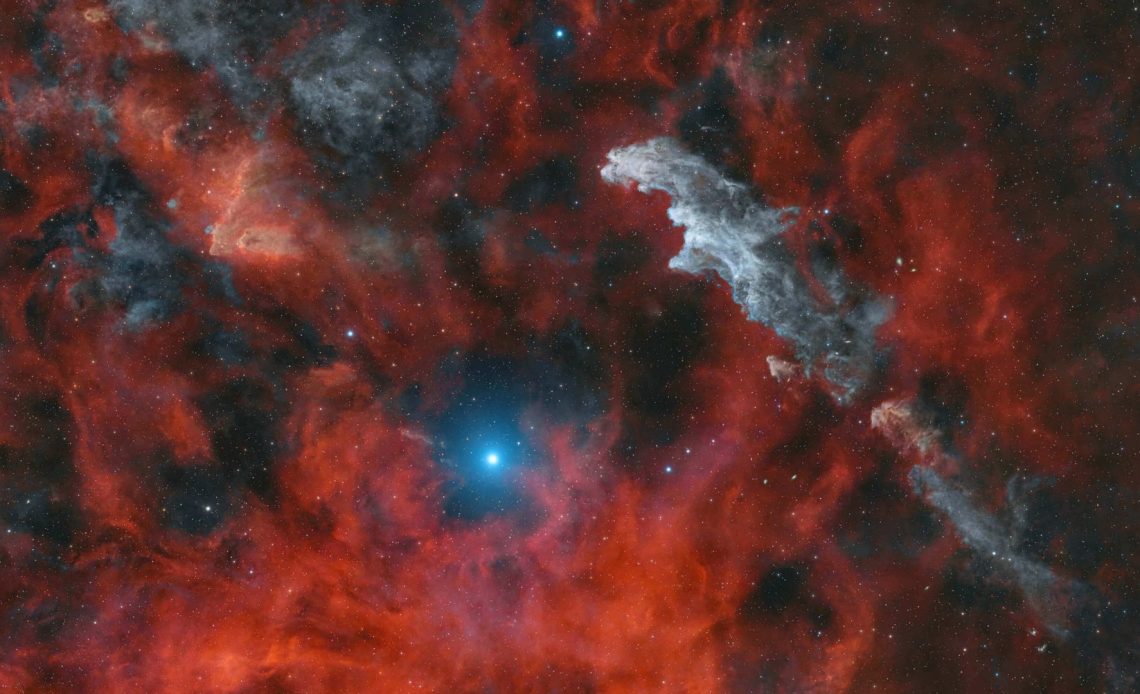
Did you know that roughly 800 light-years from Earth, out in the vast expanse of space, there is a witch who casts spells using her crystal ball?
I am, of course, talking about the Witch Head Nebula – officially cataloged by scientists as IC 2118 – a gigantic 50-light-year-long cloud of gas and dust located in the constellation Eridanus.
And her “crystal ball” is Rigel, a blue-white supergiant located in the neighboring constellation Orion. According to astronomers, the brilliant star is the seventh-brightest in the night sky, some 120,000 times brighter and 20 times more massive than the Sun.
Image 1 of 2
(Image credit: Piotr Czerksi)
(Image credit: Piotr Czerksi)
Piotr Czerski’s gear and settings
- Camera: ZWO ASI2600MC Pro
- Lens: Samyang 135mm f/2.0 ED UMC
- Exposures:
- LP filter: 62 × 300 seconds
- Multiband filter: 12 × 300 seconds
- Total integration time: 6 hours 10 minutes
“The blue reflection nebula is surrounded by a complex network of faint Hα emission (red visible light emitted by energized hydrogen atoms) and dark dust clouds, revealing subtle structures that are usually lost in shallower exposures,” Czerski explained in an Instagram post.
To capture the scene, the photographer used a ZWO ASI2600MC Pro camera and a Samyang 135mm f/2.0 ED UMC lens, taking 62 exposures with a light pollution filter and a further 12 using a multiband filter, each exposure lasting 300 seconds.
“It took six hours and ten minutes of total exposure time to capture all the faint details of the nebula,” said Czerski.
A post shared by Piotr Czerski (@piotr.czerski.photo)
So brilliant was Czerski’s frame that NASA recently selected it as its Astronomy Picture of the Day (APOD), the agency’s publication through which it shares a different and fantastic astro shot each day.
Czerski’s image was selected as the November 09 APOD, the fourth time the photographer has had an image featured by NASA.
“This long-integration view highlights the interplay of gas, dust, and radiation shaping this region of the Orion Molecular Complex (a vast, active star-forming region of interstellar gas and dust located in the constellation Orion),” Czerki said about his recently-published image.
Author: Alan Palazon
Source: DigitalCameraWorld
Reviewed By: Editorial Team
