


In a fascinating case that is sure to spark more casual arguments than it settled, a judge was recently forced to make a ruling on whether or not “mime pedaling” counted as truly pedaling an electric bike.
Mime pedaling, or the act of casually moving the pedals on an electric bicycle to provide the appearance of pedaling without actually meaningfully contributing to the mechanical locomotive effect of the bike, is a common occurrence on powerful electric bicycles being ridden on throttle-only or with substantial pedal assist motor power. It essentially makes it look like the rider is pedaling, when in fact little or no work is being done by the rider.
In the Netherlands, where fat tire bikes have come to represent a growing group of less traditional-looking e-bikes that are quite popular with younger riders, mime pedaling is sometimes used to hide the fact that the user is operating the bike with a hand throttle – a device that is not allowed on electric bicycles under EU law.
The law requires that the motor only provide assistance when the rider is pedaling, and that the motor cuts out when the rider ceases to pedal.

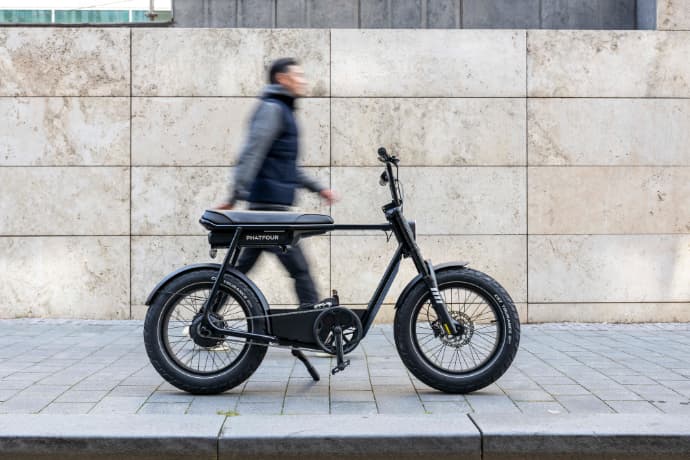
A case recently hit the courts in the Netherlands, where police had seized a Phatfour fat tire e-bike from a rider who they observed as potentially riding faster than the allowable 25 km/h (15.5 mph) legal limit and also moving his feet only up and down on the pedals, not completing a full pedal arc, but rather making just short choppy pedal movements.
The court requested the testimony of an expert, and so product compliance and safety consultant Rutger Oldenhuis was brought in. He examined the bike, performed road tests and roller tests to inspect its maximum speed, and provided his conclusions to the court.
As he explained in Bike Europe, the bike itself appeared to be fully compliant with local regulations, including that the motor assistance cut out at 25 km/h and did not allow the bike to exceed the legal power limits.
As for the strange “pedaling” motion, Oldenhuis explained that moving the pedals up and down allowed the bike’s cadence sensor to register pedal motion and thus activate the motor, despite the pedals not making complete successive 360-degree revolutions.
The more interesting question wasn’t whether this worked to engage the e-bike’s motor, but whether it was technically considered pedaling. Does pedaling require a complete 360-degree revolution to count?
“My conclusion was that Dutch law gives no clear basis for that requirement,” Oldenhuis wrote. “It does not say that pedaling must be a perfect circle. Technically, this matters. Many cheaper e-bikes use a cadence sensor rather than a torque sensor. A torque sensor measures force. A cadence sensor detects pedal movement. Limited up-and-down movement may be enough to activate assistance. But then again, even on a normal bicycle with a freewheel, you can move forward with limited pedal movements. It may not be pretty, but it is still pedaling.”
In the ruling, the court accepted the expert opinion that the Phatfour e-bike was not “tuned” or otherwise modified to operate outside of the legal electric bicycle framework, that it had no throttle, that it did not exceed legal speed limits, and that its motor was in fact activated by the user’s pedaling (even if that pedaling looked strange and inefficient). Ultimately, the court ruled that the police must return the bike to its owner.

Author: Micah Toll
Source: Electrek
Reviewed By: Editorial Team