

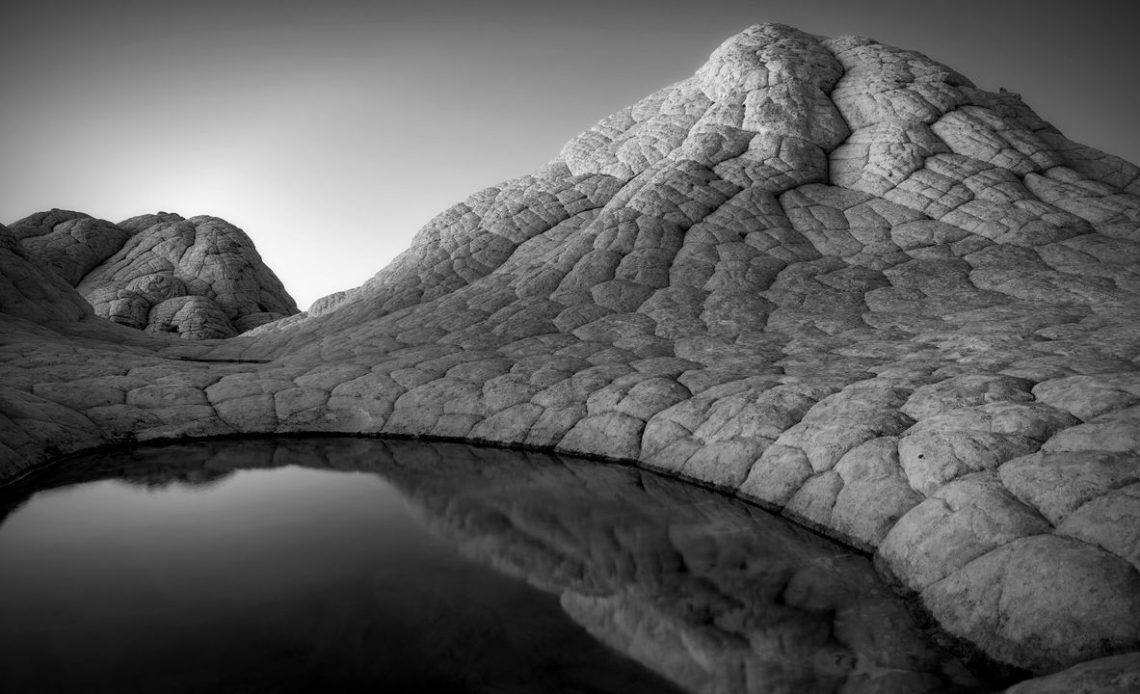
White Pocket, located in Arizona’s remote Vermilion Cliffs National Monument, requires a challenging four-wheel-drive journey across rough dirt roads. Yet despite its remoteness and the commitment required to reach it, the location has been photographed extensively.
This image by American photographer Dave Drost, however, shows that even well-known locations can yield fresh interpretations when approached with a clear creative vision.
The first thing that strikes you is the otherworldly simplicity of the scene. Brain-like sandstone formations rise from a mirror-still pool, their weathered surfaces rendered in shades of grey that emphasize every curve and crevice.
By switching to monochrome, Drost has transformed one of the American Southwest’s most colorful locations into an abstract study of form and texture. It’s a bold choice that earned him third place in the Photograph of the Year category in 2025’s International Landscape Photographer of the Year.
Technical approach
Drost used the Canon EOS R5 paired with the Canon RF 15-35mm f/2.8L IS USM lens at its widest 15mm setting. His exposure settings reveal careful planning: f/3.2 provides front-to-back sharpness, while a 1.3-second shutter speed transforms the water into a glassy mirror.
The R5’s 45MP sensor captures exceptional detail, while the ultra-wide focal length creates the dramatic perspective that makes the sandstone formations loom large against the sky.

The Canon RF 15-35mm lens is Canon’s widest constant-aperture professional zoom and notably produces virtually no visible distortion, even at 15mm. This was crucial when shooting the organic curves of White Pocket’s sandstone, ensuring the natural wave patterns remained true to life rather than being warped by lens aberrations.
Why monochrome works
White Pocket is typically photographed in color to showcase its striking red, white and pink striations. Counterintuitively, Drost’s decision to strip away color is what elevates this image above countless other shots of this location.
Without color as a distraction, viewers are free to engage directly with the extraordinary textures: the brain-like convolutions, the wave patterns etched by millennia of erosion, and the interplay of light and shadow across the weathered surfaces.

The monochrome treatment also gives the scene something of a timeless quality. Rather than appearing as a specific location in Arizona, the formations become almost abstract sculptures, their geological origins less obvious and more mysterious.
Drost positioned his camera low to the ground, incorporating the still water as a foreground element; a classic technique in landscape photography that adds depth and provides a reflective anchor for the composition.
The dual peaks of the main formation balance against this lower visual weight, creating harmony out of a scene that might otherwise look chaotic, given the complexity of the surface textures.
Overall, this award-winning image reminds us that compelling landscape photography depends on seeing beyond the obvious. Sometimes the most powerful addition to your creative toolkit can be subtraction.
Author: Tom May
Source: DigitalCameraWorld
Reviewed By: Editorial Team