

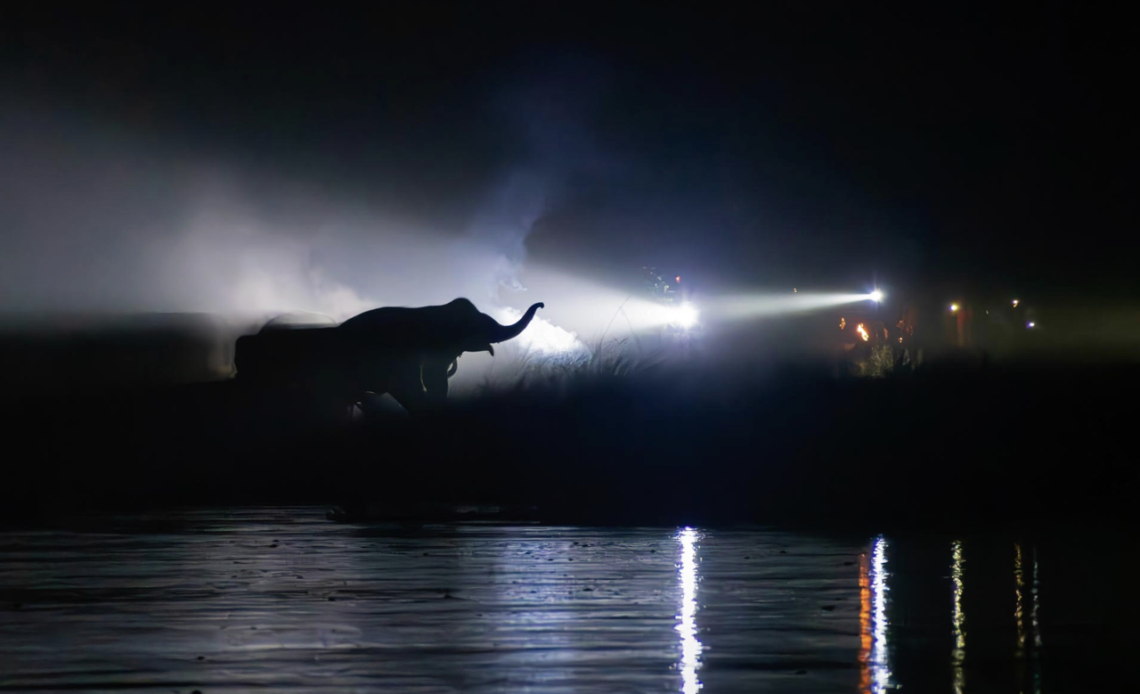
The tension between human habitation and animal migration is one of wildlife photography’s most potentially captivating themes. And this dramatic nighttime scene of an encounter between elephants and villagers along a West Bengal river captures it beautifully.
When Torchlight Meets Tusks depicts a moment of raw conflict in Bishnupur, West Bengal, India, as a herd of elephants attempts to wade across a river – only to be met with torchlight and firecrackers from local villagers attempting to drive them away.
The photograph’s power lies not in spectacle, but in its quiet documentation of a shared resource under pressure; a river that both communities depend upon for survival.
It won electrical engineer-turned-photographer Ramprasad Dutta a Special Mention in the prestigious Ramki Sreenivasan Conservation Photography Award at the Nature in Focus Photography Competition 2025.
Technical approach
What makes this image particularly impressive is Dutta’s ability to capture a coherent scene in near-total darkness. Working with a Nikon D7500 and a 70-300mm lens, he pushed the camera to ISO51,200; close to the upper limits of its standard sensitivity range.
At f/7.1 and 1/125 sec, the exposure settings reveal a photographer who understood exactly how to balance multiple light sources.

The D7500, while not Nikon’s flagship APS-C camera, has earned respect for its low-light capabilities thanks to its 20.9MP sensor and Expeed 5 processor. At ISO51,200, most cameras would produce images riddled with noise and color degradation. Here, though, Dutta retained enough detail in the elephants’ silhouettes and the atmospheric fog to evoke a cinematic, otherworldly quality.
The 70-300mm lens choice was critical, too. This focal range enabled Dutta to maintain a safe distance (essential when photographing wild elephants in a tense situation), while still compressing the scene enough to capture both the animals and the human response in a single frame.
Composition
Beyond the technical execution, what elevates this photograph is its compositional restraint and narrative power. Rather than sensationalizing the confrontation, Dutta has created an almost painterly scene.
The elephants emerge as dark silhouettes against beams of light cutting through the mist, their forms recognizable yet mysterious. The scattered lights in the background – from the warm orange of the flames to the cool white of the torchlight – add depth and context without overwhelming the frame.
The reflections in the shallow water at the bottom of the frame add a layer of visual sophistication, grounding the image while doubling the light sources into abstract patterns. This compositional choice transforms what could have been a straightforward documentary shot into something more contemplative.
In an era when wildlife photography often celebrates pristine wilderness or intimate animal portraits, When Torchlight Meets Tusks reminds us that some of the most important images emerge from the uncomfortable spaces where human and animal worlds collide.
That Dutta captured it all with accessible, consumer-level gear makes the achievement all the more remarkable.
Author: Tom May
Source: DigitalCameraWorld
Reviewed By: Editorial Team