

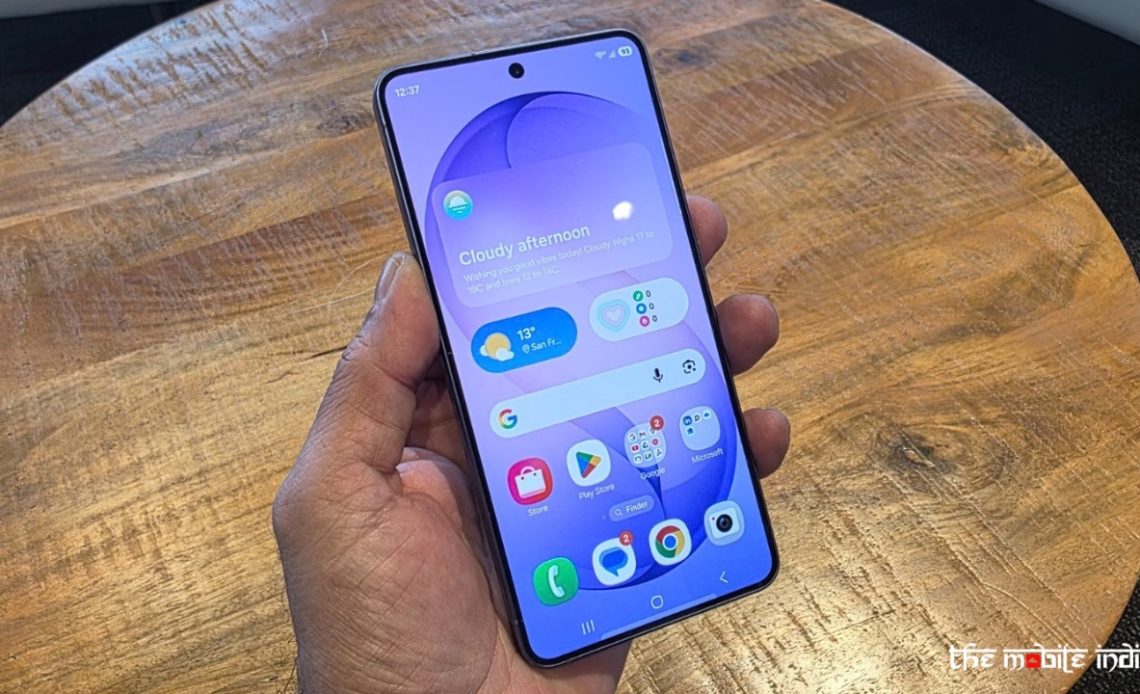
Rising memory costs and component constraints remain a challenge for smartphone makers, but Samsung Electronics is seeking to shield consumers from the full impact, a senior executive said, as the company positions artificial intelligence at the centre of its latest flagship launch.
“Memory shortage and escalation in price is a reality, and we are doing our best so that our customers don’t face a major impact because of it,” said Raju Pullan, Senior Vice President, Samsung India, in an interaction with The Mobile Indian on the sidelines of the Unpacked event at San Francisco where the Samsung Galaxy S26 Series was launched.
The comments come at a time when semiconductor supply volatility continues to influence device pricing across the industry. Manufacturers have grappled with higher input costs, especially for memory components that are key to enabling AI workloads on smartphones.
Slimmer Hardware, Broader AI Push
Samsung used its Galaxy S26 launch to underline its focus on both hardware engineering and AI integration. Pullan said the company has remained a leading player in hardware development, even as software-led intelligence becomes more prominent.
“This year, we have launched the slimmest Ultra phone ever. The S26 Ultra measures 7.9 mm,” he said, adding that design refinement remains a priority alongside performance.
The executive framed the shift in industry narrative as significant. “Gone are the days when we used to call a phone a smartphone. Now we have an AI phone as a reality,” he said.
The Galaxy S26 series builds on earlier multimodal capabilities seen in previous models, moving toward what Samsung describes as “agentic AI” – systems that can take proactive steps rather than only respond to commands. According to Pullan, earlier Galaxy S devices up to the S25 generation were equipped with multimodal AI, capable of handling text, voice and image inputs. With the S26 series, Samsung is introducing more autonomous features that can recommend actions and assist users in routine tasks.
“Our new phones are among the only smartphones in the world where AI will also recommend things to users to make their lives better,” he said.
Hardware and Software Integration
Samsung’s differentiation, Pullan argued, lies in the integration of hardware and software development. The company has been working on embedding AI capabilities in its phones for the past three years, he said, and the Galaxy S26 series reflects refinements based on consumer feedback.
“We have been ahead of the competition in terms of hardware and software, and we have optimised AI on the S26 series so that customers have a seamless experience for everyday tasks,” he said.
Despite the AI push, Pullan acknowledged that consumers in India do not yet prioritise AI features at the point of purchase. “At present, customers don’t specifically ask for AI features before buying a phone. But the winds are changing,” he said, adding that many users begin exploring AI tools after purchase.
That behavioural shift explains why Samsung continues to invest in traditional decision drivers such as camera, display and battery life – features that remain at the top of consumers’ wish lists.
Upgrade Strategy and Financing
Samsung expects not only existing S series users but also customers from its A series portfolio to consider upgrading to the S26 lineup. Pullan cited financing schemes as a lever to broaden access to the premium range.
The company is also linking its AI narrative with domestic priorities. Pullan described AI on the S26 as not just “agentic AI” but also aligned with the idea of “Atmanirbhar India,” signalling local relevance and ecosystem development.
Samsung, he said, believes in creating markets and new segments rather than merely competing within existing ones. To that end, it plans to build awareness around AI through multiple consumer touchpoints, from retail to digital engagement.
As memory prices remain under pressure, the company’s challenge will be balancing cost, innovation and consumer adoption. For now, Samsung appears to be betting that tighter integration of hardware and proactive AI features will help justify its premium positioning in an increasingly competitive smartphone market.
Author: Sandeep Budki
Source: The Mobile Indian
Reviewed By: Editorial Team