

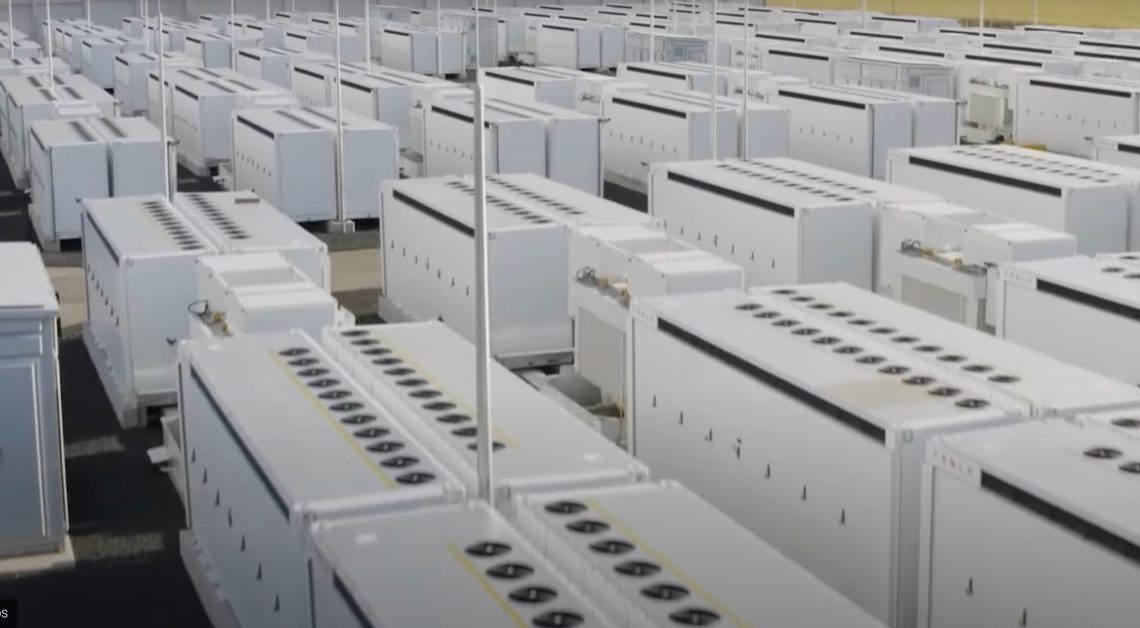
The US government has officially confirmed that Tesla is the customer behind LG Energy Solution’s massive $4.3 billion lithium iron phosphate (LFP) battery supply contract — ending months of speculation since LG first disclosed the deal last July.
The three-year agreement will see LG produce LFP prismatic cells at its Lansing, Michigan factory starting in 2027, feeding directly into Tesla’s next-generation Megapack 3 energy storage systems assembled at the Houston Megafactory.
Domestic supply to shield Tesla’s energy business from tariffs
The confirmation came during the Trump administration’s Indo-Pacific Energy Security Summit, with the US Department of the Interior stating that “American-made cells will power Tesla’s Megapack 3 energy storage systems produced in Houston, creating a robust domestic battery supply chain.”
The timing is no coincidence. Tesla’s energy storage division, the company’s only consistently growing business segment, has been under direct threat from tariffs on Chinese battery imports. Tesla’s CFO warned last April that tariffs would have an “outsized” impact on the energy business because it relies almost entirely on LFP cells sourced from China. Chinese LFP cells now face tariffs as high as 82.4% under combined Section 301 increases.
That makes this deal existential for Tesla’s Megapack production. Without a domestic LFP supply, Tesla would either need to absorb punishing tariff costs or pass them on to utility customers — either scenario threatening the growth trajectory of a business that deployed 31.4 GWh in 2024, more than double the prior year.
In 2025, growth slowed down a bit, but Tesla still deployed 46.7 GWh.
LG’s Lansing plant: from GM joint venture to Tesla supplier
The LFP cells will be produced at LG Energy Solution’s Lansing, Michigan facility — a plant with a fascinating history. It was originally built as Ultium Cells 3, a $2.6 billion joint venture between LG and General Motors announced in January 2022. GM sold its stake to LG in May 2025, giving the Korean battery maker full ownership and the freedom to pivot the 50 GWh-capacity plant toward LFP production for energy storage.
LG is now converting production lines at the facility to manufacture LFP prismatic cells, a chemistry the company hadn’t previously mass-produced in the US. Equipment orders have already been placed, with mass production expected in the second half of 2027. That timeline aligns with the contract’s August 2027 start date, running through July 2030 with options to extend duration and increase volumes.
The deal positions LG Energy Solution as the only major battery supplier currently scaling US-based LFP production, ahead of Samsung SDI and SK On.
Part of Tesla’s broader push to secure domestic battery supply
This LG deal doesn’t exist in isolation. Tesla has been aggressively locking up domestic battery supply for its energy storage business over the past year. In November 2025, Tesla secured a separate $2.1 billion deal with Samsung SDI for approximately 10 GWh of LFP cells per year, produced at Samsung’s joint venture facility with Stellantis in Indiana.
Combined, these two Korean suppliers alone represent over $6.4 billion in committed battery supply for Tesla’s energy storage products. That’s a massive bet on replacing Chinese imports with domestic production — and a significant validation of the Megapack business’s growth trajectory.
When we first reported on this deal last July, Tesla was rumored to be behind LG’s then-unnamed $4 billion LFP order. The speculation made sense: LG mentioned the cells were for stationary energy storage, and Tesla was the only buyer with enough volume to justify that kind of commitment. The US government has now removed all doubt.
Megapack 3: the product these batteries will power
The LFP cells from LG’s Lansing plant will go directly into Tesla’s Megapack 3, unveiled in September 2025. The next-generation system uses larger 2.8-liter battery cells to deliver roughly 5 MWh of capacity per unit — up from 3.9 MWh in Megapack 2. Tesla also simplified the thermal management system, reducing connections by 78%.
Tesla plans to begin building Megapack 3 at its Houston Megafactory in late 2026, with the facility targeting 50 GWh of annual production capacity. The LG supply deal starting in August 2027 suggests Tesla may initially rely on existing Chinese cell inventory or other suppliers for the first months of Megapack 3 production before the domestic LFP supply comes online.
Author: Fred Lambert
Source: Electrek
Reviewed By: Editorial Team