


Whether it’s to keep the lights on after a natural disaster or just to avoid peak energy rates, more people than ever are adding battery energy storage to their home solar systems — but li-ion batteries aren’t the only option. The new WATT Fuel Cell uses the natural gas connection your home already has to generate power when you need it.
Technically a solid oxide fuel cell, the WATT unit turns the natural gas in your home into electricity without combustion, relying instead on a chemical reaction between the natural gas and oxygen in the air to create an electric current in a way that’s conceptually similar to a hydrogen fuel cell, but that makes use of a more readily available (and far cheaper) fuel source to generate power while producing far fewer harmful emissions than a conventional generator.
How it works
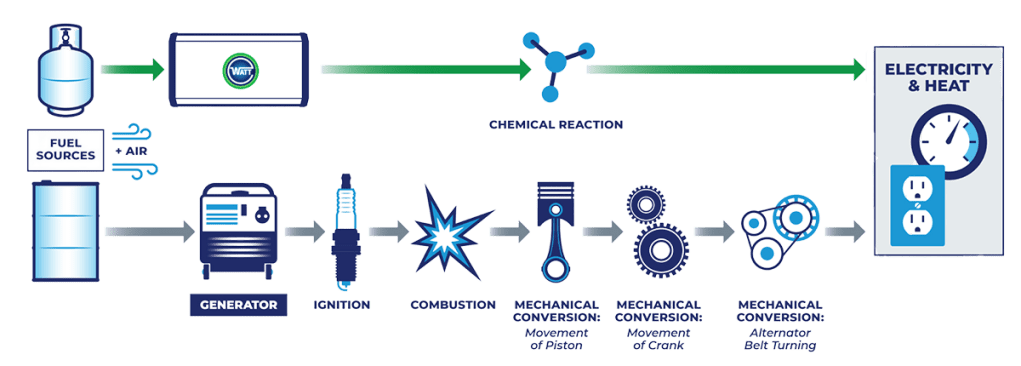
The company’s latest offering, the WATT HOME system, recently achieved certification at a 2 kW power rating, marking an important step on the company’s commercialization roadmap as it races to meet market demands for a natural-gas-powered backup solution to guarantee uptime in outage-prone regions.
This week, the company marked another major milestone by installing the of its first 2 kW WATT HOME solid oxide fuel cells (SOFC) at the Edward M. Smith National Career and Life Skills Development Center, Hope Gas’ new state-of-the-art training facility in Clarksburg, West Virginia – but the news doesn’t end there.
The company plans to take advantage of the new 30% ITC benefit (a federal tax credit that lets homeowners deduct 30% of the cost of qualifying clean energy systems, which now includes natural gas) under the One Big Beautiful Bill Act to help drive sales, with installations beginning in Hope Gas’ utility territory in Q1 of 2026.
“The WATT HOME system’s new 2 kW certification … validates the performance capabilities we’ve engineered for years and strengthens our competitive position as we move into multi-year deployment with Hope Gas,” says Caine Finnerty, WATT’s CEO and Founder. “With the ITC benefit, we anticipate accelerated adoption and substantial value for customers, utilities, and investors.”
The gas fuel cell can send power directly to the home’s panel, keeping the lights on directly, or perform the same function as a solar panel, sending power to a battery where it can be stored for later use.
Keep in mind, though – this isn’t a zero emissions option the way a solar + battery solution is. This is very much a fossil fuel-powered solution that gives off carbon and nitrous emissions, and the only reasons we’re talking about it are:
- the tech is kind of cool
- I didn’t know these existed
- it is objectively cleaner than a conventional ICE generator
That said, while solar is still the better solution in an ideal world, a WATT HOME fuel cell might be a better option in situations where rooftop space is limited (or nonexistent), such as condos or vertically-designed townhomes. In those scenarios, solar panels are unlikely to generate a meaningful amount of electricity, but a fuel cell that can tap into the buildings’ existing natural gas lines to provide reliable backup power if the grid fails.
That makes the fuel cell an attractive option for residents in multi-unit buildings, older historic neighborhoods with strict aesthetic rules, or any building where adding solar panels aren’t feasible, but a low-emission, low-noise backup solution is still needed.
The better question, then, isn’t is it better than solar – it’s is it better than solar for you? If you’re in West Virginia, you might be able to find out in just a few weeks. In the meantime, watch WATT’s own explainer video, below, then let us know what you think of the idea of a natural gas fuel cell in the comments.
Powering your home with a fuel cell
SOURCE | IMAGES: WATT, via PRNewswire.
Author: Jo Borrás
Source: Electrek
Reviewed By: Editorial Team