


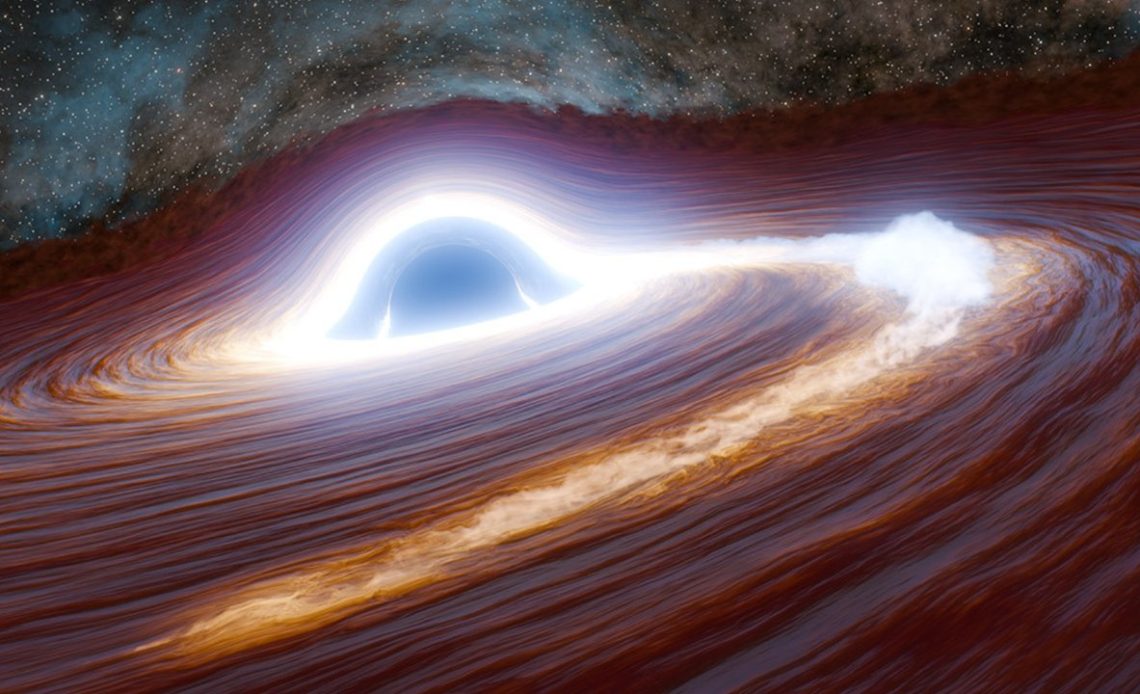
Astronomers have witnessed a cosmic explosion that emitted as much energy as 400 billion suns. The event, which has been nicknamed “the Whippet,” is a staggeringly powerful example of a Tidal Disruption Event (TDE) and is the result of a super-sized star being shredded and devoured by a black hole.
TDEs occur when stars wander too close to black holes. The immense gravity surrounding black holes generates strong tidal forces that simultaneously squash and stretch these stars, creating strands of “stellar spaghetti.” This stellar pasta twists around the black hole like spaghetti around a fork, forming a swirling flow of gas and dust known as an accretion disk that gradually feeds the cosmic titan. However, black holes are messy eaters, and some of this ex-stellar matter is blasted out from around them in parallel jets.
Even among these powerful and violent events, the Whippet, officially designated AT2024wpp, stands out as one of the biggest cosmic explosions ever seen, a TDE on a completely different scale.
“We discovered what we think is a black hole merging with a massive companion star, shredding it into a disk that feeds the black hole. It’s a rare and awe-inspiring phenomenon,” team leader Daniel Perley, of Liverpool John Moores University in the UK, said in a statement.
“Even though we suspected what it was, it was still extraordinary. This was many times more energetic than any similar event and more than any known explosion powered by the collapse of a star. Not only do these events help us identify black holes, they provide a new way to identify where black holes occur and how they form and grow, and the physics of how this happens.”
Tracking the Whippet
AT2024wpp was first discovered by astronomers using the Zwicky Transient Facility at Palomar Observatory in California. It was immediately remarkable for its resemblance to the cosmic explosion AT 2018cow, a stellar explosion that was between 10 and 100 times as bright as the average supernova.
The Whippet also resembled a Luminous Fast Blue Optical Transient (LFBOT), an incredibly bright burst of light visible at distances up to billions of light-years that typically last a few days and shine high-energy radiation ranging from the blue end of the optical region of the electromagnetic spectrum through ultraviolet and X-ray wavelengths. Though dozens of these events have been detected, LFBOTs are still poorly understood, though scientists have linked them to the destruction of stars.
Researchers followed up on the Whippet with Liverpool Telescope in the Canary Islands and NASA’s Swift spacecraft, confirming it was extremely blue and producing X-rays, exactly as is expected from an LFBOT. Team members R. Michael Rich at the University of California, Los Angeles (UCLA) and Yu-Jing Qin at the California Institute of Technology (Caltech) confirmed the distance to the Whippet, also confirming this wasn’t just a normal supernova. This, coupled with the fact that the Whippet had an extremely high temperature, led to the conclusion that this event was sparked by a black hole ripping apart a star.
Further investigation of the Whippet revealed a powerful shock wave propagating outwards from the central source at around 20% the speed of light, or around 134 million miles per hour (215 million kilometers per hour), slamming into surrounding gas. That’s around 90,000 times as fast as the top speed of a Lockheed Martin F-16 jet fighter.
These shockwaves dissipated after around half an Earth year when they reached the outer bubble of gas remaining from the destroyed star.
Scientists don’t quite have everything about the Whippet figured out just yet, however. The team spotted helium moving away from the source at around 13 million mph (21 million km/h). This suggests that some densely bound structure survived this TDE and is moving toward our position at around 750 times as fast as the top speed of NASA’s space shuttle.
The team thinks this may be a stream of material launched by the core of the doomed star as it was “spaghettified” by the black hole at the heart of the Whippet. Another possibility is that this helium stream was generated by a third body in this system as it was blasted by particles and X-rays that are being launched by the black hole as it feeds on its stellar snack.
The team’s research was presented at the American Astronomical Society (AAS) conference in Phoenix, Arizona, and has been accepted for publication in the journal Monthly Notices of the Royal Astronomical Society.
Author: Robert Lea
Source: Space.com
Reviewed By: Editorial Team
